

Details
Description
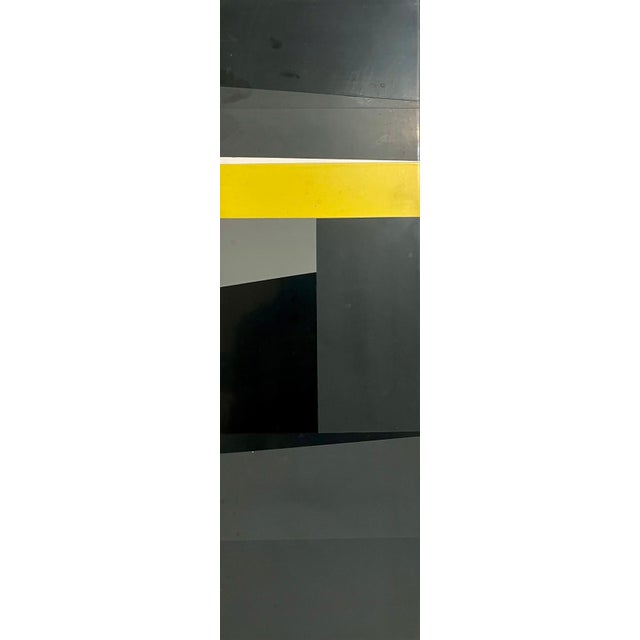
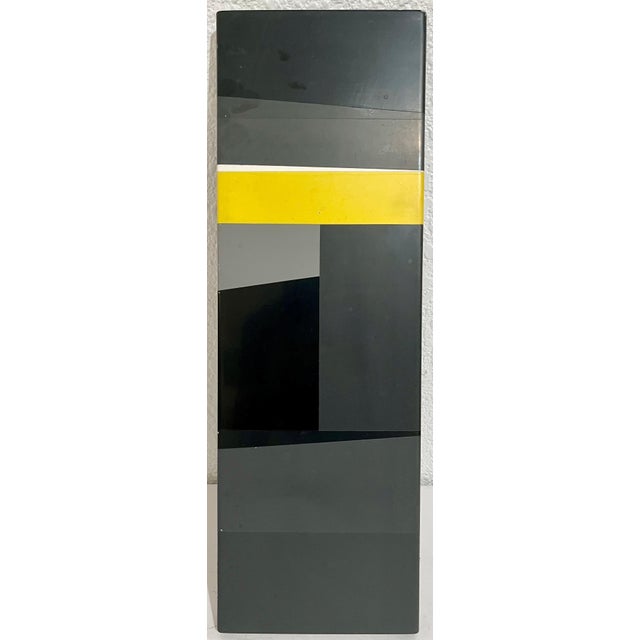
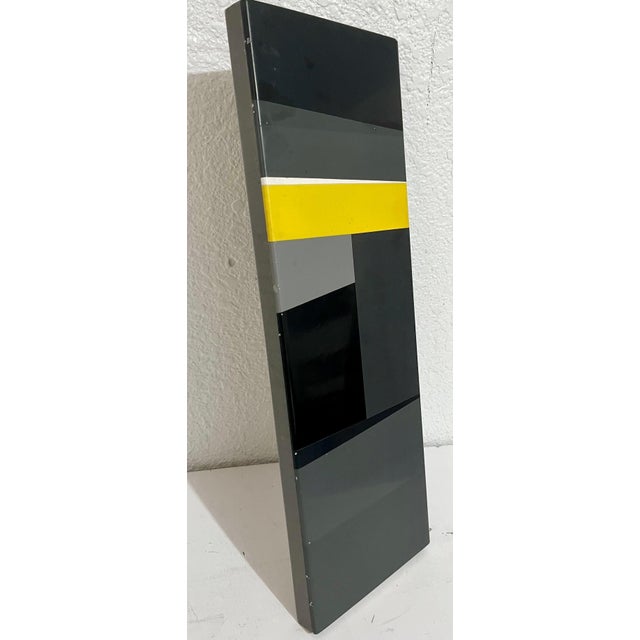
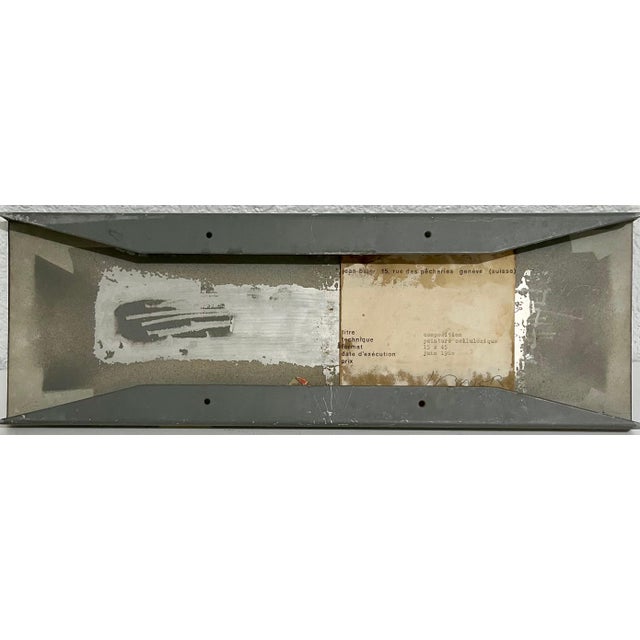
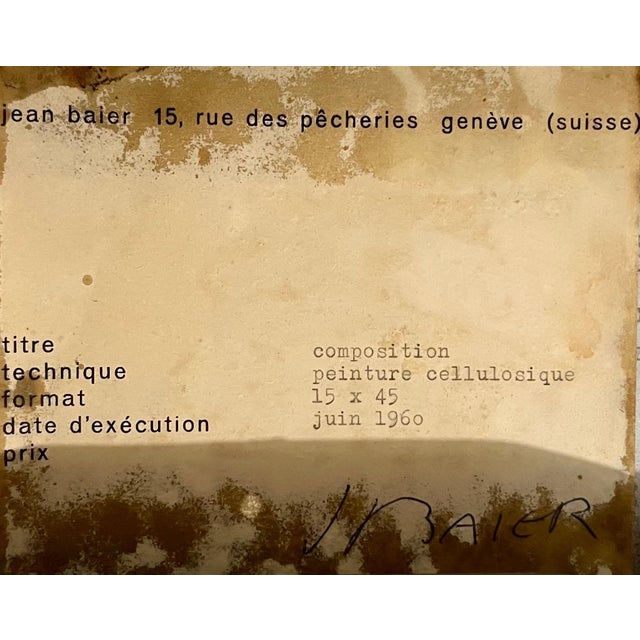
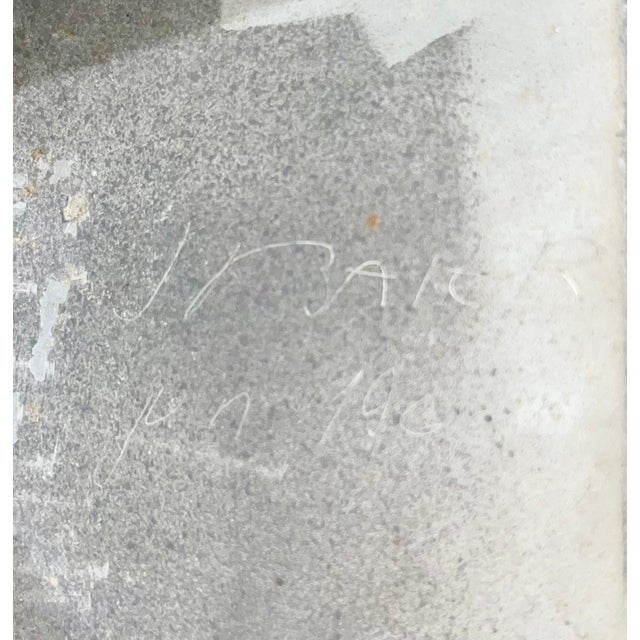
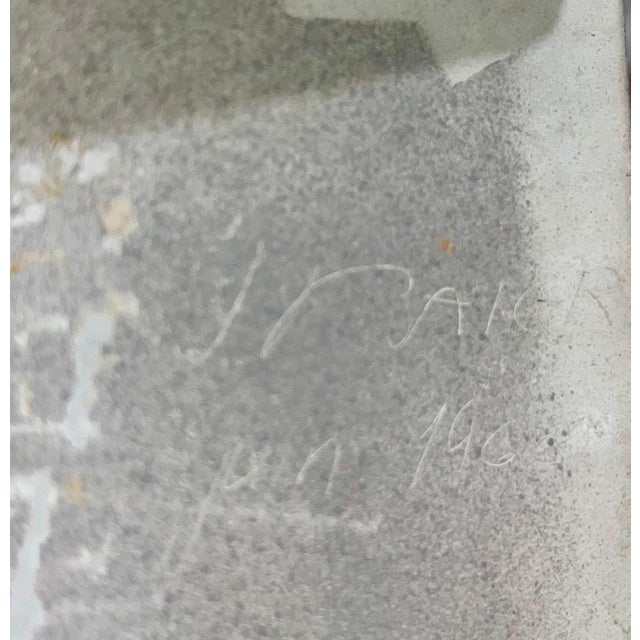
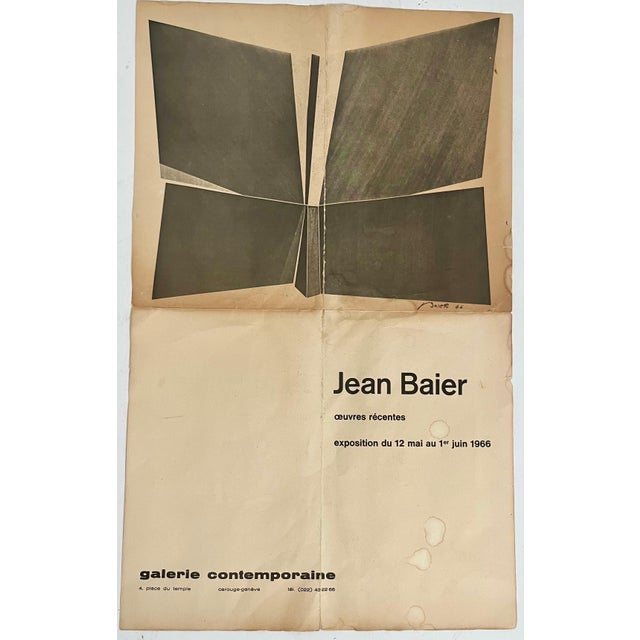
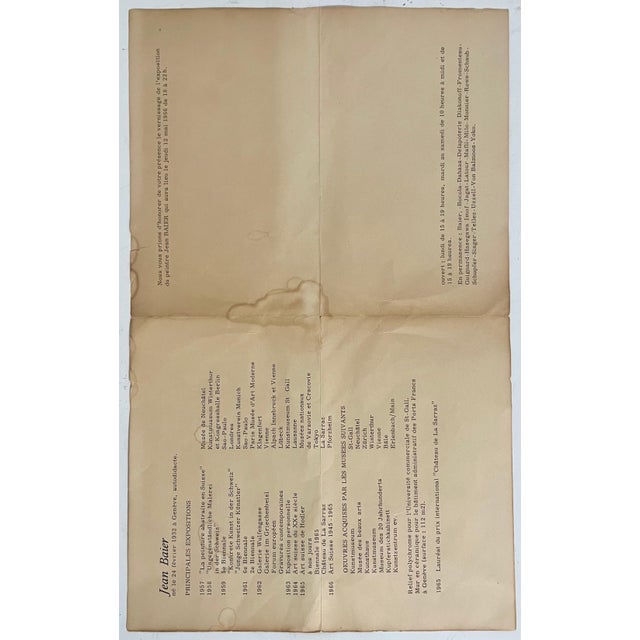
Jean Baier (Swiss, 1932-1999) "Composition" 1960 An original enamel composition on metal wall mount art. This post war contemporary work … Read more Jean Baier (Swiss, 1932-1999) "Composition" 1960 An original enamel composition on metal wall mount art. This post war contemporary work features geometric abstract designs characterized by clean lines and color blocks in various shades of gray, black, bold yellow and a white stripe, all encapsulating a minimalist approach. Retains original gallery label with artist signature along with type, format, technique, execution date, all printed on verso. Accompanied with printed literature about the artist. Dimensions: 18 X 6 X 1 in. Jean Baier, Born in Geneva. He trained mechanic after the Second World War. This interest enabled him to develop an artistic fascination for practical shapes and the aesthetics of industrial manufacturing using metal, aluminium and synthetic materials with spray paint. The highly celebrated Baier was commissioned to design and produce many public works art, including relief sculptures and murals in Switzerland. Starts painting in 1947 in 1951 attends a conference of Fernand Léger on architectural polychromy which will decide his vocation and will deeply mark his art. Jean Baier is close to the Constructivist and concrete art of Zurich, in the tradition of Max Bill. His work is in line with the aesthetic principles of Piet Mondrian: ignorance of the curved line, pure chromatism and perfect balance of the composition without any symmetry. He uses a chromatic range limited to the fundamental colors that are red, blue and black in order to best express the expressive and architectural value of each of them. These are treated in flat tints in pure and unequal geometric forms sliding against each other in subtle oblique games. He is of the same era as Le Corbusier and Jean Deyrolle. Born into a very modest family, a mechanic by training, Jean Baier approached painting as an autodidact. Painting landscapes and passionate about cinema, he attended a conference by Fernand Léger on architectural polychromy at the age of 19, which decided his vocation. Finding nothing on modern art in the Geneva libraries, he visited the Kunsthallen in Bern and Basel, then went to Paris and Saint-Etienne to see retrospectives of Vassily Kandinsky and Paul Klee ; he met the contemporary art specialist Arnold Rüdlinger, the art writer Michel Seuphor, the architectural historian Sigfried Giedion, the artists Max Bill and Victor Vasarely. In 1952, Baier married Yvonne Meyer. He was awarded a Federal Scholarship for Fine Arts three times (1958, 1960, 1962). His many solo exhibitions include the first in 1957 at Galerie 33 in Bern, and then at Galerie Palette in Zurich between 1959 and 1989; in 1963, he exhibited at the Kunstmuseum in St. Gallen, in 1968 at the Museum zu Allerheiligen in Schaffhausen, in 1973 at the Musée de l'Athénée in Geneva, and in 1983 at the Kunsthalle in Winterthur; Abroad, the European Gallery in Los Angeles showed his work in 1973. From the end of the 1950s, he participated in most of the exhibitions devoted to Swiss art presented in Switzerland or abroad, starting with the Peinture Abstraite en Suisse organized in Neuchâtel in 1957. Baier produced numerous works integrated into architecture, notably in Geneva, Zurich, Saint-Gall and Brasilia. Baier's work is entirely in line with neoplasticism and Constructivism but is in no way reduced to the work of an epigone. It begins with a radical simplification, then engages in an increasing complexity where pure forms and primary colours treated in flat tints are combined. This rigorous plastic, close to Zurich concrete art, does not, however, close in on itself by fully exploiting some initial discoveries, but, very early on, leaves the plane to conquer the third dimension. It bears affinities to the Op art and kinetic art (Agam, Jesus Soto, Carlos Cruz Diez) championed by Paris dealer Rene Denise. This path is aided by screen printing, through which, paradoxically, Baier explores the effects of depth before moving from virtual relief (suggested by the arrangement of the obliques) to real relief developing in space. From the beginning, Baier departed from the usual formats to adopt either the stretched rectangle or the square on point. And here again, anxious to go beyond painting on canvas or panel, he abandoned traditional materials by spray painting on aluminum sheets. These industrial processes ensured the durability of the work, but also responded to the desire to confront architecture and even public spaces. Painting, ceramic walls, reliefs must in fact be understood as facets of a single research. But his production is not limited to this kind of extrapolation of painting that are his reliefs – themselves entirely made up of planes – since he had the opportunity to create, about ten times in a quarter of a century, sets for the Théâtre de Poche in Geneva: he used the same language there while responding to demands for permutations of elements that further expanded his repertoire. Baier is a sculptor in the first place, because he does not subcontract his projects, but realizes them himself; he also declares himself a "sculptor by addition". He even moves on to cartoons when he composes a "synchronized sequence of dynamic and plastic motifs" on a composition by Anton Webern. Works: Geneva, Musée d'art et d'histoire; Fonds d'art contemporain de la Ville de Genève; Saint-Gallen, Kunstmuseum St.Gallen; Schaffhausen, Museum zu Allerheiligen Schaffhausen. See less
- Dimensions
- 16ʺW × 1ʺD × 18ʺH
- Styles
- Contemporary
- Frame Type
- Unframed
- Art Subjects
- Geometric
- Period
- 1960s
- Item Type
- Vintage, Antique or Pre-owned
- Materials
- Metal
- Paint
- Condition
- Good Condition, Original Condition Unaltered, Some Imperfections
- Color
- Gray
- Condition Notes
- Good Wear commensurate with age; minor enamel losses at edges please refer to photos. Good Wear commensurate with age; minor enamel losses at edges please refer to photos. less
Questions about the item?
Returns & Cancellations
Return Policy - All sales are final 48 hours after delivery, unless otherwise specified in the description of the product.
Cancellation Policy - Prior to shipping or local pickup, buyers may cancel an order for up to 48 hours, unless otherwise specified.
Related Collections
- Photorealism Paintings in New York
- Richard Serra Paintings
- Joseph Solman Paintings
- Margaret Kennedy Paintings
- Donald Judd Paintings
- George Coggeshall Paintings
- Photorealism Canvas Paintings
- William IV Paintings
- Keith Haring Paintings
- Jacobean Paintings
- Lowell Nesbitt Paintings
- Louis Wolchonok Paintings
- Jean Calogero Paintings
- Francine Tint Paintings
- Vienna Secession Paintings
- Michelle Arnold Paine Paintings
- René Magritte Paintings
- BandB Italia Paintings
- Jeff Slemmons Paintings
- Karen Offutt Paintings
- Paintings in Panama City, FL
- Camille Pissarro Paintings
- Ralph Lauren Paintings
- Black Photorealism Paintings
- Photorealism Paintings in Los Angeles