

Details
Description
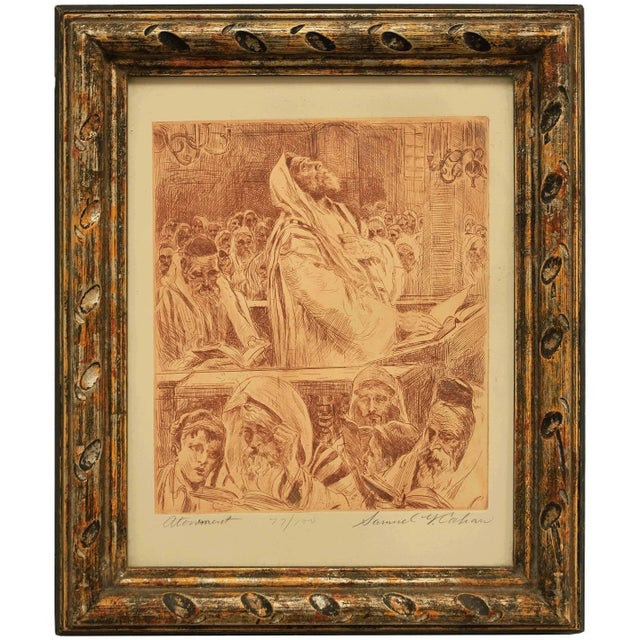
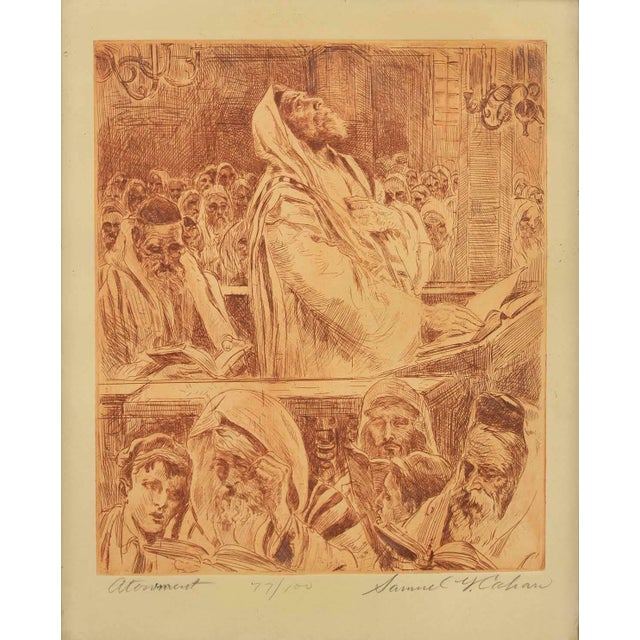
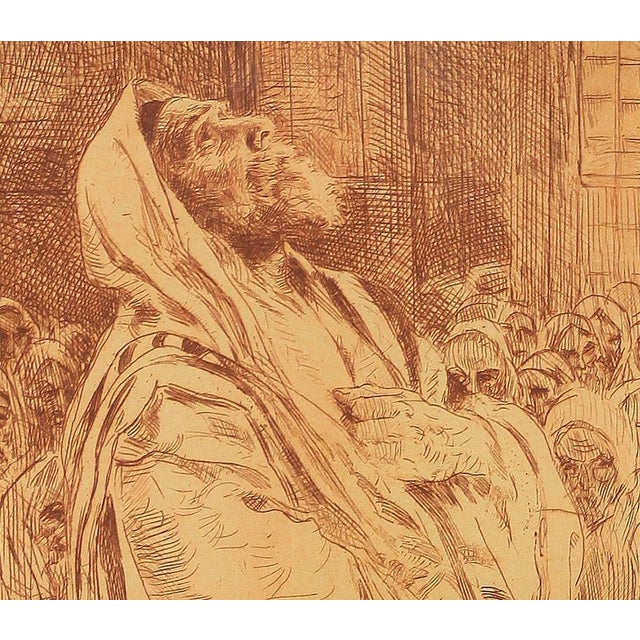
In this copper plate etching, Cahan captures the religious ardor and penitent sentiment shared by the figures in the artwork. … Read more In this copper plate etching, Cahan captures the religious ardor and penitent sentiment shared by the figures in the artwork. The piece is number seventy-six in a series of one-hundred etchings entitled Atonement. Cahan’s heavy use of line, as well as, his ability to convey emotion give the viewer a sensitive but harmonized rendering of Jewish prayer. Dimensions w/Frame: 17 1/2" x 15" The well-known twentieth century American illustrator, etcher, and painter Samuel George Cahan was born in Kovno, Russia, now part of Lithuania. His parents were both born in Russia during the early 1870’s. Two years after his birth, his family emigrated to America and eventually settled in New York City's Lower East Side. Cahan said that his interest for drawing started when he was only an infant. In a 1967 interview, the artist describes his primary school years as vastly disinteresting. While other students heeded their teachers or studied math, Cahan drew. At 12-years-old, Cahan exhibited his early talent for drawing on Fulton Street’s sidewalk. Barefoot and armed with chalk, he crouched outside a restaurant and drew the sinking of Maine. At the time, it was recognizable ship that was smashed by the British. One of the men who passed by his vibrant rendering of the wreckage was the Chief Editor of the New York World newspaper, Nelson Hersh. Upon seeing the young boy’s skill, Hersh offered him a job in the newspaper’s art department. During his time at the newspaper, he worked on sketching court trials and learned from other prominent American artists working in the art department, such as George Luks. After leaving the newspaper, he explored other artistic mediums that combined his love of color and line. From etchings on copper plates, he moved onto watercolor, and finally to oil. As an adult, he began to seriously study Fine art. Cahan first studied with the famous American artist Robert Henri. They would meet in the evenings along with other students including George Bellows and Stuart Davis. He continued his studies at the distinguished Art Students League of New York and eventually became a life member. Throughout his life, he exhibited his work with French & Company Gallery. In addition, he showed his work at the National Academy of Design where he was honored with several awards. “An artist is not a camera,” was one of Cahan’s favorite mottos. He applied this belief to all his paintings. The artist was a great supporter of Judaism and would often take his inspiration from the Jewish community. Whether landscapes or portraits, many of his works blend his interest in culture, color, and narratives. Cahan uses gestural line and brush strokes to create emotion masterpieces that connect to broad audiences. Although Cahan died in 1974, he left a legacy of artworks that chronicle the Jewish community in New York City. See less
- Dimensions
- 15ʺW × 1ʺD × 17.5ʺH
- Styles
- Expressionism
- Art Subjects
- Figure
- Frame Type
- Framed
- Period
- Mid 20th Century
- Item Type
- Vintage, Antique or Pre-owned
- Materials
- Etching
- Condition
- Good Condition, Original Condition Unaltered, Some Imperfections
- Color
- Brown
- Condition Notes
- Good Good less
Questions about the item?
Returns & Cancellations
Return Policy - All sales are final 48 hours after delivery, unless otherwise specified in the description of the product.
Cancellation Policy - Prior to shipping or local pickup, buyers may cancel an order for up to 48 hours, unless otherwise specified.
Related Collections
- Patrick Nagel Reproduction Prints
- Reproduction Prints in Panama City, FL
- Sam Francis Reproduction Prints
- Jute Reproduction Prints
- Leather Reproduction Prints
- Utagawa Kunisada (Toyokuni Iii) Reproduction Prints
- Reproduction Prints in Mobile
- Daylight Dream Editions Reproduction Prints
- Alvar Aalto Reproduction Prints
- William Hogarth Reproduction Prints
- Tuscan Reproduction Prints
- Gold-Plate Reproduction Prints
- Polychrome Reproduction Prints
- Ethan Allen Reproduction Prints
- Paule Marrot Reproduction Prints
- Jim Dine Reproduction Prints
- Qing Reproduction Prints
- Francis Orpen Morris Reproduction Prints