


Details
Description
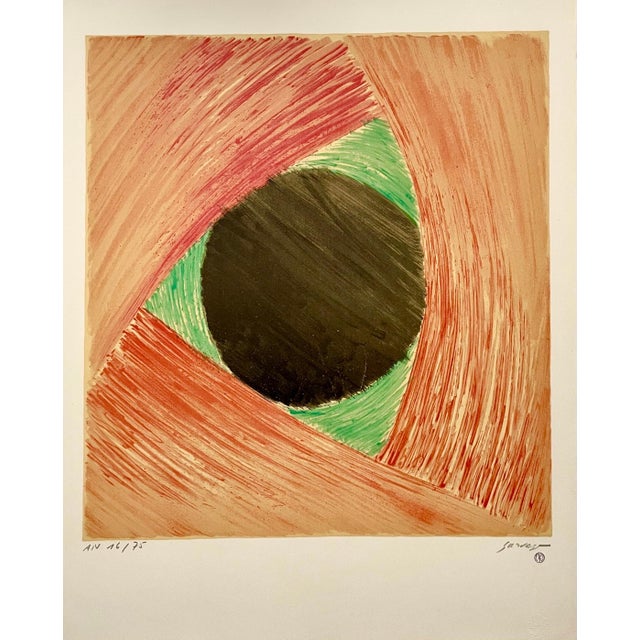
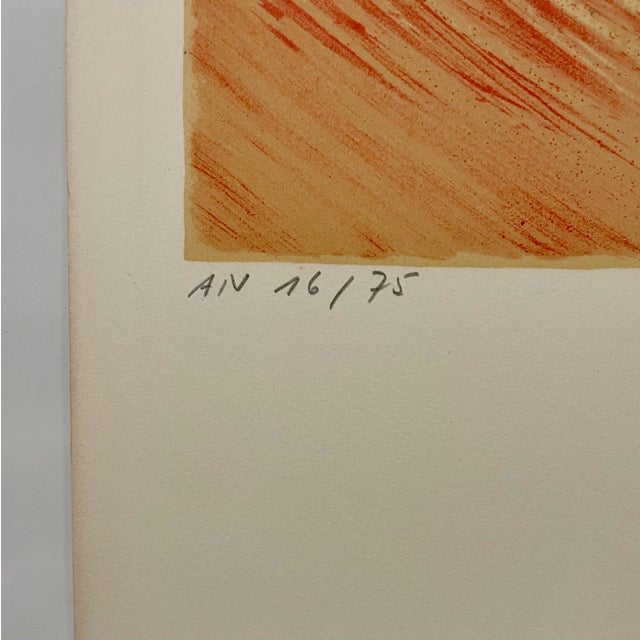
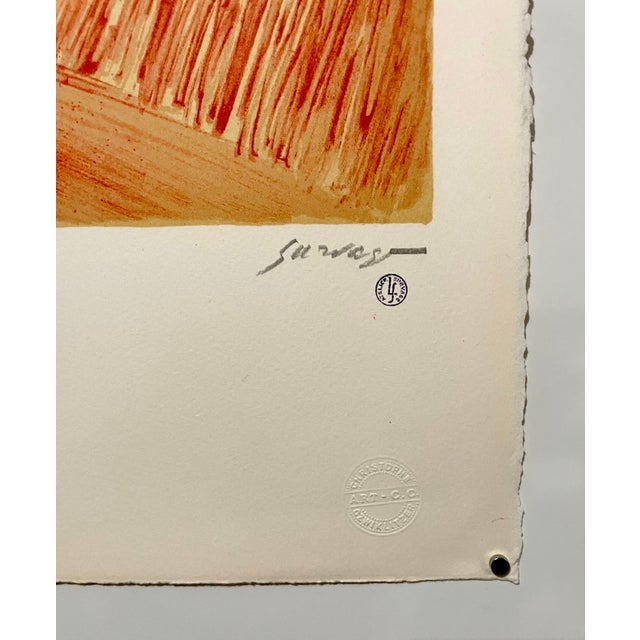
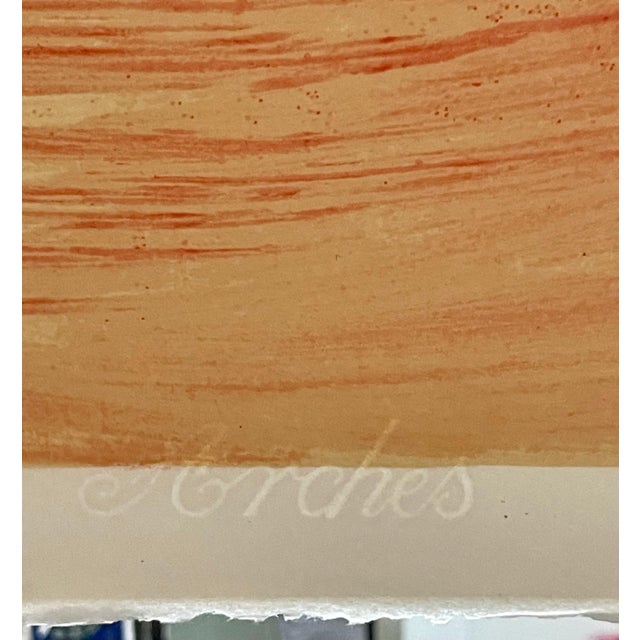
Léopold Survage (French/Russian, 1879-1968), "Rythmes Colorés", 1967-1968 Lithograph on Vélin d'Arches paper, Printed by Mourlot, Paris Hand signed in pencil … Read more Léopold Survage (French/Russian, 1879-1968), "Rythmes Colorés", 1967-1968 Lithograph on Vélin d'Arches paper, Printed by Mourlot, Paris Hand signed in pencil and numbered "AN 16/75", artist atelier stamp and bears "Christopher Czwiklitzer" blind stamp. Measurements: image 19 3/8 in. x 18 in., sheet 25 1/2 in. x 20 1/8 in. Provenance: deaccessioned from the Mobile Museum of Art, Mobile, AL Léopold Frédéric Léopoldowitsch Survage (1879 – 1968) was a French painter of Finnish origin. Trained in Moscow, Russia he identified with the Russian avant-garde before moving to Paris, France where he shared a studio with Amedeo Modigliani and experimented with abstract movies. He also gained commissions for Serge Diaghilev's Ballets Russes. Survage was French, of Russian Danish Finnish descent, born in Lappeenranta, Finland (with selected references indicating a birthplace of Moscow, Russia). Variant names included Léopold Sturzwage, Leopold Sturwage, Leopoldij Sturzwasgh and Leopoldij Lvovich Sturzwage, Leopold Survage. At a young age, Leopold Survage was directed to enter the piano factory operated by his Finnish father. He learned to play piano, then completed a commercial diploma in 1897. After a severe illness at the age of 22, Survage rethought his career and entered the Moscow School of Painting, Sculpture and Architecture. Introduced to the modern movement through the collections of Sergei Shchukin and Ivan Morozov, he cast his lot with the Russian avant-garde and, by 1906, was loosely affiliated with the circle of the magazine Zolotoe runo (Golden fleece—see also Maximilian Voloshin). He met Alexander Archipenko, exhibiting with him in the company of David Burliuk, Vladimir Burlyuk, Mikhail Larionov and Natalia Goncharova. With Helena Moniuszko, later his wife, he travelled to Western Europe, visiting Paris in July 1908. The couple eventually settled in Paris where Survage worked as a piano tuner and briefly attended the short-lived school run by Henri Matisse. He exhibited with the Jack of Diamonds group in Moscow in 1910 and first showed his work in France—at the urging of Archipenko—in the Salon d'Automne of 1911. In 1913, Survage produced abstract compositions using color and movement to evoke a type of musical sensation. Entitled Rythmes colorés, he planned to animate these illustrations by means of film to form "symphonies en couleur". He saw these abstract images as flowing together, but he exhibited the ink wash drawings separately at the Salon d'Automne in 1913 and Salon des Indépendants in 1914. Articles on these works were published by Guillaume Apollinaire (Paris-J., July 1914) and Survage himself (Soirées Paris, July–August 1914). In June 1914, in order to develop his idea, Survage unsuccessfully applied for a patent to the Gaumont Film Company. Had he been able to raise the funds, he would have preceded Viking Eggeling and Hans Richter as the first to develop abstract films. Beginning in 1917, Survage shared a studio—and a penchant for alcoholic excesses—with Amedeo Modigliani in Paris. Survage later moved to Nice and, over the next eight years, produced highly structured oil painting and watercolor works on paper linked together by a series of leitmotifs, repeating groups of symbolic elements—man, sea, building, flower, window, curtain, bird—as if they were protagonists in a series of moving images. The influence may have been Marc Chagall, an artist well known for his insertions of floating couples, cows, roosters, and sundry Expressionist Jewish iconography. By 1922, Survage had begun to move away from Cubism in favour of the neo-classical form. He was perhaps influenced by commissions for Serge Diaghilev's Ballets Russes, beginning with sets and costumes for Igor Stravinsky opera buffa Mavra at the Paris Opéra in 1922. Although mainly a painter, he also produced stage, tapestry, and textile designs during this period (notably for the house of Coco Chanel in 1933). Toward the end of the 1930s, as a result of his contact with Surrealist Andre Masson, Survage became increasingly charmed by Surrealism, symbols and mysticism. His work bears some similarities to Robert Delaunay and Sonia Delaunay. The curvilinear forms that had previously dominated his compositions came, once again, under the control of geometric structure. On 12 March 1963 Survage was named Officer of the Légion d'Honneur. He died on 31 October 1968 in Paris. Selected exhibitions 1968: Musée des beaux-arts, Lyon 1930: Museum of Modern Art, New York 1929: Knoedler Gallery, New York 1920: Galerie de L'Effort Moderne, Paris 1914: Salon des Indépendants, Paris 1913: Salon d'Automne, Paris Selected collections Musée national d'art moderne Georges Pompidou, Paris Bezalel Museum, Jerusalem Tretyakov Gallery, Moscow Musée des beaux-arts, Lyon Musée du Petit Palais, Geneva Musée national d'art moderne, Paris San Francisco Museum of Modern Art Museum of Modern Art, New York National Museum of Arts, Moscow National Museum, Athens Literature Artistes russes de l'École de Paris [exhibition catalogue]. Geneva: Musée d'art moderne, 1989. Léopold Survage [exhibition catalogue]. Lyon: Musée des beaux-arts, 1968. Léopold Survage: aquarelles, peintures, dessins [retrospective exhibition]. Nice: Direction des musées de Nice, 1975. Les lumières de Léopold Survage: oeuvres, 1910-1932 [exhibition catalogue]. Aix-en-Provence: Galerie d'art du Conseil général des Bouches-du-Rhône, 2001. Putnam, Samuel. The Glistening Bridge: Léopold Survage and the Spatial Problem in Painting. New York: Covici-Friede, 1929. Seyrès, Hélène (ed.). Écrits sur la peinture: Léopold Survage. Paris: L'Archipel, 1992. Warnod, Jeanine. Survage. Brussels: A. de Rache, 1983. See less
- Dimensions
- 20.13ʺW × 1ʺD × 25.5ʺH
- Styles
- Cubism
- Art Subjects
- Geometric
- Frame Type
- Unframed
- Period
- 1960s
- Item Type
- Vintage, Antique or Pre-owned
- Materials
- Lithograph
- Condition
- Good Condition, Original Condition Unaltered, Some Imperfections
- Color
- Black
- Condition Notes
- Good good. this has never been framed. Good good. this has never been framed. less
Questions about the item?
Returns & Cancellations
Return Policy - All sales are final 48 hours after delivery, unless otherwise specified in the description of the product.
Cancellation Policy - Prior to shipping or local pickup, buyers may cancel an order for up to 48 hours, unless otherwise specified.
Related Collections
- Patrick Nagel Reproduction Prints
- Qing Reproduction Prints
- Reproduction Prints in Panama City, FL
- William Hogarth Reproduction Prints
- Classical Greek Reproduction Prints
- Monotype Reproduction Prints
- Sol LeWitt Reproduction Prints
- Utagawa Kunisada (Toyokuni Iii) Reproduction Prints
- William Gropper Reproduction Prints
- Reproduction Prints in Mobile
- Ethan Allen Reproduction Prints
- Paule Marrot Reproduction Prints