

Details
Description
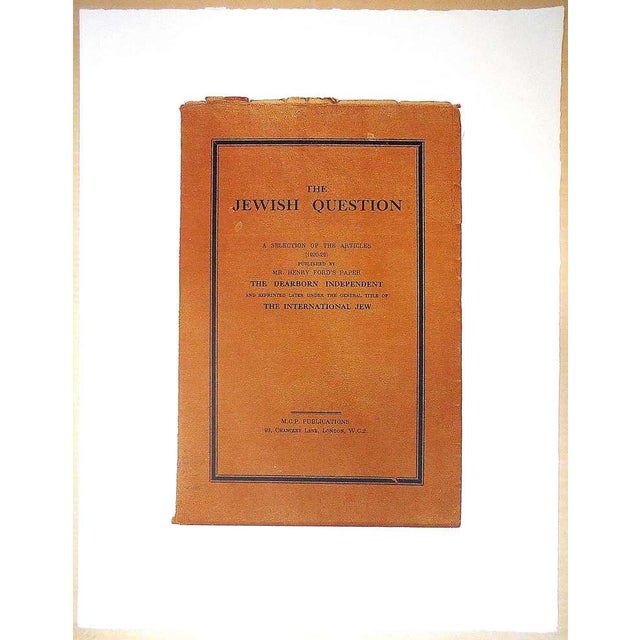
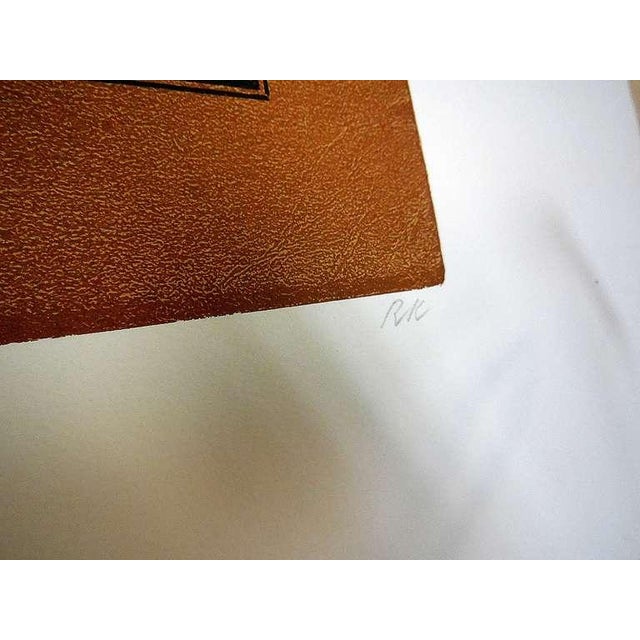
Initialled signed in pencil From R. B. Kitaj, In Our Time: Covers for a Small Library After the Life for … Read more Initialled signed in pencil From R. B. Kitaj, In Our Time: Covers for a Small Library After the Life for the Most Part, screenprint 1969 edition of 150 photo screenprint. A cover of the infamous Henry Ford book from the Dearborn Independent "The Jewish Question". Printed by Kelpra Studio, London, published by Marlborough AG, Schellenberg, Florida. The Jewish Museum. a cover related to Russian Soviet cinema and film. Stylistically, these are hybrid works, influenced by Pop art and the modernist tradition of the Readymade, a work of art created when a mundane found object is named as an artwork and set in an art context. This avant-garde concept was originally invented by the Dada master Marcel Duchamp early in the twentieth century. In the 1960s it received renewed attention at a time when artistic norms were again being questioned. Reacting to Andy Warhol’s Pop imagery, Kitaj poignantly called his repurposed book covers “his soup can, his Liz Taylor.” The blatant use of images taken directly from commercial sources situates In Our Time as a precursor of appropriation art. In turning book covers into works of art, Kitaj is offering fragments of a history of knowledge, in which the content of each volume is at once mysterious and absent. Coming from this passionate bibliophile, the series is nothing less than an intellectual self-portrait. R.B. Kitaj, in full Ronald Brooks Kitaj . Ron Kitaj was born in Ohio, USA in 1932. American-born painter noted for his eclectic and original contributions to Pop art. He became a merchant seaman with a Norwegian freighter when he was 17. He studied at the Akademie der Bildenden Kunste in Vienna and the Cooper Union in New York. After serving in the United States Army for two years, in France and Germany, he moved to England to study at the Ruskin School of Drawing and Fine Art in Oxford and then the Royal College of Art in London, alongside David Hockney, Allen Jones and Patrick Caulfield. Kitaj was recognised as being one of the world's leading draftsmen, almost on a par with, or compared to, Degas. Indeed, he was taught drawing at Oxford by Percy Horton, himself a pupil of Walter Sickert, who was a pupil of Degas; and the teacher of Degas studied under Ingres. Kitaj had a significant influence on British Pop art and was recognised as being one of the world’s leading draughtsmen. In his later years he developed a greater awareness of his Jewish heritage, considering himself to be a ‘wandering Jew’. He was awarded Royal Academician in 1991 and Golden Lion at the Venice Biennale in 1995. Examples of his work are held in most major public collections worldwide. Kitaj was elected to the Royal Academy in 1991, the first American to join the Academy since John Singer Sargent. He received the Golden Lion at the Venice Biennale in 1995. He staged another exhibition at the National Gallery in 2001, entitled "Kitaj in the Aura of Cézanne and Other Masters". In September 2010 Kitaj and five British artists including Howard Hodgkin, John Walker, Ian Stephenson, Patrick Caulfield and John Hoyland were included in an exhibition entitled The Independent Eye: Contemporary British Art From the Collection of Samuel and Gabrielle Lurie, at the Yale Center for British Art. Kitaj was associated with the beginnings of the Pop art movement in Great Britain in the early 1960s. His works mingled the impersonal finish characteristic of Pop canvases with the loose, painterly brushwork of Abstract Expressionism but differed from the work of his Pop contemporaries in their complex and allusive figurative imagery. Kitaj’s semi abstract paintings feature brightly coloured and imaginatively interpreted human figures portrayed in puzzling and ambiguous relation to one another. His work was highly intellectual in its wealth of pictorial references to historical, artistic, and literary topics. Kitaj continued to exhibit widely throughout the 1960s and ’70s while teaching painting at various British fine arts schools. In his later years, he developed a greater awareness of his Jewish heritage, which found expression in his works, with reference to the Holocaust and influences from Jewish writers such as Franz Kafka and Walter Benjamin, and he came to consider himself to be a "wandering Jew". In 1989, Kitaj published "First Diasporist Manifesto", a short book in which he analysed his own alienation, and how this contributed to his art. He staged a major exhibition at Los Angeles County Museum of Art in 1965, and a retrospective at the Hirshhorn Museum in Washington D.C. in 1981. He selected paintings for an exhibition, "The Artist's Eye", at the National Gallery, London in 1980. See less
- Dimensions
- 13.59ʺW × 1ʺD × 19.97ʺH
- Styles
- Pop Art
- Frame Type
- Unframed
- Art Subjects
- Text
- Period
- 1960s
- Item Type
- Vintage, Antique or Pre-owned
- Materials
- Screen Print
- Condition
- Good Condition, Original Condition Unaltered, Some Imperfections
- Color
- Burnt Orange
- Condition Notes
- Good Good less
Questions about the item?
Returns & Cancellations
Return Policy - All sales are final 48 hours after delivery, unless otherwise specified in the description of the product.
Cancellation Policy - Prior to shipping or local pickup, buyers may cancel an order for up to 48 hours, unless otherwise specified.
Related Collections
- Patrick Nagel Reproduction Prints
- Qing Reproduction Prints
- Reproduction Prints in Panama City, FL
- Monotype Reproduction Prints
- Sol LeWitt Reproduction Prints
- Utagawa Kunisada (Toyokuni Iii) Reproduction Prints
- Reproduction Prints in Mobile
- Daylight Dream Editions Reproduction Prints
- William Hogarth Reproduction Prints
- William Gropper Reproduction Prints
- Classical Greek Reproduction Prints
- Polychrome Reproduction Prints
- Gold-Plate Reproduction Prints
- Ethan Allen Reproduction Prints
- Paule Marrot Reproduction Prints
- Jim Dine Reproduction Prints