


Details
Description
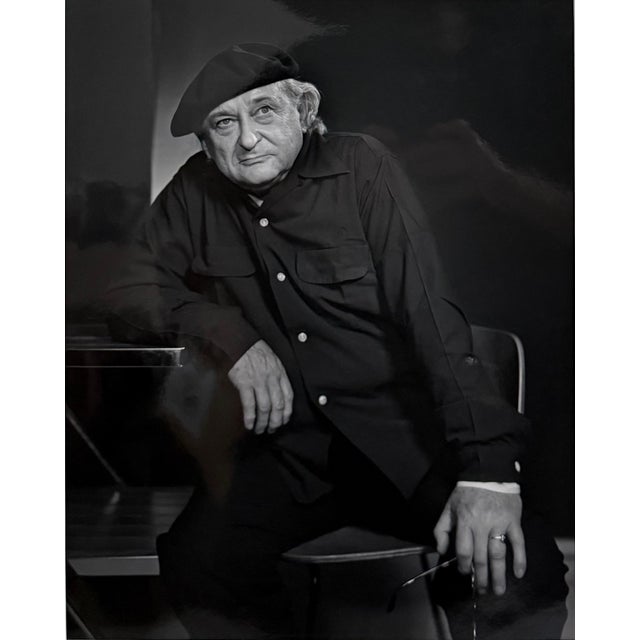
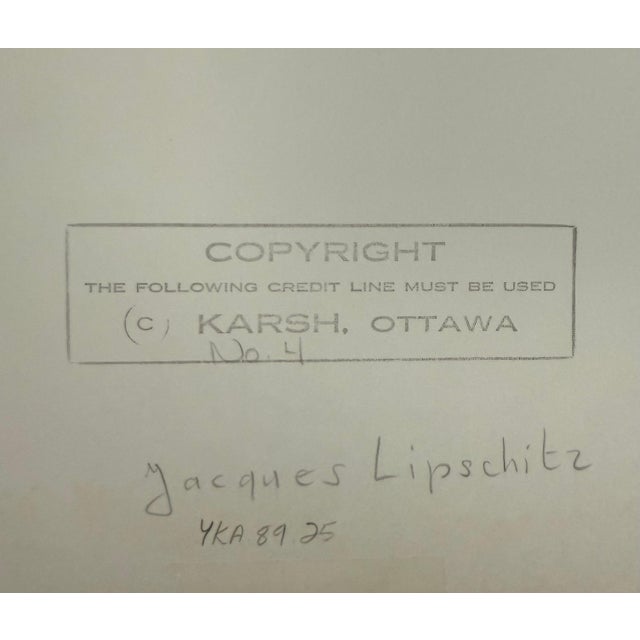
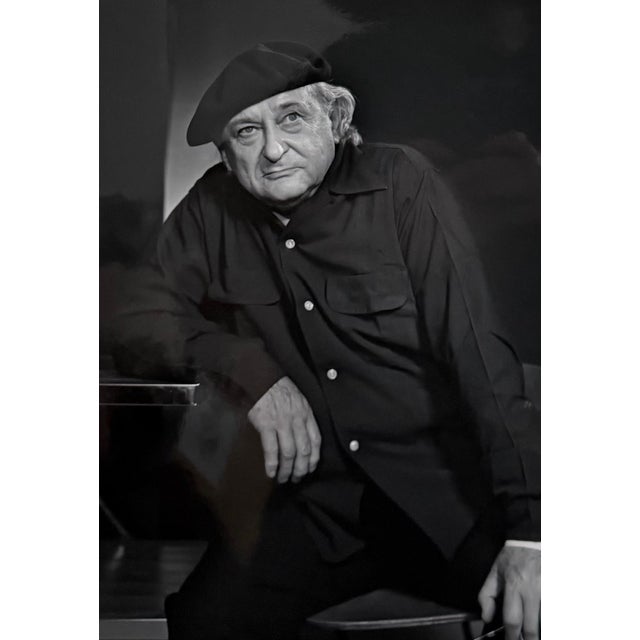
YOUSUF KARSH Vintage Photograph of Sculptor Jacques Lipchitz, Dimensions: sight 13 x 10-1/2 overall size is 16.5 X 14 inches … Read more YOUSUF KARSH Vintage Photograph of Sculptor Jacques Lipchitz, Dimensions: sight 13 x 10-1/2 overall size is 16.5 X 14 inches mat This bears a studio stamp verso inscribed Copyright Karsh Ottawa. It has a hand written title. It is not hand signed. Chaim Jacob Lipchitz, 1891-1973, was born in Lithuania and came of age in Paris during the early 20th century, where he was active in the avante-garde community of Pablo Picasso, Amedeo Modigliani, Diego Rivera, Chaim Soutine, and Juan Gris. Art historian H. H. Arnason, who ranked Lipchitz with Picasso and Chagall, wrote, "Lipchitz, as a pure sculptor, is ...unquestionably one of the greatest sculptors of this century." There is a famous Karsh photo of Lipchitz with Marino Marini and Henry Moore. Yousuf Karsh CC RCA FRPS (1908 – 2002) was an Armenian-Canadian photographer known for his portraits of notable individuals. He has been described as one of the greatest portrait photographers of the 20th century. An Armenian genocide survivor, Karsh emigrated to Canada as a refugee. By the 1930s he established himself as a significant photographer in Ottawa, where he lived most of his adult life, though he traveled extensively for work. His iconic 1941 photograph of Winston Churchill was a breakthrough point in his career, through which he took numerous photos of known political leaders, men and women of arts and sciences. More than 20 photos by Karsh appeared on the cover of Life magazine, until he retired in 1993. Yousuf Karsh was born to Turkish Armenian parents Amsih Karsh (1872–1962), a merchant, and Bahia Nakash (1883–1958), on December 23, 1908, in Mardin, Diyarbekir Vilayet, Ottoman Empire. His father was Catholic, while his mother was Protestant. He had two brothers, Jamil and Malak the latter was also a photographer. His illiterate father travelled extensively to trade furniture, rugs, and spices, while his mother was "an educated woman, a rarity in those days, and was extremely well read, particularly in her beloved Bible." The city's Armenian population was largely Arabic-speaking. He grew up during the Armenian genocide, during which some of his family were murdered. "My recollections of those days comprise a strange mixture of blood and beauty, of persecution and peace," he later wrote. Karsh and his family escaped to a refugee camp in Aleppo, Syria in 1922 in a month-long journey with a Kurdish caravan. The Economist's obituary said Karsh "thought of himself as an Armenian". According to Vartan Gregorian: "Although he was proud to be Canadian, Karsh was equally proud to be Armenian." Karsh worked for, and was taught photography by his uncle. He gave Karsh a Box Brownie camera. From 1928 to 1931, Karsh apprenticed in Boston, Massachusetts for John H. Garo, the most prominent Armenian photographer in America at the Karsh settled in Ottawa, initially working for photographer John Powis; his first commissions were from local Ottawa theatre groups. Karsh opened his first studio in 1932. He remained there until 1972, when he moved to the Château Laurier. He was known professionally as "Karsh of Ottawa", which was also his signature. He achieved initial success by capturing the attention of Canadian Prime Minister Mackenzie King, who helped Karsh arrange photography sessions with visiting dignitaries. Karsh was also introduced into the Rideau Hall social circle, and his portraits of Lord Bessborough, Governor General from 1931 to 1935, and his wife were widely published. Karsh became a member of the Ottawa Camera Club and exhibited works in the International Salon of Photography exhibitions held at the National Gallery of Canada from 1934 onwards. ] By the time he retired in 1992, more than 20 of his photos had appeared on the cover of Life magazine. Karsh's photos were known for their use of dramatic lighting, which became the hallmark of his portrait style. He had studied it with both Garo in Boston and at the Ottawa Little Theatre, of which he was a member. Karsh's portrait of Winston Churchill, titled The Roaring Lion, December 30, 1941 His 1941 photo of Winston Churchill, the British Prime Minister, brought him international prominence. The photograph was taken on December 30, 1941, in the Speaker's chamber of the Speaker of the House of Commons in the Canadian Parliament in Ottawa after Churchill delivered a speech on World War II to the Canadian members of the parliament. It was arranged by Canadian Prime Minister William Lyon Mackenzie King. Churchill is particularly noted for his posture and facial expression, which have been compared to the wartime feelings that prevailed in the UK: persistence in the face of an all-conquering enemy. The photo session was short and, just before exposure, Karsh moved towards Churchill and removed the cigar which was in his mouth. Churchill was miffed and showed his displeasure in the portrait. The photo, which according to The Economist is the "most reproduced portrait in the history of photography", has been described as one of the "most iconic portraits ever shot". USC Fisher Museum of Art described it as a "defiant and scowling portrait [which] became an instant icon of Britain's stand against fascism. It appeared on the cover of the May 21, 1945, issue of Life, which bought it for $100. One of the first silver gelatin prints of the original currently hangs on the wall in the Speaker's chamber of the Speaker of the House of Commons of Canada, where the iconic image was photographed. It is considered Churchill's most famous picture and appears on the Bank of England £5 note. During World War II, Karsh photographed political and military leaders and began capturing photos of writers, actors, artists, musicians, scientists, and celebrities in the post-war period. His 1957 portrait of the American novelist Ernest Hemingway, taken at Hemingway's Cuban home Finca Vigía, is another well-known photo by Karsh. According to Amanda Hopkinson it made Hemingway look like the hero of his 1952 novel The Old Man and the Sea. His other notable portraits include George Bernard Shaw at an old age (1943), Dwight D. Eisenhower as a five-star general and Supreme Commander of the Allied Expeditionary Force (1946), American artist Georgia O'Keeffe in her New Mexico studio (1956), and Soviet leader Nikita Khrushchev swathed in fur (1963). In 1984, Karsh photographed the Canadian rock band Rush for their album Grace Under Pressure. Besides portraits of the famous, Karsh photographed assembly line workers in Windsor, Ontario, commissioned by the Ford Motor Company of Canada. He also shot photos for Canadair that were used in an advertising campaign. His landscape photographs of Rome and the Holy Land were included in books in collaboration with Bishop Fulton J. Sheen, an annual poster for the Muscular Dystrophy Association, and other works. Karsh closed his studio at Château Laurier in June 1992. His penultimate sittings in May 1993 were with President Bill Clinton and First Lady Hillary. He was a visiting professor at Ohio University and at Emerson College in Boston. Of the 100 most famous people of the 20th century according to International Who's Who (2000), Karsh photographed many famous celebrities. Among them were Audrey Hepburn, Elizabeth Taylor, Ernest Hemingway, Pablo Picasso, Walt Disney, Princess Elizabeth (future Queen Elizabeth II), Leonid Brezhnev, Nikita Khrushchev, Martin Luther King, Fidel Castro, Yuri Gagarin and others.Recognition A bust of Karsh, a gift from Armenia, unveiled before Château Laurier, Ottawa, in 2017 Karsh has been recognized as Canada's leading portrait photographer. In general, he is recognized as one of the best-known and great portrait photographers of the 20th century. The Economist wrote upon his death that Karsh was "for half a century perhaps the greatest portrait photographer in the monumental manner". The website of the Governor General of Canada describes him as the "pre-eminent portrait photographer of the twentieth century". The Metropolitan Museum of Art described him as "one of the greatest portrait photographers of the twentieth century [who] achieved a distinct style in his theatrical lighting". The Canadian Encyclopedia noted that his portraits "have come to represent the public images of major international figures of politics, science, and culture in the twentieth century". By the time of his death, his work was included in numerous museum collections including the Metropolitan Museum of Art, Museum of Modern Art (both in New York), National Gallery of Canada, National Portrait Gallery in London, National Museum of Modern Art in Tokyo, Art Institute of Chicago, Saint Louis Art Museum, Muscarelle Museum of Art, George Eastman Museum, and elsewhere. In 1987 the National Archives of Canada acquired the complete collection of Karsh items, including the negatives, prints and transparencies produced and retained by Karsh since 1933. The current Library and Archives Canada collection has 355,000 items in its Karsh collection, including all of his 150,000 negatives, kept at a facility in Gatineau, Quebec. Karsh's widow Estrellita gifted more than 100 photographic prints to the National Portrait Gallery in Washington, D.C. He was a member of the Royal Canadian Academy of Arts and an honorary fellow of the Royal Photographic Society (UK). Awards Golden Plate Award of the American Academy of Achievement (1961) Order of Canada: Officer (1967), Companion (1990) Canada Council Medal (1965) Achievement and Life Award, Encyclopædia Britannica (1980) Gold Medal of Merit, National Society of Arts and Letters (1991) Karsh was awarded honorary degrees from Dartmouth College (1961), Ohio University (1968), Tufts University (D.F.A., 1981), Syracuse University (D.F.A., 1986), Ohio State University (Doctor of Humane Letters, 1996), University of Hartford (1980), University of Massachusetts at Amherst (1979),[57] Bishop's University (1969), Emerson College, Queen's University, Carleton University, Mount Allison University, Karsh has been inducted into the International Photography Hall of Fame and Museum. See less
Questions about the item?
Returns & Cancellations
Return Policy - All sales are final 48 hours after delivery, unless otherwise specified in the description of the product.
Cancellation Policy - Prior to shipping or local pickup, buyers may cancel an order for up to 48 hours, unless otherwise specified.