



Details
Description
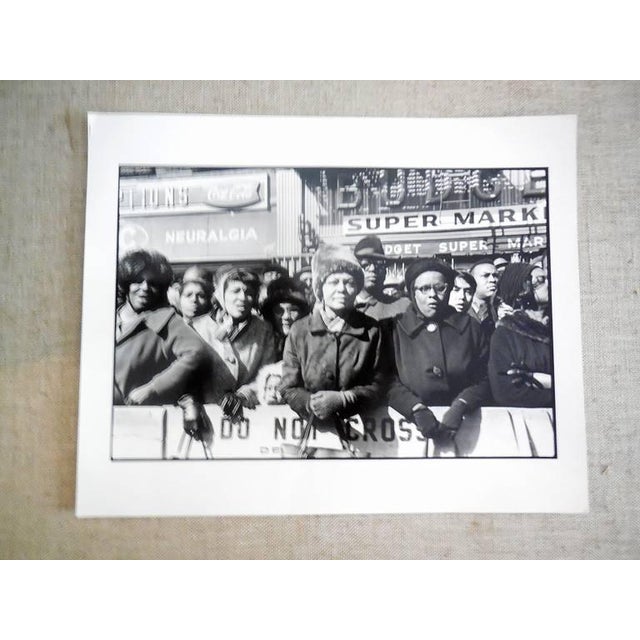
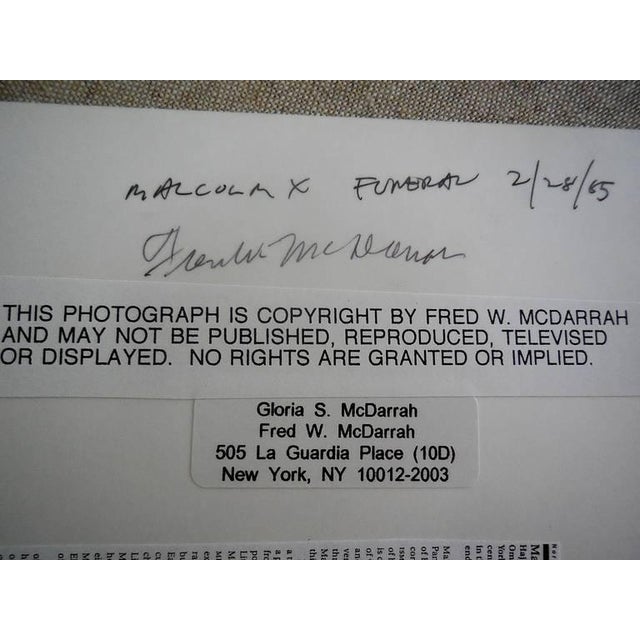
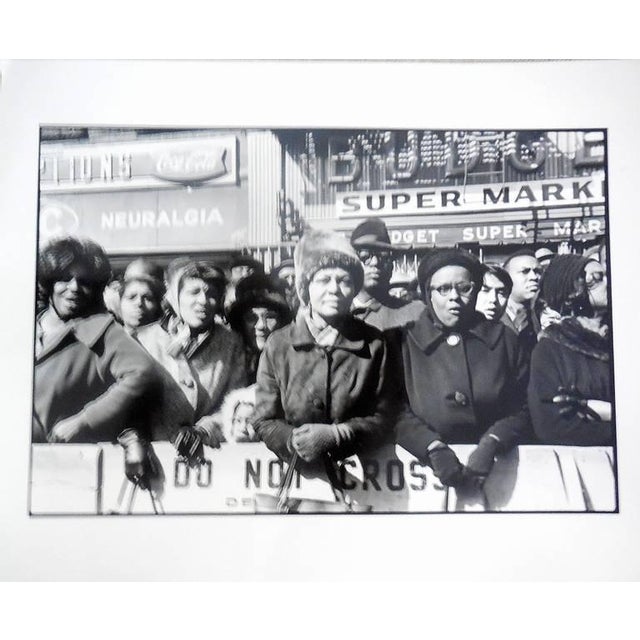
Malcolm X Funeral signed in ink Veteran Village Voice photographer Fred W. McDarrah Over a 50-year span, McDarrah documented the … Read more Malcolm X Funeral signed in ink Veteran Village Voice photographer Fred W. McDarrah Over a 50-year span, McDarrah documented the rise of the Beat Generation, the city’s postmodern art movement, its off-off-Broadway actors, troubadours, politicians, agitators and social protests. Fred captured Jack Kerouac frolicking with women at a New Year’s bash in 1958, Andy Warhol adjusting a movie-camera lens in his silver-covered factory, and Bob Dylan offering a salute of recognition outside Sheridan Square near the Voice’s old office. Not just a social chronicler, McDarrah was a great photo-journalist. For years, McDarrah was the Voice's only photographer and, for decades, he ran the Voice’s photo department, where he helped train dozens of young photographers, including James Hamilton, Sylvia Plachy, Robin Holland and Marc Asnin. His mailbox was simply marked "McPhoto." An exhibit of McDarrah’s photos of artists presented by the Steven Kasher Gallery in Chelsea was hailed by The New York Times as “a visual encyclopedia of the era’s cultural scene.” artists in their studios, (Alice Neel, Philip Guston, Stuart Davis, Robert Smithson, Jasper Johns, Franz Kline), actors (Dustin Hoffman, Robert De Niro on the set of “Taxi Driver”), musicians (Janis Joplin, Alice Cooper, Bob Dylan) and documentary images of early happenings and performances (Yayoi Kusama, Charlotte Moorman, Al Hansen, Jim Dine, Nam June Paik). The many images of Andy Warhol include the well-known one with his Brillo boxes at the Stable Gallery in 1964. Woody Allen, Diane Arbus, W. H. Auden, Francis Bacon, Joan Baez, Louise Bourgeois, David Bowie, Jimmy Breslin, William Burroughs, John Cage, Leo Castelli, Christo, Leonard Cohen, Merce Cunningham, William de Kooning, Jim Dine, Mark di Suvero, Marcel Duchamp, Bob Dylan, Federico Fellini, Allen Ginsberg, Robert Indiana, Mick Jagger, Jasper Johns, Kusama, John Lennon, Sol Lewitt, Roy Lichtenstein, Nam June Paik, Elvis Presley, Claes Oldenburg, Yoko Ono, Robert Rauschenberg, Lou Reed, James Rosenquist, Mark Rothko, Ed Ruscha, Robert Smithson, Susan Sontag, Andy Warhol, and others. McDarrah’s prints have been collected in depth by the J. Paul Getty Museum and the National Portrait Gallery, Washington. His work is in numerous public and private collections. Malcolm X born Malcolm Little and also known as El-Hajj Malik El-Shabazz was an African-American Muslim minister and a human rights activist. To his admirers he was a courageous advocate for the rights of blacks, a man who indicted white America in the harshest terms for its crimes against black Americans; detractors accused him of preaching racism and violence. He has been called one of the greatest and most influential African Americans in history. Malcolm X was effectively orphaned early in life. His father was killed when he was six and his mother was placed in a mental hospital when he was thirteen, after which he lived in a series of foster homes. In 1946, at age 20, he went to prison for larceny and breaking and entering. While in prison he became a member of the Nation of Islam, and after his parole in 1952 quickly rose to become one of its leaders. For a dozen years he was the public face of the controversial group; in keeping with the Nation's teachings he espoused black supremacy, advocated the separation of black and white Americans and scoffed at the civil rights movement's emphasis on integration. By March 1964, Malcolm X had grown disillusioned with the Nation of Islam and its leader Elijah Muhammad. He ultimately repudiated the Nation and its teachings and embraced Sunni Islam. After a period of travel in Africa and the Middle East, he returned to the United States to found Muslim Mosque, Inc. and the Organization of Afro-American Unity. While continuing to emphasize Pan-Africanism, black self-determination, and black self-defense, he disavowed racism, saying, "I did many things as a [Black] Muslim that I'm sorry for now. I was a zombie then ... pointed in a certain direction and told to march". In February 1965, shortly after repudiating the Nation of Islam, he was assassinated by three of its members. The Autobiography of Malcolm X, published shortly after his death, is considered one of the most influential nonfiction books of the 20th century. See less
Questions about the item?
Returns & Cancellations
Return Policy - All sales are final 48 hours after delivery, unless otherwise specified in the description of the product.
Cancellation Policy - Prior to shipping or local pickup, buyers may cancel an order for up to 48 hours, unless otherwise specified.