

Details
Description
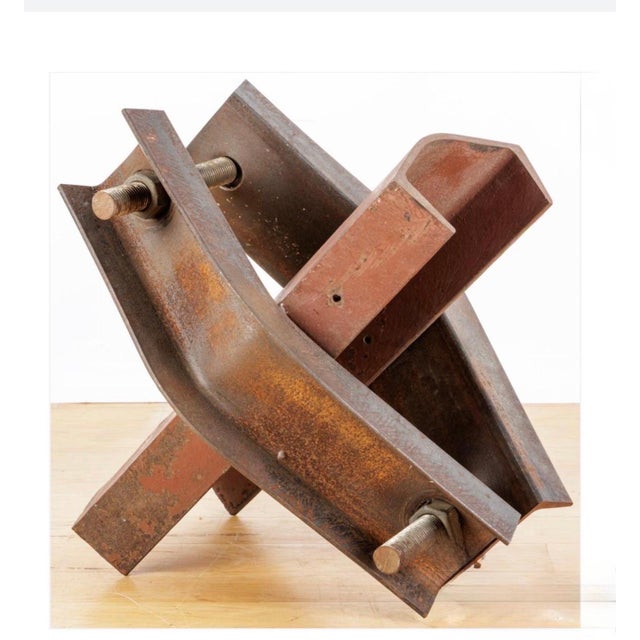
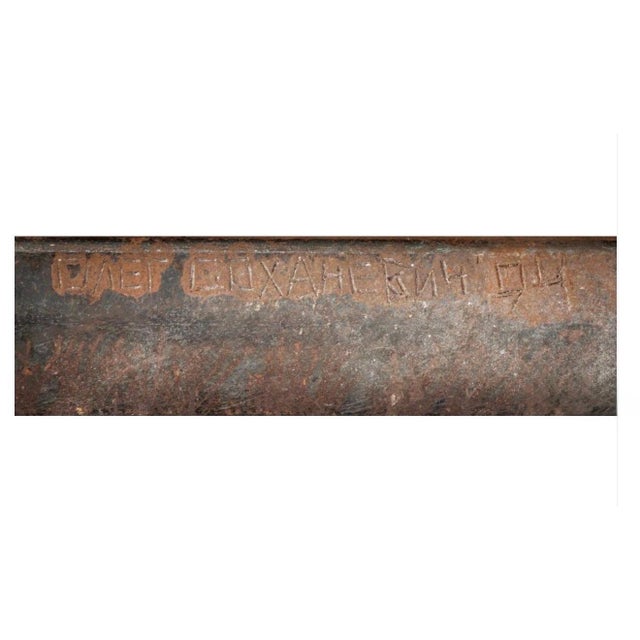
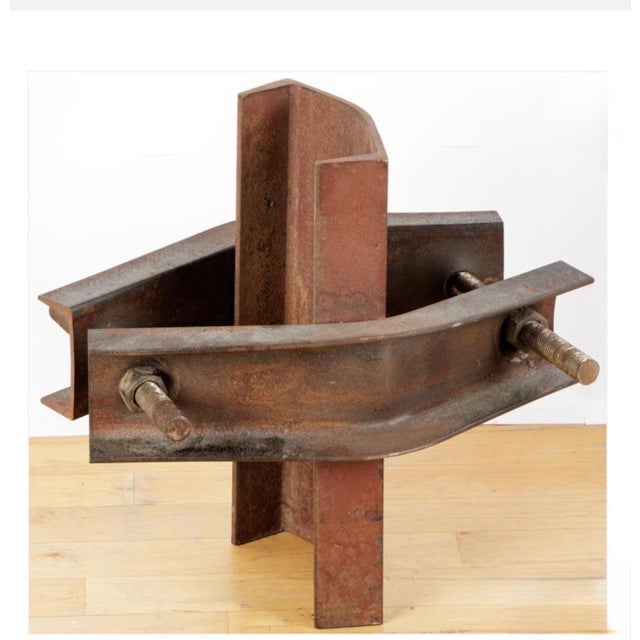
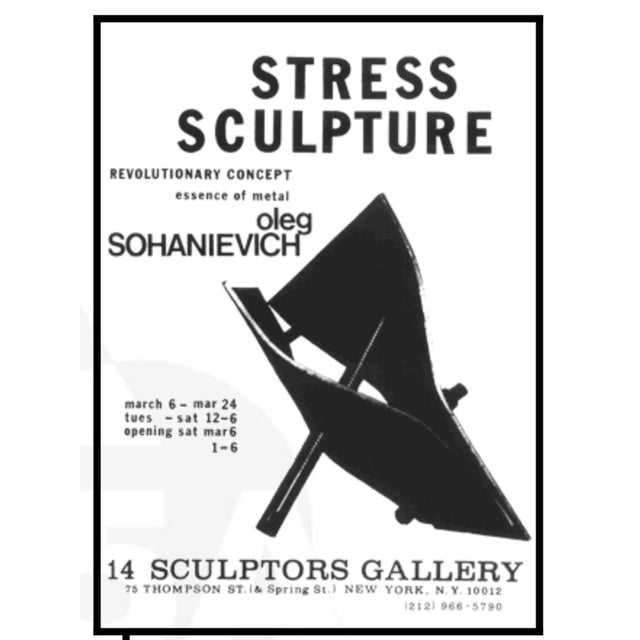
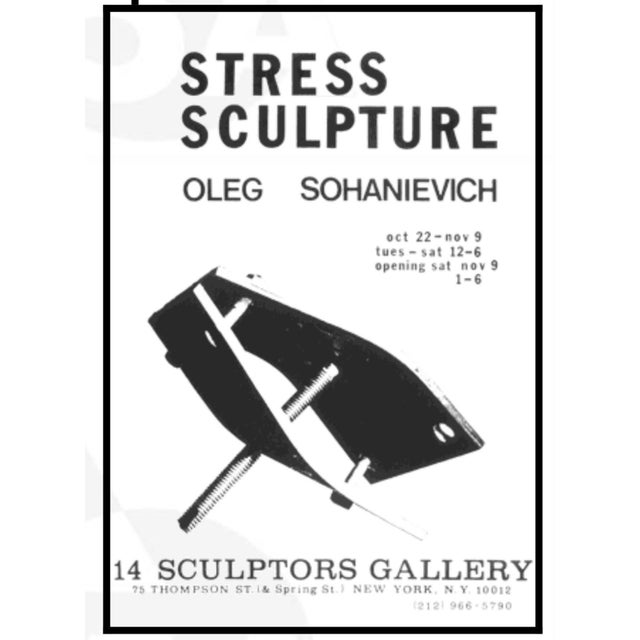
Oleg Sohanievich (Soviet Ukrainian, American 1935-2017) Corten steel, U-beams and rods Steel Stress Sculpture, 1994, Hand signed in Cyrillic and … Read more Oleg Sohanievich (Soviet Ukrainian, American 1935-2017) Corten steel, U-beams and rods Steel Stress Sculpture, 1994, Hand signed in Cyrillic and dated 94, Dimensions: 15" h., 16" w., 11" d. Very heavy These were apparently hand made and took enormous strength to make. Provenance: Leonid Sokov and Natalia Sokov collection later donated to a private college in Pennsylvania. The posters in the listing are not included in the sale and are just here for reference. From an article at Ripon College: Ukrainian-born sculptor Oleg Sohanievich creates one of his stress sculptures for the College. To create a sculpture, Sohanievich uses readily available materials such as aluminum and steel, but his pieces are made without the use of industrial technology. He uses only leverage and his own strength to twist, contort or even break the metal, all while the material is still cold. His creation at Ripon provided an opportunity for art students and the campus community in general to witness this process. Sohanievich studied art at the Art School in Kiev and at the Art Academy in St. Petersburg, Russia. Uncomfortable with the repressive societal conditions in the USSR, Sohanievich defected in 1967 by traversing the Black Sea, a journey of more than 150 miles, in a rubber life raft. Oleg Sohanievich (J1935, Tulchin, Ukraine – 2017, New York) was a Ukrainian-American artist, sculptor and poet and dissident famous for his escape from the USSR on an inflatable row boat to Turkey. He became the living legend of his generation after his spectacular escape from the USSR by sea, sailing more than 300 km to Turkey in an inflatable boat. in 1967 he famously jumped overboard from a Soviet cruise liner with an inflatable rubber raft, rowing for nine days and 300 kilometers to reach the Turkish coast. His work is part of the legacy of the Post Soviet Avant Garde, Sots art influenced by Post Modernism, Minimalism and Arte Povera. (art of unconventional materials and style. Alighiero Boetti, Jannis Kounellis, Mario Merz, Marisa Merz, Michelangelo Pistoletto were all early exponents as well as Antoni Tàpies, Alberto Burri, Piero Manzoni, and Lucio Fontana). Both parents were engineers. His teenage artworks were shown to Igor Grabar who recommended Oleg Sohanievich to be admitted to the Art School in Kyiv. After graduating from the art school got admitted to Mukhin Art School in Leningrad, Russia and transferred to Ilya Repin Leningrad Institute for Painting, Sculpture and Architecture which he graduated from in 1962. Sohanevich's non conformist art was highly criticized by the Soviet authorities for being abstract and not following Soviet art guidelines. His art career and artistic development was not possible under such restraints. Authorities would refuse permission to exhibit his work. Hence the label unofficial art. (Nonconformist). Sohanievich firmly decided to leave the USSR, and since he had no legal means to get abroad, he decided on an extremely dangerous escape by sea. In 1965, he made an unsuccessful attempt to reach Turkey by swimming from a beach near Batumi. With only 11 miles to Turkey, the border was extremely well guarded. Sohanievich hid his clothes under the rock on the beach and started swimming hiding his head with the hoodie from border patrol lights scanning the area. Unluckily the strong current was fighting his progress and he finally gave up and returned to the shore. This failure did not lessen his desire to escape. On August 7, 1967, he and his friend who decided to run away with him climbed overboard the Russian Rossiya cruise liner, which was making a flight between Yalta and Novorossiysk. In the water, they inflated a rubber boat hidden in a bag and began to row south. On the ninth day, they reached the Turkish coast, having swum over 300 km in 119 hours. Soon Sohanievich was allowed to emigrate to the United States. From 1969 to 1970, Sohanievich was a Fellow at MacDowell art colony (when Louise Nevelson was honored there). Sohanievich has lived in New York. The aura of New York, it's skyscrapers and East Village Bohemian culture has made a significant impact on Sohanievich's artistic vision. In 1972, in his own words, he has picked a piece of metal from the street, started bending it with his hands and created a minimalist sculpture, which among others, made by him in a short period of time was exhibited in a group show in Union Carbide building in 1972. Influenced by the Pop Art Combine sculptures of Robert Rauschenberg and Jasper Johns. In 1973, Sohanievich had joined "14 Sculptors" gallery in SoHo, organizing solo exhibitions every 10 months for 4 years. They showed Harold Olejarz, Henry Chalfant, Cusi Masuda and Walter Weissman. In 1975, participated in a group show Russian Emigre Artists at the Andre Emmerich Gallery with Igor Galanin. John Russell spoke highly of his artwork in his articles in the NY Times both in December 1975 and March 1976. Amei Wallach reviewed the exhibition in 1976. In 1979, participated in a group show at Frank Marina Gallery in New York. The exhibition was reviewed in ArtNews in September 1979 and by Robbie Enrich in Art Magazine in 1979, page 34. In 1986, group show "Russians in America" at "Gallery International 52" with Mihail Chemiakin, Oleg Tselkov, Ernst Neizvestny, Vitaly Dlugy and others. In 2004, solo exhibition at Caestecker Art Gallery, C.J. Rodman Center for the Arts at Ripon College, Wisconsin. In the US, Sohanievich worked as a mover in order to support himself and create art that did not depend on commerce. Sohanievich referred to the art style of his paintings as "Abstract Minimalism" and his sculptures as "Stress sculpture". (Postmodernist, Postmodernism) He is loosely identified with Sots art, a Soviet Pop Art movement and was a contemporary of Vitaly Komar, Alexander Melamid, Grisha Bruskin, Eric Bulatov, Alexander Kosolapov, Igor Novikov and Dmitri Prigov. He worked as a mover, so he could paint and create sculptures. He is best known for sculptures described as Stress Sculptures, made from metal. His abstractions may be described as a combination of dynamic power and energy with a logic which he associates with the computer and machine, in a search for compositional perfection. As well, the spatial consciousness in his paintings and sculptures may relate to his escape to the U.S., which was a distinct adventure through space. Select Exhibitions 14 Sculptures Gallery-One man Show. Soho, New York. 1973, 1974, 1975, 1976, 1977. Andre Emmerich, Group show New York, N.Y -1975 Frank Marino Gallery - Soho, N.Y. - 1979 Caestecker Art Gallery- Ripon, Wisconsin - 2004 Public Collections Zimmerli Art Museum at Rutgers University, New Brunswick, USA Nasher Museum of Art at Duke University, North Carolina, USA State Russian Museum, St. Petersburg C. J. Rodman Center for the Arts at Ripon College, Wisconsin The Kolodzei Art Foundation, US The Tabakman Collection, US See less
- Dimensions
- 16ʺW × 11ʺD × 15ʺH
- Styles
- Postmodern
- Art Subjects
- Other
- Period
- 1990s
- Item Type
- Vintage, Antique or Pre-owned
- Materials
- Steel
- Condition
- Good Condition, Original Condition Unaltered, Some Imperfections
- Color
- Brown
- Condition Notes
- Good please see photos. Good please see photos. less
Questions about the item?
Returns & Cancellations
Return Policy - All sales are final 48 hours after delivery, unless otherwise specified in the description of the product.
Cancellation Policy - Prior to shipping or local pickup, buyers may cancel an order for up to 48 hours, unless otherwise specified.
Related Collections
- Lime Sculpture
- Mathurin Moreau Sculpture
- Roman Bronze Works Sculpture
- Chaim Gross Sculpture
- David Palombo Sculpture
- Boris Lovet-Lorski Sculpture
- Gourd Sculpture
- Polycarbonate Sculpture
- Fernando Botero Sculpture
- Peter Shire Sculpture
- Straw Sculpture
- Far Pavilions Sculpture
- Maison Jansen Sculpture
- Oil-Rubbed Bronze Finish Sculpture
- Georgian Sculpture
- Parchment Sculpture
- Bakelite Sculpture
- Constantin Brancusi Sculpture
- Albert Ernest Carrier-Belleuse Sculpture
- Recycled/Repurposed Sculpture
- Austin Productions Sculpture
- Mid-Century Modern Sculpture
- Brutalist Sculpture
- Alabaster Sculpture
- Nude Sculptures