

Details
Description
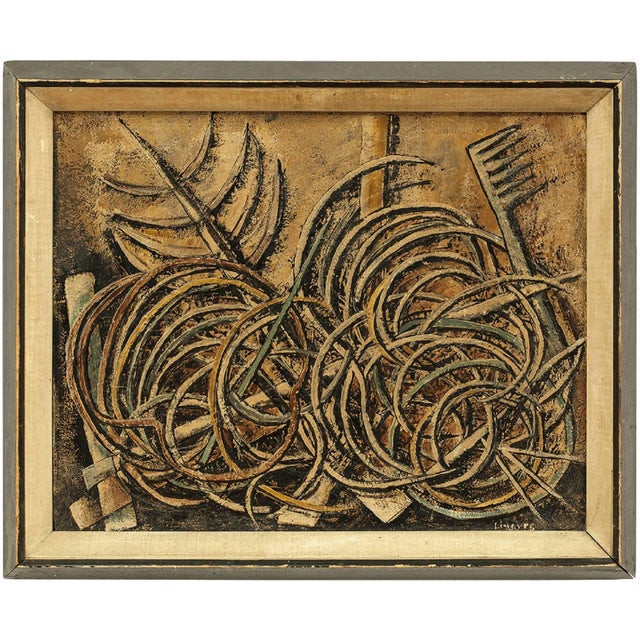
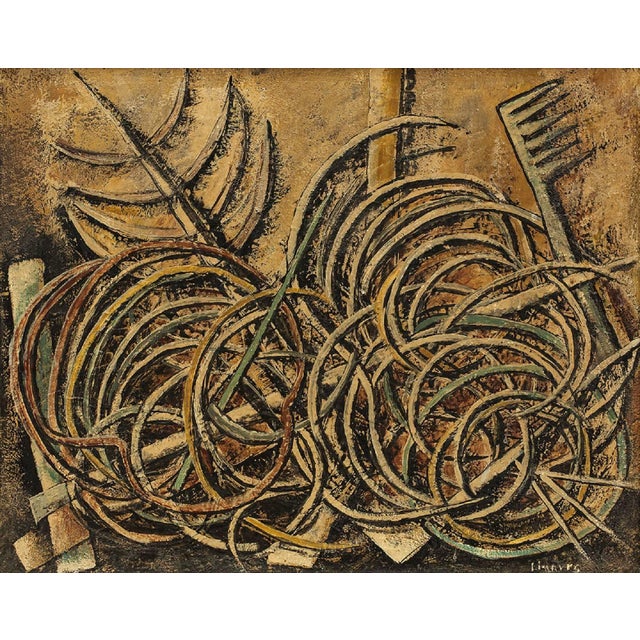
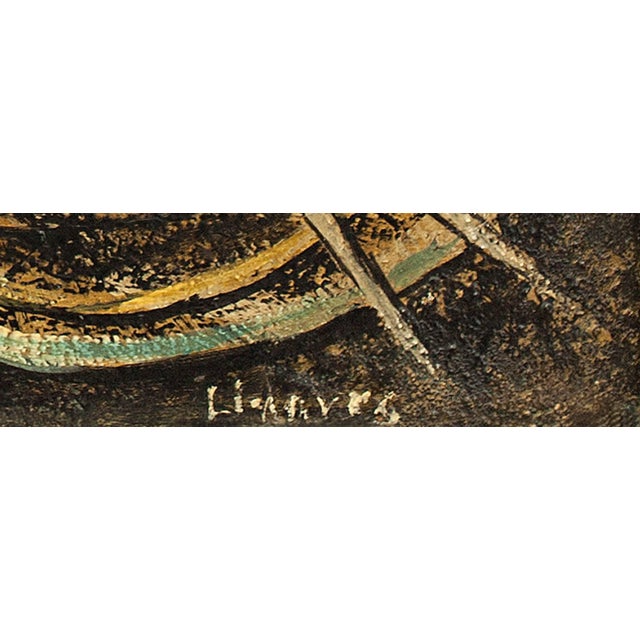
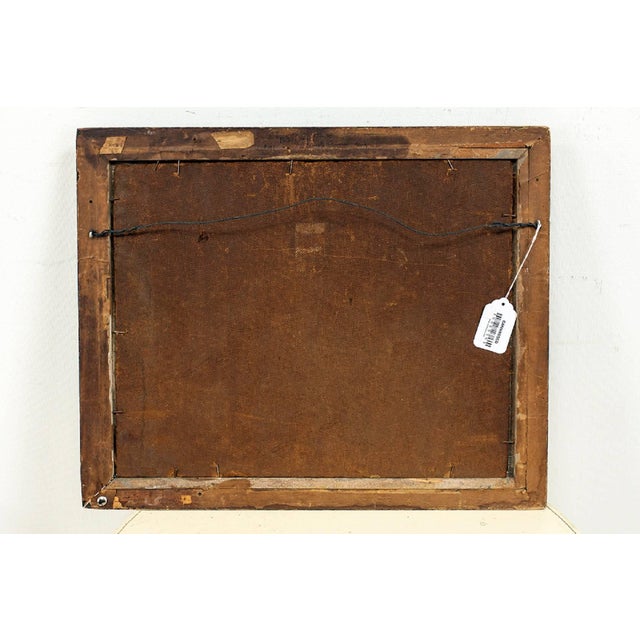
Genre: Modern Subject: Abstract Medium: Oil Surface: Board Dimensions: 16" x 19 3/4" x 1/4" Dimensions w/Frame: 19 1/4" x … Read more Genre: Modern Subject: Abstract Medium: Oil Surface: Board Dimensions: 16" x 19 3/4" x 1/4" Dimensions w/Frame: 19 1/4" x 23 1/4" Hand signed lower right Ernesto Linares Early Mexican Modernist Abstract Expressionist. Mexican artist Ernesto Butterlin Linares, “Lin,” had close ties with Ajijic and was active in the 1940s and 1950s. Ernesto’s parents and his two older brothers were born in Germany and moved to Mexico in 1907, sailing 1st class aboard the “Fürst Bismarck” of the Hamburg-America line, from Hamburg to Veracruz. The family settled in Guadalajara, and also owned a huerta orchard near Ajijic. By the early 1940s, Ernesto, now in his twenties and using the name Linares for his art, is living and painting year-round in Ajijic. From about 1943 to 1945, he shared his village home with American artists Charmin Schlossman Lanier and Sylvia Fein, whose husbands were on active military service overseas. American writer Neill James first moved to Ajijic in September 1943 and in an early article about the village described Linares as a “young Mexican abstract painter who is currently showing his works in a traveling exhibition in the USA.” That brief description shows that Ernesto had already achieved some success as an artist, even at this early age. In about 1945, Ernesto entertained visiting American artist George Buehr (1905-1983), a professor at the Art Institute of Chicago, as his house guest. Shortly afterwards, in about 1947, American artist, anthropologist and author Tobias Schneebaum arrived on the scene. In Wild Man, Schneebaum writes, “A young blond painter, born in Guadalajara of German parents, also lived in Ajijic. He was twenty-seven, blue-eyed, four inches over six feet, and very handsome, and was subject to the attentions of both the men and the women who later passed through town…” He’d changed his Germanic name to Linares to identify more closely with the country of his birth, and liked to be called Lynn. He painted during the day with bright reds and yellows in wide bands of color, freely brushed and ripped on, a technique he claimed preceded Jackson Pollock, who he insisted had seen his work. He’d had one-man shows in New York and Mexico City.” (Wild Man, 12). Elsewhere, Schneebaum describes how Ernesto “had inherited a considerable amount of farmland on the outskirts of Ajijic, but he spent most of his time painting in a drip technique that might have preceded the work of Jackson Pollock.” (Secret Places, 7) Schneebaum, Ernesto Butterlin and a third artist Nicolas Muzenic were all employed by Irma Jonas to teach students attending her summer painting schools in Ajijic (held 1947-1949 inclusive). According to Schneebaum, an ill-fated love triangle developed between the three artists at this time, complicated by the arrival of “haughty and radiantly beautiful” Zoe, the “fourth member of our group”, who had previously been living with Henry Miller in Big Sur, when she heard about Lin and decided to visit Ajijic: “After my return to Ajijic from Mexico City, other foreigners came to stay, notably Nikolas (sic) Muzenic, with whom I fell in love. He had been a student of Josef Albers at Black Mountain College… In about 1952, Ernesto Butterlin, in association with one or more of his brothers, opened an art gallery in Ajijic. This is the gallery pictured in the Life Magazine article (23 December 1957) about Ajijic. The “Margo de Butterlin” or “Margaret North de Butterlin” described in that article was Otto’s lover (during his marriage to Peggy); Margo married Ernesto (who was gay) in order to acquire the Butterlin surname; she appears to have provided the financial means to help establish the gallery. In Life Magazine, she is described as “both rich and fashionable”, as well as, “US-born but Mexican by her last marriage”. Disappointingly little is known of what became of most of Ernesto Butterlin’s pioneering artworks though both Ernesto and his older brother Otto were among the 28 artists given a joint exhibition in June 1954, in Mexico City, at the Instituto Nacional de Bellas Artes’ Salón de la Plástica Mexicana. Other artists whose work was featured on that occasion include Roberto F. Balbuena, Michael Baxte, Leonora Carrinqton, Enrique Climent, José Feher, Elvira Gascón, Gunther Gerzso and Carlos Mérida. See less
- Dimensions
- 23.25ʺW × 1ʺD × 19.25ʺH
- Styles
- Abstract Expressionism
- Frame Type
- Framed
- Art Subjects
- Other
- Period
- 1940s
- Item Type
- Vintage, Antique or Pre-owned
- Materials
- Oil Paint
- Condition
- Good Condition, Original Condition Unaltered, Some Imperfections
- Color
- Brown
- Condition Notes
- Good Good less
Questions about the item?
Returns & Cancellations
Return Policy - All sales are final 48 hours after delivery, unless otherwise specified in the description of the product.
Cancellation Policy - Prior to shipping or local pickup, buyers may cancel an order for up to 48 hours, unless otherwise specified.
Related Collections
- Ed Ruscha Paintings
- Photorealism Canvas Paintings
- Ralph Lauren Paintings
- Photorealism Paintings in New York
- Karen Offutt Paintings
- Richard Serra Paintings
- Silk Velvet Paintings
- Jo Baskerville Paintings
- Jeff Slemmons Paintings
- Black Photorealism Paintings
- Herman Miller Paintings
- Cassina Paintings
- Vienna Secession Paintings
- Jaanika Peerna Paintings
- Photorealism Paintings in Los Angeles
- BDDW Paintings
- Louise Nevelson Paintings
- Lee Reynolds Paintings
- Mid-Century Modern Paintings
- Abstract Paintings
- Nautical Paintings
- Velvet Paintings
- Landscape Paintings
- 19th Century Oil Paintings
- Oil Paintings