

Details
Description
This exceptional and unique austrian empire sewing and writing box represents one of the finest expressions of viennese luxury craftsmanship …
Read more
This exceptional and unique austrian empire sewing and writing box represents one of the finest expressions of viennese luxury craftsmanship in the early 19th century. Conceived for an elite and highly cultivated patron, it transcends its functional purpose to become a true work of art in miniature, where masterful cabinetmaking, refined decorative bronzes, rich symbolism and intellectual ambition converge in perfect harmony.
this is not a simple box, but a concentrated synthesis of history, craftsmanship, technical mastery and cultural meaning. Objects of this complexity and refinement were not conceived for ordinary use: acquiring such a piece means embracing a unique and irreproducible creation, born from the highest levels of artistic and technical expertise of its time.
the exceptional quality of the materials, the complexity of the construction, and the richness of the decorative programme strongly suggest that this box was commissioned by an important patron, very likely of noble rank. Such a level of execution, both technical and artistic, was clearly not accessible to a broad clientele, but reserved for a restricted elite capable of appreciating—and affording—objects of the highest refinement.
rare, elegant and profoundly intriguing, the box captivates not only through its remarkable aesthetic presence but also through the discreet fascination of its ingeniously concealed secret drawers, an element that elevates it decisively into the realm of true collector’s objects.
an object of prestige, culture and symbolism
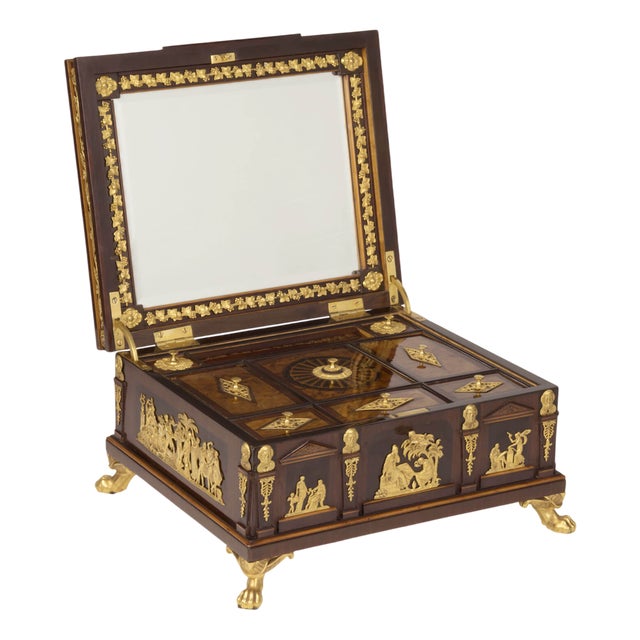
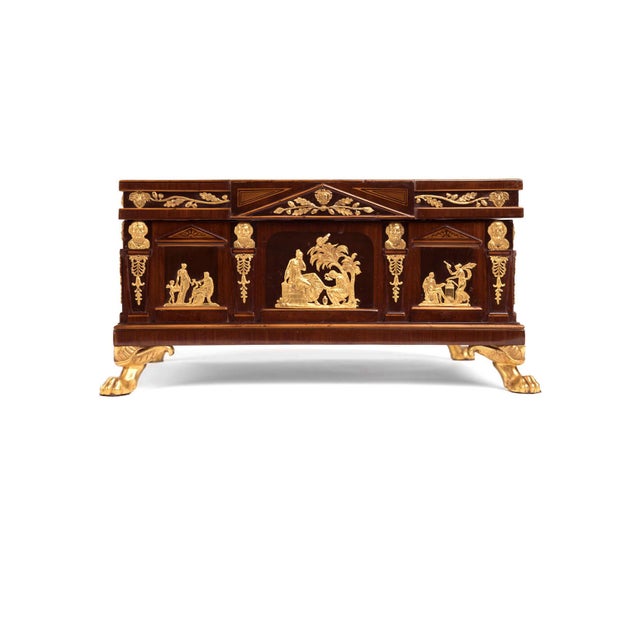
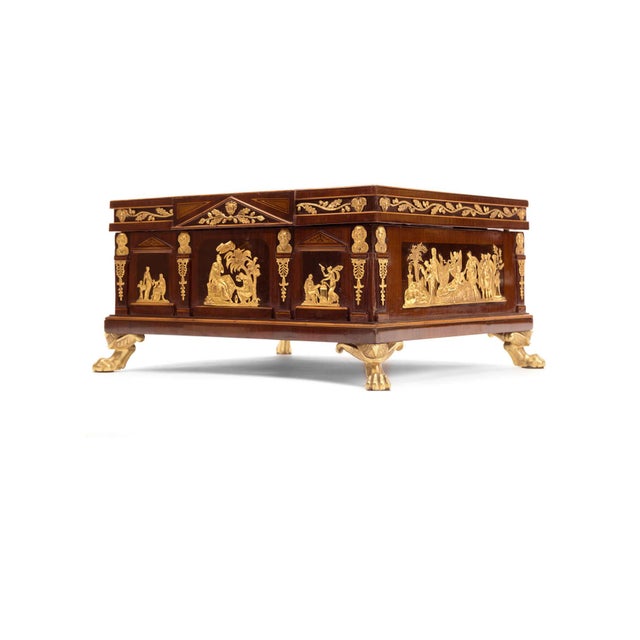
the exterior is lavishly enriched with finely embossed and gilded bronze mounts, forming a sophisticated iconographic programme inspired by classical antiquity.
the two principal lateral friezes depict scenes drawn from greco-roman mythology, where bacchus, ariadne, the muses and the three graces can be identified—allegories of harmony, creativity, pleasure and cultivated life.
on the front and side capitals appear finely modelled busts of aristotle, a deliberate reference to philosophy, rational thought and the intellectual foundations of classical culture. This choice leaves little doubt that the box was conceived for a patron who valued learning, erudition and symbolic depth as much as visual splendour.
at the centre of the front tympanum appears the figure of hermes, entwined with oak branches and acorns—ancient symbols of power, prosperity, good fortune and spiritual growth. These motifs are further complemented by ram heads, animals celebrated in the mythological cycle of the argonauts, reinforcing the heroic and allegorical narrative that permeates the entire decorative scheme.
the mirror is framed by an elegant interlacing of vine leaves and grape clusters, a motif traditionally associated with bacchus and long connected to allegories of happiness, friendship and abundance—meanings deeply rooted in both classical mythology and sacred texts.
a fascinating interior: secret drawers and ingenious design
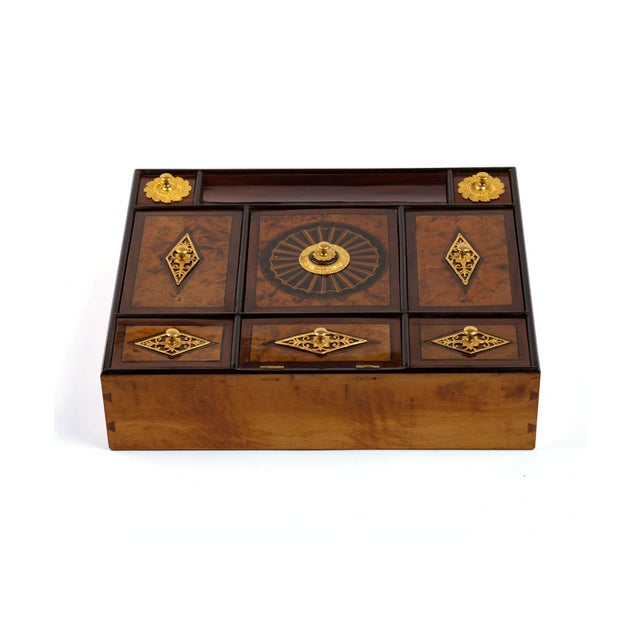
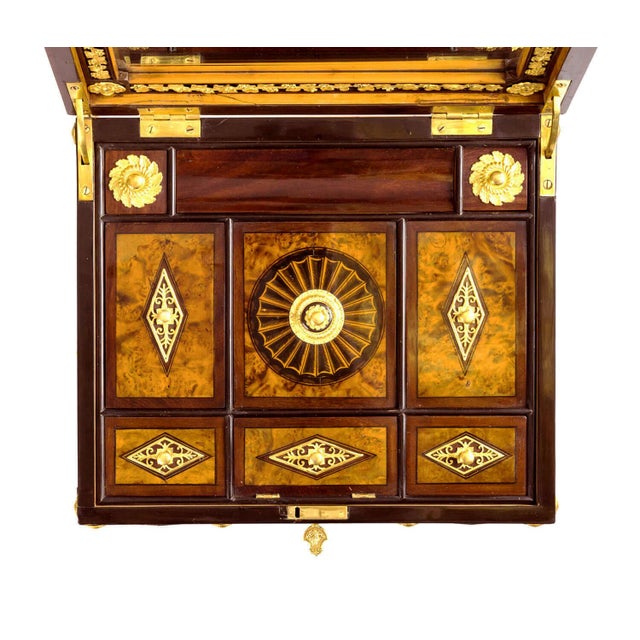
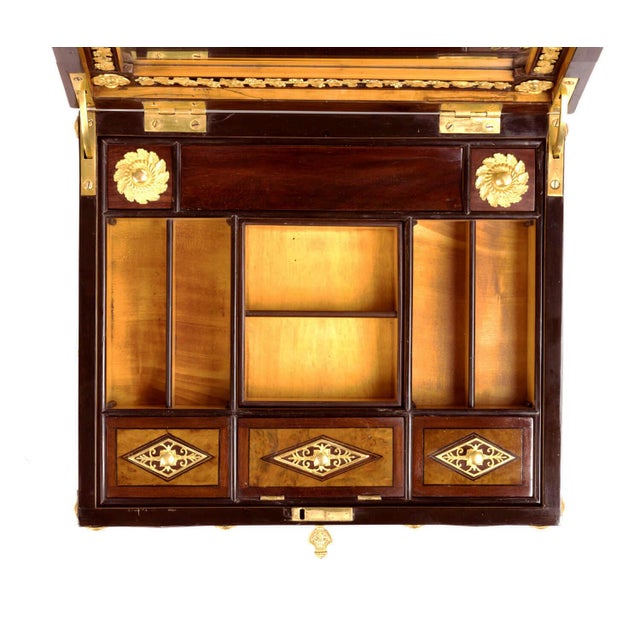
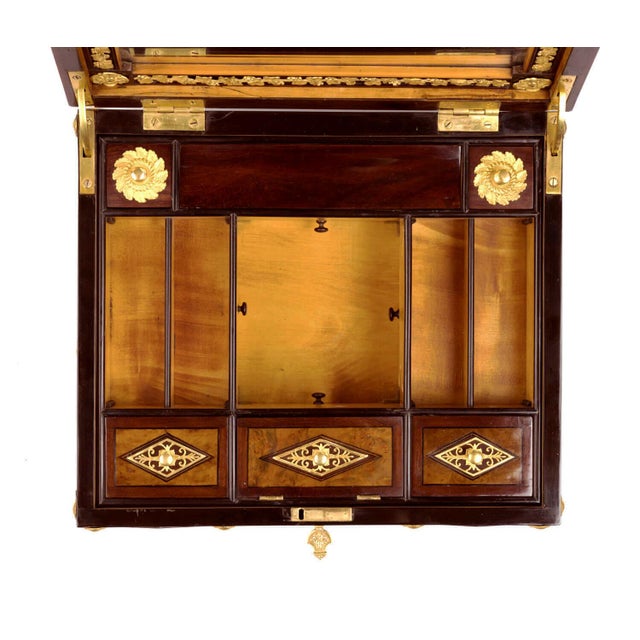
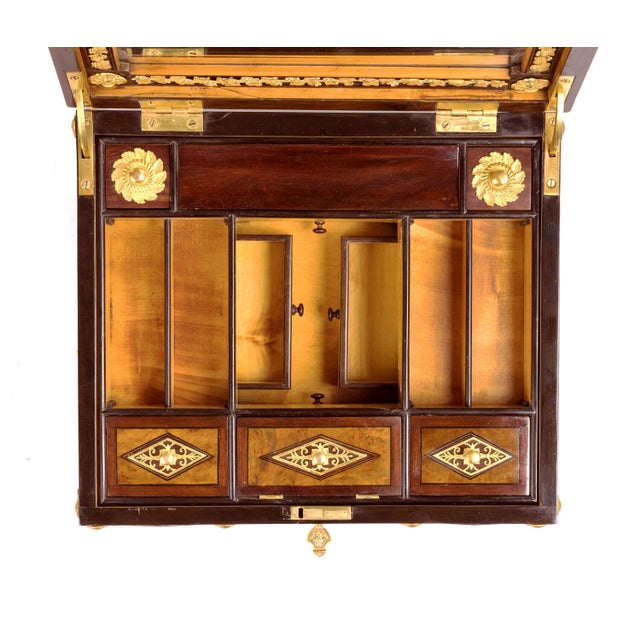
opening the box reveals an extraordinarily complex and refined interior, conceived with intelligence and a subtle sense of theatricality. The object combines two distinct functions—writing and sewing—while concealing a sophisticated system of five secret drawers, discreetly integrated into the structure.
the interior includes:
two compartments designed for sewing spools,
a dedicated space for a pin holder,
a container for pens,
two upper corner compartments intended for ink and talc,
three central compartments, each further subdivided for precise organisation.
this ingenious internal architecture transforms the box into a true cabinet of curiosities, where discovery and surprise accompany use—an aspect that greatly enhances its appeal for discerning collectors.
materials, cabinetmaking and decorative excellence
the cabinetmaking is of outstanding quality, executed with exceptional precision using a refined combination of fine woods, including mahogany, walnut, olive wood, birch and pearwood. The careful selection and harmonious juxtaposition of these materials testify to a workshop of the highest level.
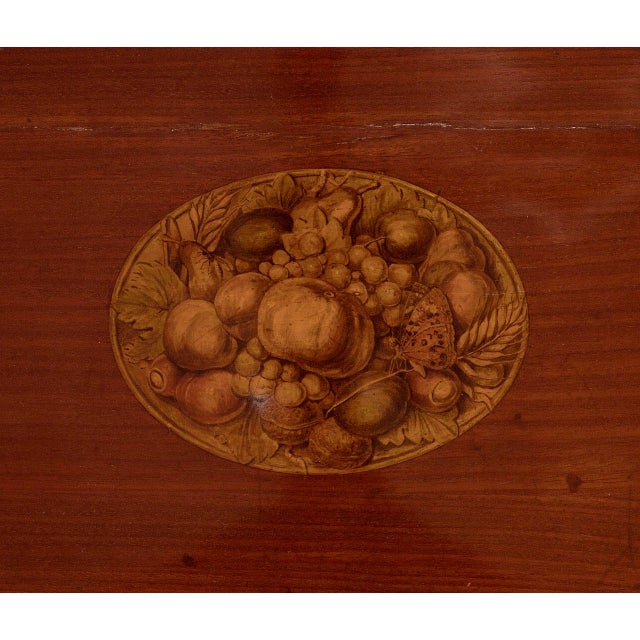
the top lid is enriched with a delicate painted panel depicting fruit, a butterfly and a bee—symbols laden with meaning: the butterfly alluding to transformation and the struggle between good and evil, the bee representing diligence, virtue and moral integrity.
the box rests on four finely chiselled and gilded bronze feet, further enhancing its sculptural presence and confirming its status as a luxury object conceived for distinguished interiors.
historical context and attribution
this remarkable box belongs to the height of the austrian empire style, formally established in 1804 and shaped by the refined cultural climate of the viennese court, already anticipating the ideal of austria felix.
the period was profoundly influenced by the renewed fascination with classical antiquity following archaeological discoveries and the theoretical writings of johann joachim winckelmann, whose ideas deeply shaped european neoclassicism and the decorative arts.
the splendid gilded bronze friezes are attributed to franz d. Detler, a documented viennese bronzist and medallist active in the early 19th century. His work is recorded in institutional collections such as the mak – museum of applied arts in vienna. Detler was internationally renowned for his commemorative medals, including portraits of the protagonists of the congress of vienna, and his decorative bronzes were employed by leading cabinetmakers serving aristocratic and imperial clientele.
rarity and collectability
objects of this level were produced almost exclusively for a restricted circle of noble and high-ranking patrons. Boxes combining such a rich allegorical programme, exceptional bronze work, complex internal mechanics and excellent preservation are extremely rare on the present-day antiquarian market.
condition
the box is preserved in excellent condition, with minimal signs of age. The gilded bronzes retain their brilliance, the woods display a warm and harmonious patina, and all internal compartments and mechanisms are intact and fully functional.
conclusion
this magnificent viennese empire box is not merely a utilitarian object, but a statement of taste, culture and status. Beautiful, intellectually engaging and intriguing for its secret drawers, it is a rare and highly desirable work—ideal for an important private collection, a refined study or as a distinguished centerpiece in a prestigious interior.
a truly unique and collectible masterpiece of early 19th-century austrian decorative arts.
See less
- Dimensions
- 14.17ʺW × 11.81ʺD × 7.48ʺH
- Period
- 19th Century
- Country of Origin
- Austria
- Item Type
- Vintage, Antique or Pre-owned
- Materials
- Wood
- Condition
- Good Condition, Original Condition Unaltered, Some Imperfections
- Color
- Brown
Returns & Cancellations
Return Policy - All sales are final 48 hours after delivery, unless otherwise specified in the description of the product.
Cancellation Policy - Prior to shipping or local pickup, buyers may cancel an order for up to 48 hours, unless otherwise specified.
Related Collections
- Acacia Wood Boxes
- Polyester Boxes
- Alessandro Albrizzi Boxes
- Enzo Mari Boxes
- Abaca Boxes
- Violet Boxes
- Tony Duquette Boxes
- Anthony Redmile Boxes
- Ettore Sottsass Boxes
- Bright Green Boxes
- Port 68 Boxes
- Silk Velvet Boxes
- Jewelry Boxes
- Burlwood Boxes
- Hat Boxes
- Silver Boxes
- Japanese Boxes
- Pill Boxes
- Alabaster Boxes
- Maitland - Smith Boxes
- Tool Boxes
- Cigar Boxes
- Porcupine Quill Boxes
- Porcelain Boxes
- Marble Boxes