


Details
Description
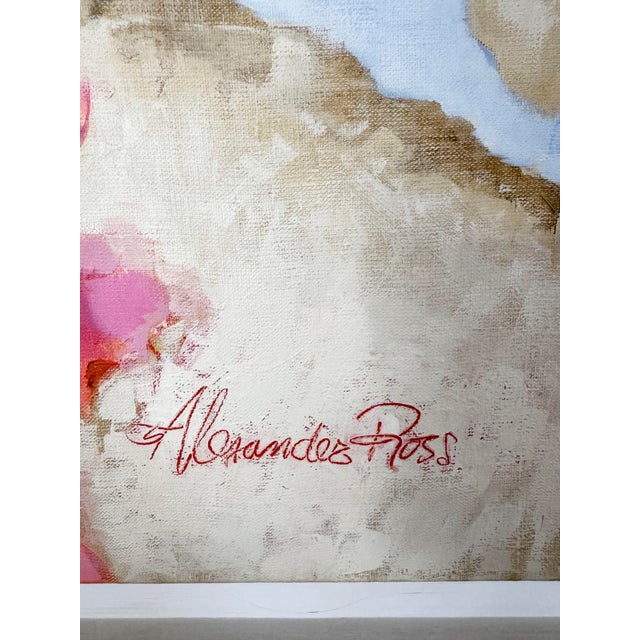
Alexander Ross (Scottish American, 1908–1990), oil on canvas titled “Blossoming Flowers,” depicting a lively, expressive floral composition rendered with gestural, …
Read more
Alexander Ross (Scottish American, 1908–1990), oil on canvas titled “Blossoming Flowers,” depicting a lively, expressive floral composition rendered with gestural, layered brushwork in vibrant pinks, soft blush tones, saturated blues, fresh greens, and warm neutral passages creating a dynamic interplay of color and movement across the surface, signed lower right Alexander Ross, presented in a silver gilt wood frame with white liner and inner molding, sight size 39 1/4" x 52"; with frame 45.5" x 57.5"
"Painting should always have some mystery about it."
Alexander Sharpe Ross
Ross was a leading American illustrator in the 50s and 60s, with his work on the covers of Good Housekeeping, Saturday Evening Post, Ladies Home Journal and Colliers. Along with a handful of key illustrators Coby Whitmore, John Whitcomb, Al Parker, Norman Rockwell, Ross helped create an indelible image of Americans in the post WWII decades.
In the 1960s, Ross moved dramatically into the fine arts painting abstracts, surrealists, portraits, always seeking new technique. "Inventive Realism" he called it when pressed for nomenclature, and explained, "My subjects are mainly flowers and dreamlike human figures. Flowers have beautiful shapes that lend themselves to abstraction, and I incorporate new dimensions in them, using the essence of 'flower' from memory to create a whole gamut of emotions."
Ross was awarded an Honorary Degree of Master of Arts by Boston College in 1953. An assignment from the US Air Force took him to Alaska where he painted his impressions of one of American's foremost frontiers. The award-winning works are now in the permanent collection of the Air Force. In 1969, Ross designed a postage stamp for professional baseball, celebrating the centennial of the Cincinnati Reds.
Youth and Illustrations
Born in Dunfermline, Scotland, Ross came to Wilkinsburg, Pennsylvania, as a youth. He was largely self-taught, although he had one year of night school at Carnegie Tech. His first break occurred in 1941 when one of his illustrations was chosen from a roomful of contestants to be a Good Housekeeping cover. The editor, Herbert Mayes, commissioned 130 additional cover illustrations over the next dozen years at roughly $1000 apiece.
The covers were of children, mostly Ross's own, who early on learned to model for him. After that, Ross became quite popular as a painter of "clinch" picturesmen and women in romantic postures. His clinches appeared in Saturday Evening Post, McCall's, Cosmopolitan, and Colliers. When photography entered commercial art, he switched to fine arts painting.
Styles and Media
Ross worked in a large variety of media: oils, watercolors, serigraphs, collages, pastels, halftones, and acrylics on gesso. For a time, Ross preferred watercolor "because of the spontaneous outburst factor. When one is feeling happy, he doesn't put the feeling aside, but expresses it at once, at the full height of his feelings. That is the way with watercolor."
As one art critic summarized, "The overall impact of Alexander Ross's painting is one of immense enjoyment of the spectacle of nature. His are assured and happy pictures."
Ross, On Himself and His Art
"I am awed by the skill of photo realists. But I find no real challenge there, for the mystery is gone. I prefer to alter the natural contours and form of an object and thereby benefit the composition, structure and esthetic value. I avoid extreme alteration, which leads to abstraction and loss of identity, for there is more challenge in the objective than the non-objective.
"My most important development was a new style I call 'Inventive Realism' the alteration of light and color on forms. I sacrifice certain contours when the forms overlap or come in contact with other formsparticularly when their respective values are the same. Thus, I invent altered real forms to create an overall abstraction.
"I am not trying to improve on an already perfect phenomenon. A flower's magnificence has turned my mind to thoughts, perhaps metaphysical in their new abstraction, on how to catch a mystical something beyond the beauty our eyes and minds behold."
In a note penciled on Jan. 21, 1981, Ross anticipated this developing style, "I envision a continuing overall image of abstract forms that, upon closer inspection, are in reality representational." He went on to write that he wanted to emphasize the mystical and fantastic, avoid sentimentality, obviousness, and classical nude positions, but he scribbled emphatically "beauty of form is not taboo! Color is so important!" He planned painting with an over-all single color with strategically placed accents of opposing colors.
What the Critics Said
The critic and commentator, Robert Ulrigh Godsoe, gave his impressions of Ross in a lengthy article on the artist. "Overlying all of Ross's activities is the conception of life as a miracle. He does not think science has exploded the great unbelievable facts of life. Science itself is a miracle. The miraculous nature of all life leads him to believe literally in the smallest miracle of the ancients, the stars, man's consciousness; the seasons are no less believable than the miracle of the loaves. There can be no doubt that the fire comes through in Alexander Ross's work. And when it does, something of what Ross really is breaks out into the open, where zeal and ardor and most of all delight shine through."
Art critic Kathryn Hedgman wrote, "Quite aware of the radiance of flower forms, Ross deliberately lightens and brightens the tone, making the values high and alternately intense and pale. In the bright, pale high-value areas, he contrasts them with dark and deep accents. This effect accentuates the abstract quality of the painting, for he feels free to alter the natural contours of an object. It is interesting that this painter, so well equipped to present realistic flowers, is trying to express the essence of the world of flowers in near abstractions. The technique Ross developed for his Inventive Realism is mainly washes of different chemical media, which sometimes are resisted by the surface of his paper and sometimes absorbed. Great variation in effect is gained. Sometimes the effect is of a wash which barely touches the surface; sometimes it is deep, sometimes mat. It gives sparkle and life to the painting."
Martha B. Scott, another art critic, summarized Ross's inventive Realism. "He is obsessed with the celebration of all the joys of nature, especially spring and summer the profusions of wild flowers, the bursts of buds into full-blown petals, the murmur of voices, from young children and young nudes alone with their thoughts in sylvan settings."
Religious Art
Ross was profoundly interested in religious art. "It's one of the most fascinating fields of creation I can think of." He has created paintings of biblical prophets for the Mormon Church, illustrated three religious book's and designed stained glass windows for a Danbury, Connecticut, church.
His Place in the Scheme of Things
In a major show in the 57th Street gallery, Eric, in New York City, a critic wrote, "It has been said that Ross's vision resembles that of Renoir and Marie Laurencin, as all three share a passion for nudes, flowers and children. However, this is where the resemblance ends, as Alexander Ross has brought to his compositions an entirely new and very personal interpretation, dynamic but also sensitive, where abstractions taken over from realism in a magic blend of forms and colors."
Successful watercolorist Fred Whitaker gave a major, published speech in 1980 about Ross's achievements as an illustrator, likening his work to such famous American illustrators as Remington, Homer and Hopper. "When the story of today's art epoch is written, there may well be general agreement that the real art contribution of the mid-twentieth century was that of the illustrators and commercial artists. I know of no artist who experiments more than Ross in approach to the mode of presentation; in color, in the manner of applying paint, in his brushing, in the use of new angles of compositional arrangement. His one great fear is that he may become static, even afraid of copying himself."
Personal
Ross had a passionate love affair with life; a positivism almost diametrically at odds with the pessimism and existential despair of much 20th century art. As a youth, his overwhelming ambition was to be a professional acrobat, and he briefly succeeded at it, earning money for acrobatic performances.
"I wanted to fly through the air with the greatest of ease," said Ross. "At age 18, with mind and body dedicated to soaring through the air, I was shot down by an arrow. It is very difficult to perform acrobatics with an arrow in your heart." This was the beginning of a love affair with his wife Helen Connolly that lasted more than 58 years, until his death in 1990. According to Ross, "[Helen] has taken me to far greater heights than I ever attained as a gymnast."
Ross had four children: Robert (Bob), deceased; Arlene, a retired medical doctor living in Arizona and alternately attending seminary school in Chicago; Alan, a successful author, singer/songwriter and business owner living in Monteagle, Tennessee, and Wendy, retired from Brother Corp and living in Hilton Head, South Carolina. Helen also lives in Hilton Head; she is 94 years young.
Ross Genealogy
Parents: James & Elizabeth Ross
Birthplace: Dunfermline, Scotland
Date of Birth: October 28, 1908
EXHIBIT
Smithsonian Institute Washington, DC
Metropolitan Museum of Art New York, NY
National Academy of Design Galleries New York, NY
Society of Illustrator's New York, NY
Salamagundi Gallery New York, NY
Royal Society of Painters London, England
Australian Watercolor Institute Sydney, Australia
Wadsworth Atheneum Hartford, CT
New Britian Museum of Art New Britian, CT
Mattatuck Museum of Art Waterbury, CT
De Cordova Museum Lincoln, MA
Tennessee Fine Arts Center Nashville, TN
Chouinard Art Center Los Angeles, CA
Scareb Club Gallery Detroit, MI
Eric Galleries New York, NY
Thompson Galleries Phoenix, AZ
Collector's Gallery Nashville, TN
Carlson Gallery, U of Bridgeport Bridgeport, CT
Joe DeMers Gallery Hilton Head Island, SC
Palm Beach Galleries Palm Beach, FL
Naples Art Gallery Naples, FL
Phillips Gallery Dallas, TX
AWARDS
1955 Silvermine Guild New England Annual Exhibition
Prize award in Watercolor
1960 Los Angeles County Fair Exhibition
First Prize popular opinion medal award
1962 American Watercolor Society Annual Exhibition
Salamagundi prize award
1963 Society of Illustrator's Annual Exhibition
Award of Excellence
1964 Society of Illustrator's Annual Exhibition
Award of Excellence
1964 American Watercolor Society Annual Exhibition
Ranger Fund Purchase Award
1964 New Caanan Annual Exhibition
First prize award in Watercolor
1964 Connecticut Watercolor Society Annual Exhibition
Dixie Award
1965 Society of Illustrator's Annual Exhibition
Award of Merit
1965 Connecticut Watercolor Society Annual Exhibition
Alexander Crane Memorial Award
1967 New Canaan Annual Exhibition
Thomas Saxe Foundation Award
1967 Ridgebury Gallery & Exhibition
First Prize-oil
1967 Connecticut Watercolor Society Annual Exhibition
Sage Allen Award
1968 Connecticut Watercolor Society Annual Exhibition
Sage Allen Award
1969 Connecticut Arts Festival
Third Prize
1971 Connecticut Watercolor Society Annual Exhibition
Dixie Award
1972 National Academy of Design Annual Exhibition
Adolph and Clara Obrig Award
1973 American Watercolor Society Annual Exhibition
Ford Times Award
1974 American Watercolor Society Annual Exhibition
Martha T. McKinnon Award
1975 National Academy of Design Annual Exhibition
Walter Biggs Memorial Award
1976 American Watercolor Society Annual Exhibition
Ford Times Award
1976 Connecticut Watercolor Society Annual Exhibition
Connecticut Watercolor Prize (second place)
1976 Ellsworth National Art Competition
Award of Excellence
1977 28th New England Exhibition of Painting and Sculpture
Laura M. Gross Memorial Award
1980 National Academy of Design Annual Exhibition
Adolph and Clara Obrig Award
1981 Georgia Watercolor Society
Columbus Award
1982 American Watercolor Society Annual Exhibition
Lena Newcastle Award
From Scotland, Alexander Ross became one of the better-known American illustrators of of the 20th century. He did numerous magazine illustrations including for Collier's, Good Housekeeping, The Ladies Home Journal, Cosmopolitan, and Saturday Evening Post.
He arrived in the United States at age three, and first studied to be an industrial designer with Robert Lepper at the Carnegie Institute of Technology in Pittsburgh. Although he had no formal training in illustration, he took an illustration job with Rayart Studios in Pittsburgh, and from there he moved to Pitt Studios and then to New York with Charles E. Cooper Studio. Two years later, he sold his first cover design to Good Housekeeping and this was followed by a total of 130 cover paintings for the magazine over the next twelve years. Meanwhile, he also had other commissions including the illustrating of several books including Saints and Adventures in Courage.
Ross liked the media of watercolor and was a member of the American Watercolor Society and the Fairfield (Connecticut) Watercolor Group.
Awards included the Ranger Fund purchase prize, the Saxe Foundation award, and the Connecticut Watercolor Society Award. In 1953, he was awarded a Master of Arts honorary degree by Boston College.
Source: Walt Reed, The Illustrator in America, 1860-2000
See less
- Dimensions
- 52ʺW × 3ʺD × 39.25ʺH
- Styles
- American
- Frame Type
- Framed
- Art Subjects
- Still Life
- Botanic
- Period
- Late 20th Century
- Country of Origin
- United States
- Item Type
- Vintage, Antique or Pre-owned
- Materials
- Canvas
- Oil Paint
- Wood
- Condition
- Good Condition, Original Condition Unaltered, Some Imperfections
- Color
- Almond
- Condition Notes
- Very Good Condition Very Good Condition less
Questions about the item?
Returns & Cancellations
Return Policy - All sales are final 48 hours after delivery, unless otherwise specified in the description of the product.
Cancellation Policy - Prior to shipping or local pickup, buyers may cancel an order for up to 48 hours, unless otherwise specified.
Related Collections
- Photorealism Canvas Paintings
- Ed Ruscha Paintings
- Photorealism Paintings in New York
- Richard Serra Paintings
- Herman Miller Paintings
- BDDW Paintings
- Jo Baskerville Paintings
- Louise Nevelson Paintings
- Karen Offutt Paintings
- Nicola Simbari Paintings
- Carl-Axel Acking Paintings
- Joseph Stella Paintings
- Karl-Erik Ekselius Paintings
- James McCray Paintings
- Jaanika Peerna Paintings
- Leroy Neiman Paintings
- Cassina Paintings
- Black Photorealism Paintings
- Lawson-Fenning Paintings
- Vienna Secession Paintings
- Jean-Paul Barray Paintings
- Hans Andersen Paintings
- Johannes Andersen Paintings
- Pedro Friedeberg Paintings
- Peter Behrens Paintings