

Details
Description
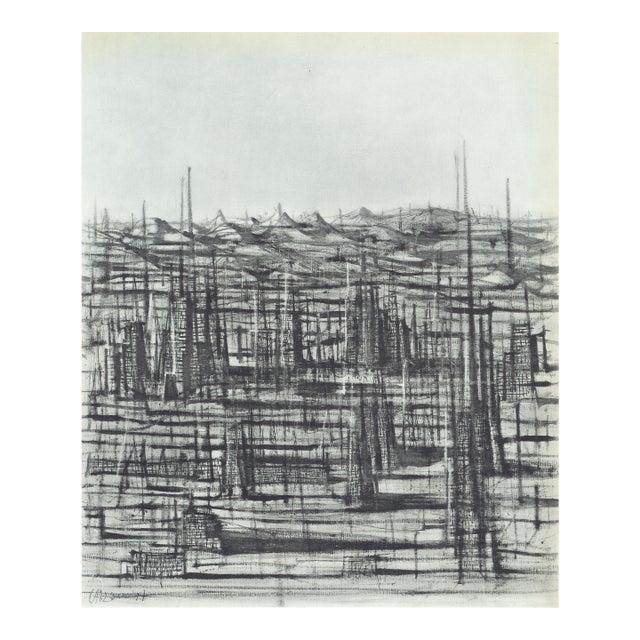
Original lithograph after the painting "Gomorrhe" (Gomorrah) by Jean Carzou, published in the 1959 monograph "L'Apocalypse" by André Sauret and …
Read more
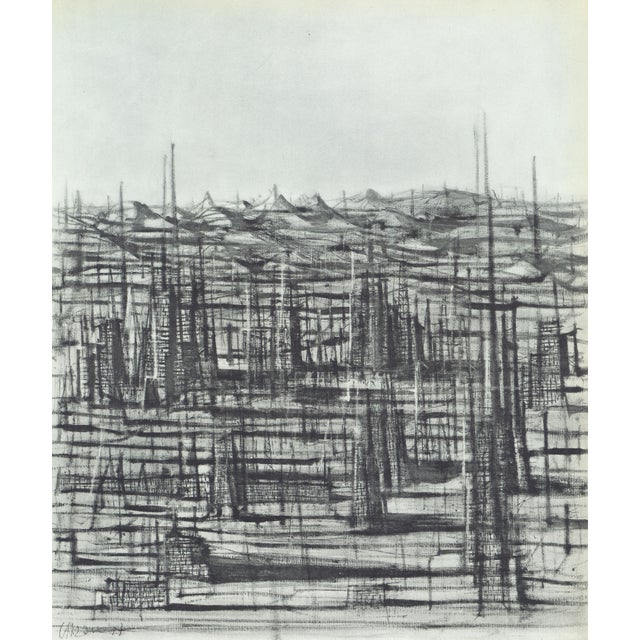
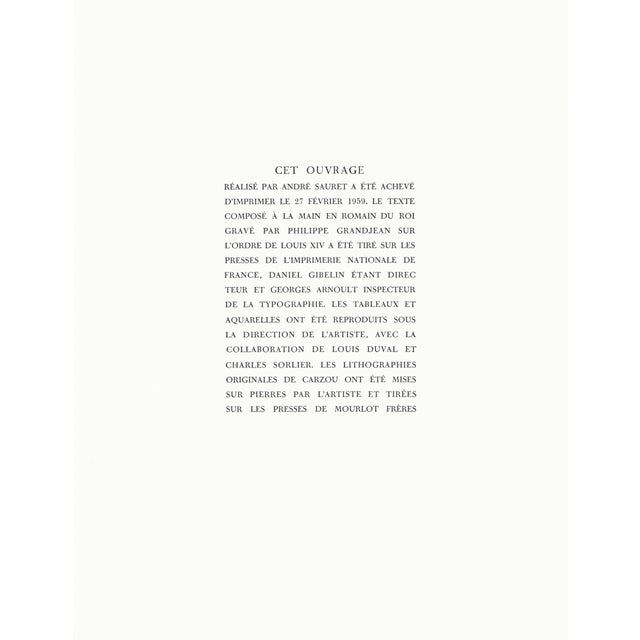
Original lithograph after the painting "Gomorrhe" (Gomorrah) by Jean Carzou, published in the 1959 monograph "L'Apocalypse" by André Sauret and printed by Mourlot Frères in Paris. Sheet size: 12-1/2 x 9-3/4 inches; print size: 10-1/2 x 8-3/4 inches with verso text. Mint condition new old stock, taken from a complete Carzou monograph "L'Apocalypse".
“Gomorrhe” was inspired by the biblical city of Gomorrah, symbolizing destruction, decadence, and human fragility. In typical Carzou style, the work is highly stylized and architectural, emphasizing rigid lines, geometric forms, and structured spaces rather than realistic figures. Rather than directly depicting catastrophe, Carzou uses the imagery of Gomorrah to explore themes of civilization’s fragility, the inevitability of decay, and the tension between human creation and emptiness, which are central to his artistic vision.
L’Apocalypse is a deluxe monograph in which the artist Jean Carzou interprets the biblical Book of Revelation through a series of dramatic drawings and compositions, published by André Sauret, a French publisher known for high-quality art books. Rather than retelling the text in a literal or narrative way, Carzou offers a visual meditation on Revelation’s major themes: the end of the world, judgment, chaos, and the fragile fate of humanity. His imagery is marked by sharp, architectural lines, skeletal cities, and distorted human figures, creating a sense of tension and impending collapse. The scenes often feel timeless—less about a specific religious prophecy and more about modern anxieties, such as war, destruction, and moral breakdown. Carzou’s style is symbolic rather than graphic: angels, beasts, and apocalyptic events are suggested through abstraction and structure instead of detailed action. This gives the work a poetic and philosophical tone, emphasizing fear, silence, and inevitability rather than spectacle. Overall, L’Apocalypse is considered a major example of 20th-century illustrated books, blending sacred text with modern artistic expression. It reflects Carzou’s broader concern with civilization under threat and stands as both a spiritual and humanistic interpretation of the end times.
Mourlot Frères (also know as Atelier Mourlot) is a famous French lithographic print studio founded in Paris in 1852 by François Mourlot and later run by his descendants, most notably Fernand Mourlot in the mid to late 20th Century. The atelier became world-renowned for producing high quality fine art lithographs for some of the most important modern artists, including Picasso, Matisse, Chagall, Miró, Carzou, Braque, and Léger. These prints were made using authentic fine art lithographic techniques, typically with direct involvement from the artist, and are particularly collectible prints.
Jean Carzou (1907-2000), was born in Syria to an Armenian family. Carzou created his name from the first syllables of his birth first name and surname (Karnik Zouloumian). He moved to Paris in the early 1920s to study art and architecture, and in 1925 he graduated from the Paris School of Architecture. However, he abandoned his pursuit of architecture for fine art, resorting to work as a street artist painting caricatures and portraits to support himself. His art became noticed, providing Carzou with a steady income from his sketches of politicians and public figures that were published in Paris newspapers. Through his line drawings and engravings he became well known as an illustrator for some of the 20th century's most important writers, including Hemingway, Camus, Ionesco and Rimbaud. Carzou's works adorn opera houses and chapel walls, and his paintings are in the permanent collection of renowned art museums. Over the course of his career, Carzou received many honors. He was a member of France's Academie des Beaux-arts, and decorated with the National Order of Merit, three Hallmark Prizes for painting, the Grand Prize of Europe, and the Grand Prize of the Ile de France. In 1976, Carzou became the first living artist to have his work appear on a French postage stamp.
See less
- Dimensions
- 9.75ʺW × 0.1ʺD × 12.5ʺH
- Styles
- Industrial
- Modern
- Frame Type
- Unframed
- Art Subjects
- Architecture
- Abstract
- Landscape
- Period
- 1950s
- Country of Origin
- France
- Item Type
- Vintage, Antique or Pre-owned
- Materials
- Lithograph
- Condition
- Mint Condition, No Imperfections
- Color
- Blue
- Condition Notes
- Mint condition new old stock, taken from a complete Carzou monograph titled L'Apocalypse. Photographs are detailed and taken under controlled … moreMint condition new old stock, taken from a complete Carzou monograph titled L'Apocalypse. Photographs are detailed and taken under controlled lighting; post-production is performed with calibrated monitors. Thus, our photographs accurately capture the work's condition and colors. However, monitors vary and can affect the way art appears online. Contact us for any concerns. less
Questions about the item?
Returns & Cancellations
Return Policy - All sales are final 48 hours after delivery, unless otherwise specified in the description of the product.
Cancellation Policy - Prior to shipping or local pickup, buyers may cancel an order for up to 48 hours, unless otherwise specified.
Related Collections
- Patrick Nagel Reproduction Prints
- Hable Reproduction Prints
- Reproduction Prints in Panama City, FL
- Jonathan Adler Reproduction Prints
- William Hogarth Reproduction Prints
- Sister Parish Reproduction Prints
- Lauren Ralph Lauren Reproduction Prints
- Leather Reproduction Prints
- Edward S. Curtis Reproduction Prints
- Mark D. Sikes Reproduction Prints
- Dorothy Draper Reproduction Prints
- Gold-Plate Reproduction Prints
- Jute Reproduction Prints
- Sam Francis Reproduction Prints
- William Gropper Reproduction Prints
- Alvar Aalto Reproduction Prints
- Polychrome Reproduction Prints
- Serena and Lily Reproduction Prints
- Utagawa Kunisada (Toyokuni Iii) Reproduction Prints
- Daylight Dream Editions Reproduction Prints
- Reproduction Prints in Mobile
- Restoration Hardware Reproduction Prints
- Joshua Reynolds Reproduction Prints
- Tuscan Reproduction Prints
- Bunny Williams Home Reproduction Prints