




Details
Description
School of Antonio Allegri, known as Correggio (Correggio c. 1489 – 1534)
Attributable to Pomponio Allegri (Correggio, 1522 – Parma, …
Read more
School of Antonio Allegri, known as Correggio (Correggio c. 1489 – 1534)
Attributable to Pomponio Allegri (Correggio, 1522 – Parma, 1593)
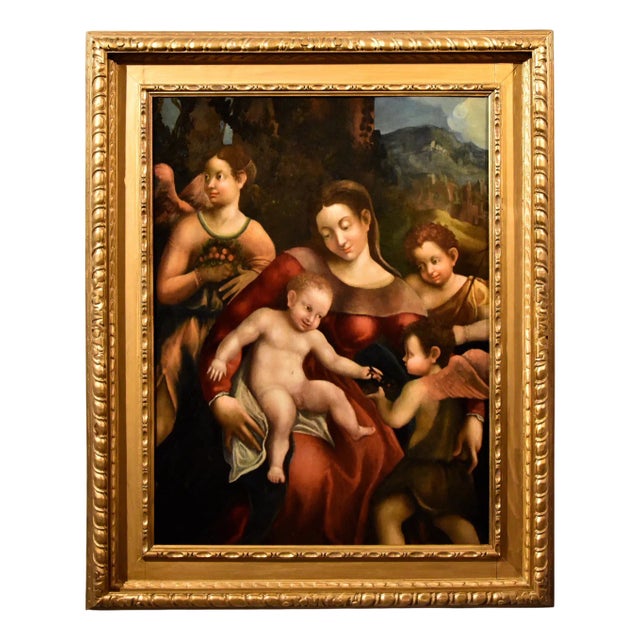
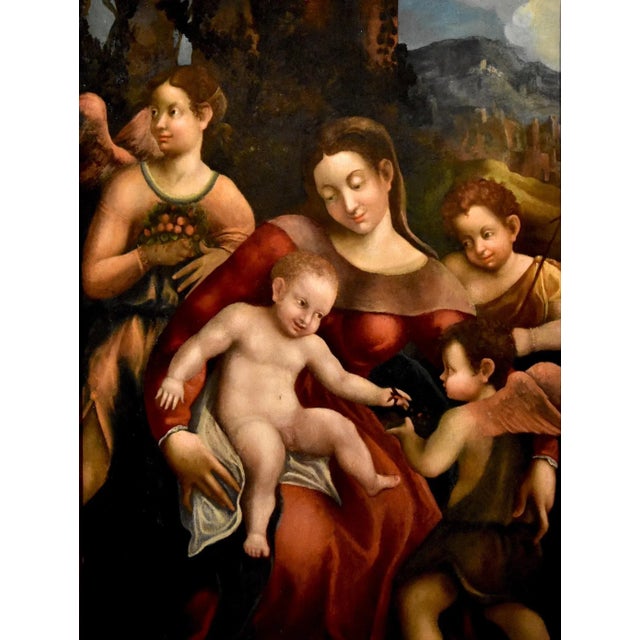
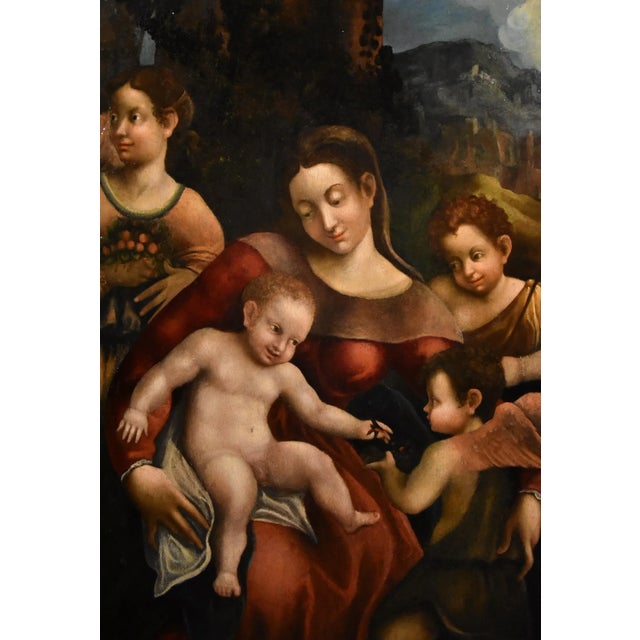
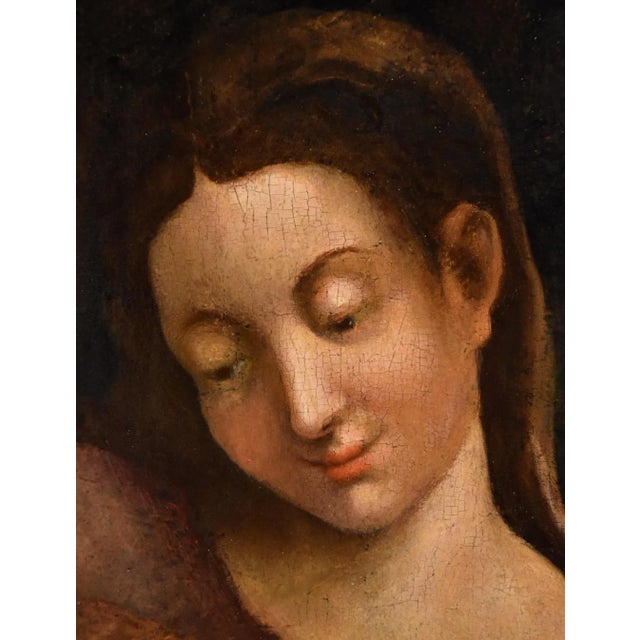
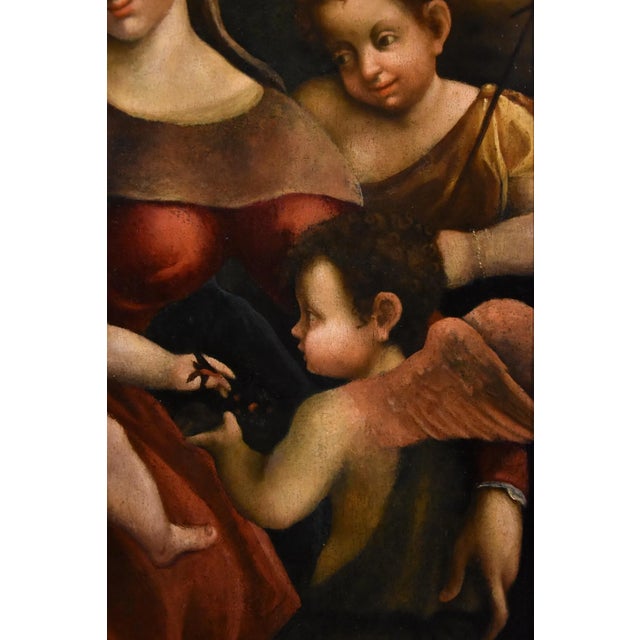
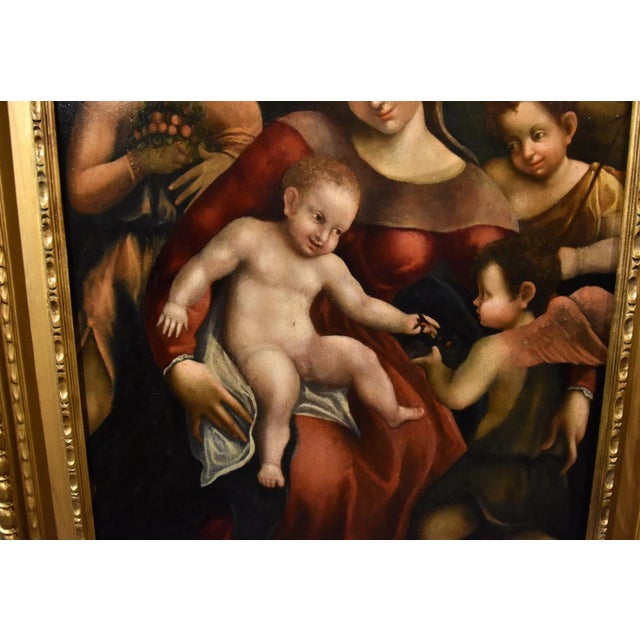
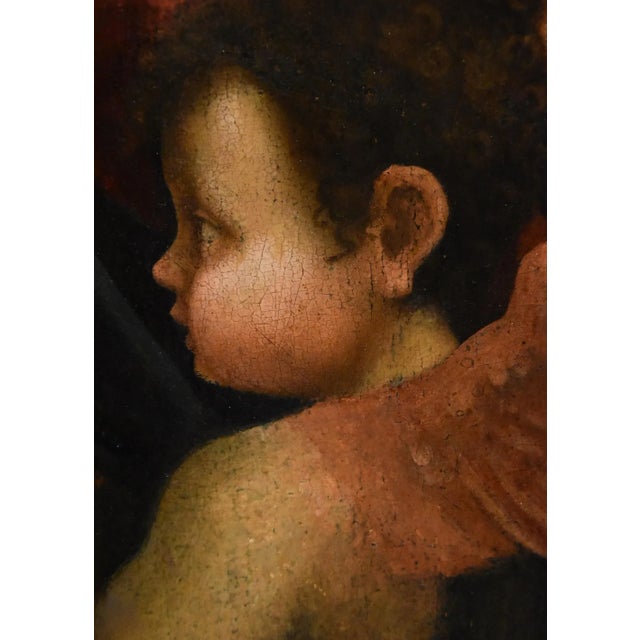
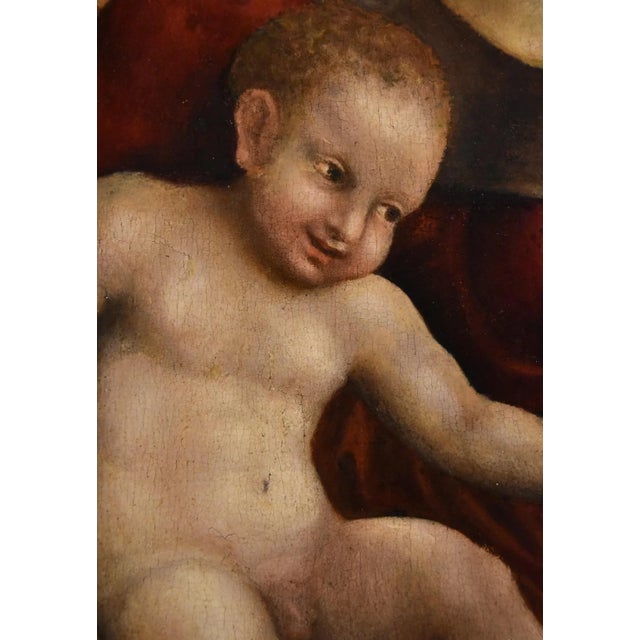
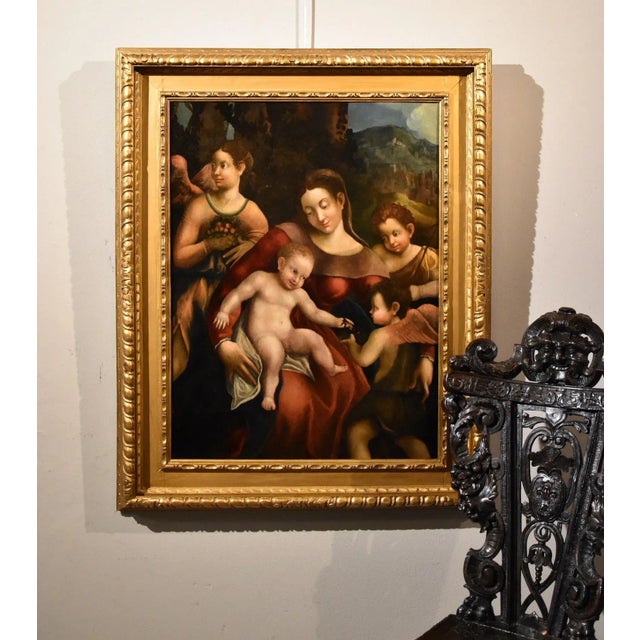
Madonna and Child with Two Angels and John the Baptist
Oil on panel, 92 x 69 cm, framed 119 x 96 cm
The work, whose format suggests it was intended for domestic devotion, offers a pleasing example of Emilian art in the mid-16th century, with clear references to the school of Antonio Allegri, known as Correggio (Correggio c. 1489 – 1534), an undisputed master renowned for the great elegance of his creations, perfectly balanced between chromatic finesse and dynamic effect, achieved through the interplay of gestures and glances.
Carrying Leonardo da Vinci's teachings to the utmost, he succeeded in capturing the most authentic connection between the various figures. Furthermore, thanks to the expressive sweetness of his figures and his extensive use of perspective, he established himself in the Po Valley as the most modern and bold representative of Renaissance ideals.
As we can also see in our beautiful panel, he contrasted the explosion of Venetian color and Roman Mannerism with a fluid, luminous, and highly emotional style.
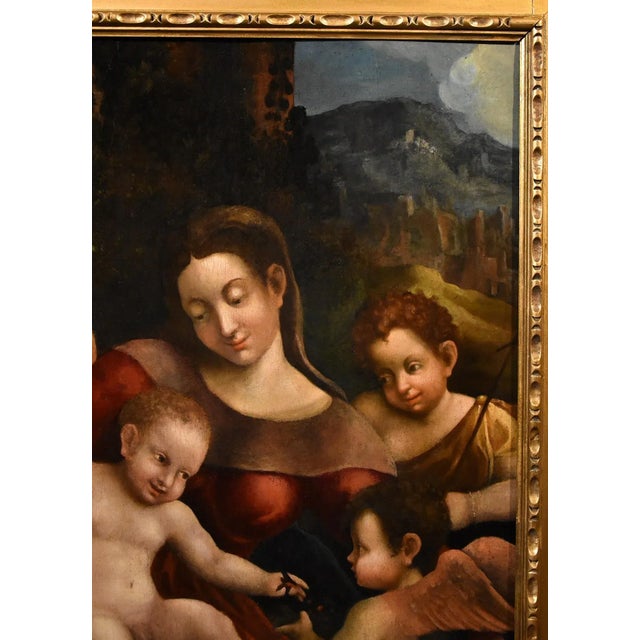
A closer look at the style makes it easy to place the authorship in the hands of Pomponio Allegri; the positioning of the Virgin in particular, with her slightly bowed head, her lowered gaze, and the pose of her body, recall, pay homage to, and almost copy, the Madonna del Nursing in Budapest, painted by his father.
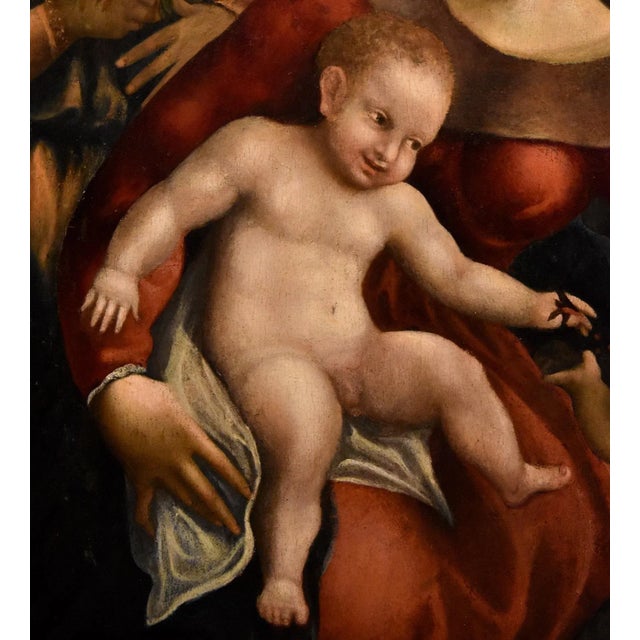
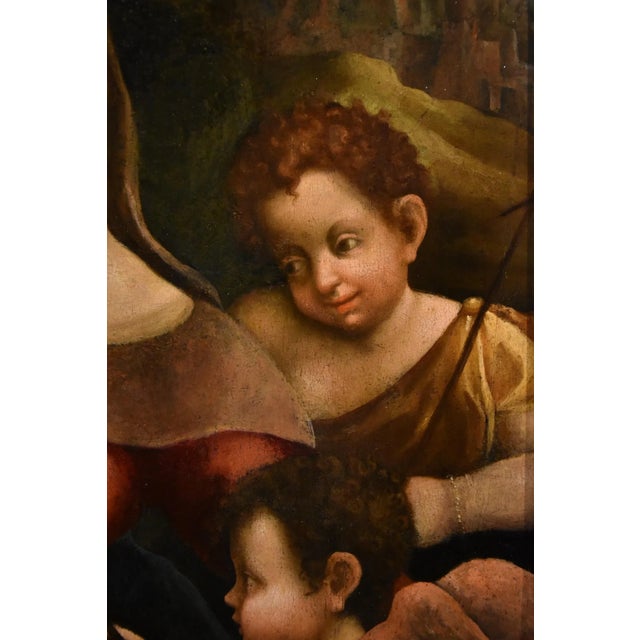
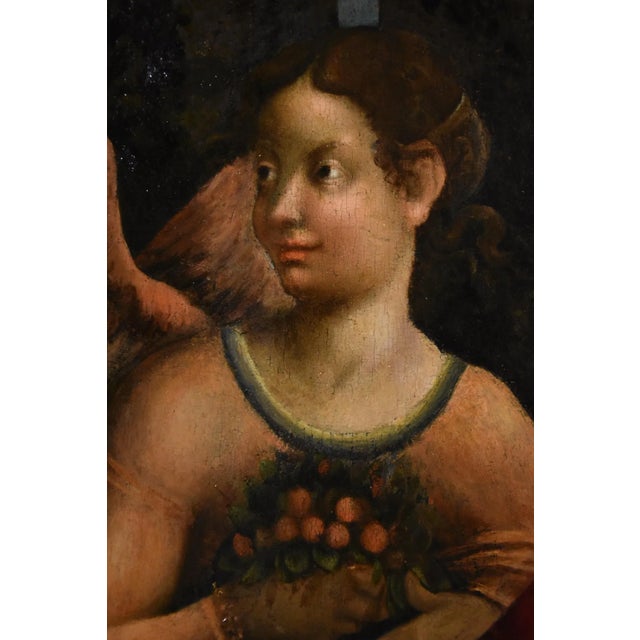
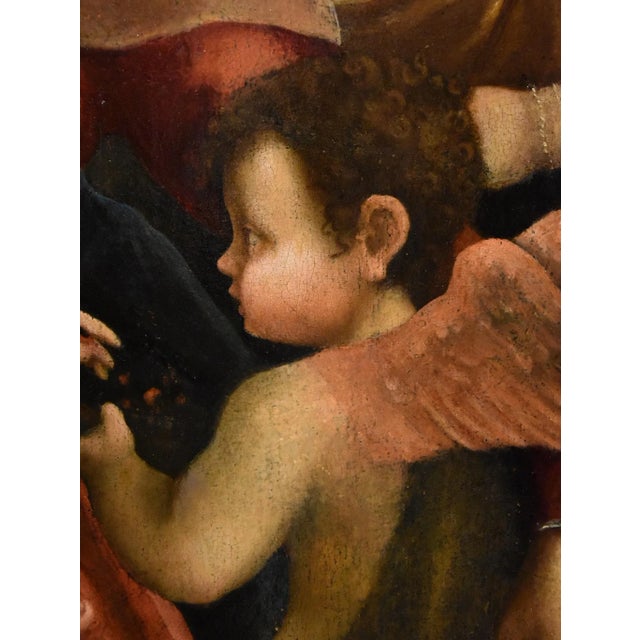
The extremely refined composition features the Madonna seated with the Child supported on her lap, and is enriched by the presence of a pair of angels, one holding a branch full of cherries and the other offering a piece to the child. These fruits allude to Original Sin, by virtue of the red color of the blood of the Passion. Behind, finally, on the right, is a young Saint John the Baptist, already wearing his typical desert hermit attire, namely camel fur and a staff with a cross.
A detail of pure poetry is the glimpse we can glimpse on the right, treated with a vigor and a spirit of modernity rare for the time, characterized by brilliant colors and a clear light, allowing glimpses of a village and an evocative perched castle.
Pomponio's production is highly detailed, as his works combine the formal research and linearity of the late Parma Mannerists with, above all, the distinctly classicizing stylistic elements similar to the art of his father, Antonio Allegri, known as Correggio (Correggio c. 1489 – 1534).
He trained in his father's workshop and was his pupil, albeit briefly. His works demonstrate a clear adherence to the master's taste and style and a faithfulness to his compositional and typological modules, demonstrating the influence of Pomponio's art on that of Correggio.
Pomponio's first works date back to around the middle of the century, and the frescoes for the Corpus Domini chapel in the church of San Quirino in Correggio date back to 1546. In 1555, he was in Reggio Emilia, where he stayed until his final move to Parma in 1559, enjoying considerable success with local patrons.
In this panel, which we can date to the painter's full maturity, we note that the Virgin's typology reflects a specific model of his work, characterized by a massive physicality and, as we have already mentioned, an iconographic conception typical of Correggio.
The figurative scheme proposed in the painting also harks back to his father's graceful compositions: the figures, characterized by rigid and restrained gestures, are arranged diagonally, interrupted by the figure of Mary, firm and immobile in her still fairly centralized position. This piece is attributed to the mentioned designer/maker. It has no attribution mark and no
official proof of authenticity,
however it is well documented in design history. I take full responsibility for any authenticity
issues arising from misattribution
See less
- Dimensions
- 37.8ʺW × 4.72ʺD × 46.85ʺH
- Art Subjects
- Figure
- Period
- 16th Century
- Country of Origin
- Italy
- Item Type
- Vintage, Antique or Pre-owned
- Condition
- Good Condition, Unknown, Some Imperfections
- Color
- Condition Notes
- Patina Consistent with Age and Use,Reupholstered,Partially Restored Patina Consistent with Age and Use,Reupholstered,Partially Restored less
Returns & Cancellations
Return Policy - All sales are final 48 hours after delivery, unless otherwise specified in the description of the product.
Cancellation Policy - Prior to shipping or local pickup, buyers may cancel an order for up to 48 hours, unless otherwise specified.
Related Collections
- Lee Krasner Paintings
- Steve Kaufman Paintings
- Limoges, France Paintings
- Richard Anuszkiewicz Paintings
- Nikolaos Schizas Paintings
- Michelle Arnold Paine Paintings
- Jacobean Paintings
- Louis Wolchonok Paintings
- Vienna Secession Paintings
- Francine Tint Paintings
- Jean Calogero Paintings
- Joseph Solman Paintings
- Camille Pissarro Paintings
- René Magritte Paintings
- Paul Jenkins Paintings
- Paintings in Panama City, FL
- BandB Italia Paintings
- Sol LeWitt Paintings
- Ralph Lauren Paintings
- Donald Judd Paintings
- Laminate Paintings
- Damien Hirst Paintings
- Keith Haring Paintings
- Mark Lewis Paintings
- Mark Lewis Art Paintings