




Starting at 70% Off
Sale Ends Today! - Shop Now
Details
Description
A mahogany shield-back armchair in the Hepplewhite style. This style is named after the 18th-century English cabinetmaker George Hepplewhite, and …
Read more
A mahogany shield-back armchair in the Hepplewhite style. This style is named after the 18th-century English cabinetmaker George Hepplewhite, and it is known for its light, graceful, and delicate appearance. This chair was likely produced in the early 19th century.
Key characteristics of Hepplewhite-style chairs include:
Back: A shield-shaped back, often with a central carving or open space.
Legs: Typically straight and tapered, sometimes with fluted or reeded edges, and ending in a spade or arrow foot.
Materials: Often made of mahogany, with satinwood or other contrasting woods used for inlays.
Decoration: Minimal ornamentation, with subtle carvings or painted designs to maintain a simple, elegant look.
Hepplewhite shield-back chairs are known for their graceful and delicate appearance, often featuring motifs inspired by neoclassical design. The ornamentation is typically restrained and refined, with a focus on inlays and carvings.
Hepplewhite Style Furniture:
Named after London designer and cabinetmaker George Hepplewhite (?-1768), whose The Cabinet Maker and Upholsterers Guide was published posthumously by his wife Alice in 1788, Hepplewhite furniture dates from about 1780-1810. It is a neoclassic style and falls within the Federal period in the United States.
Hepplewhite style often overlaps with that of British designer Thomas Sheraton, whose 1791 guidebook, like Hepplewhite's, documented popular furniture designs of the day. The slightly older Hepplewhite style tends to be more ornate, with substantial carving and curvilinear shapes in comparison to Sheraton style. Considered "city furniture," Hepplewhite was especially popular in early American states along the Eastern Seaboard, from New England to the Carolinas.
Woods Used in Hepplewhite Style Pieces
As Hepplewhite furniture is characterized by contrasting veneers and inlays depicting seashells or bellflowers, pieces often contain more than one type of wood. For the base, mahogany was most often the wood of choice, but satinwood and maple were also popular.
Other woods include sycamore (especially common for the aforementioned veneers), tulipwood, birch, and rosewood. Since those crafting these pieces frequently used the local woods at hand, American versions of Hepplewhite's designs can be made of ash or pine as well.
Hepplewhite Style Legs and Feet
In contrast to the popular curving cabriole legs of earlier styles such as Queen Anne and Chippendale, Hepplewhite pieces usually have straight legs. These can be square or tapered and often have reeded or fluted edges. They were designed to imitate Classical columns of Greek and Roman architecture.
Complementing the plain, straight legs of a chair or table, Hepplewhite-style feet are usually simple. They usually take the shape of a rectangular spade foot or a tapered arrow foot. Bracket feet, however, are more common on larger, heavier case pieces, such as chests, desks, and bookcases.
Other Hepplewhite Style Features
In addition to the characteristic plain legs and simple feet usually found on Hepplewhite style pieces, look for these features:
Hepplewhite furniture is known for its graceful, delicate appearance. It is especially light in comparison to earlier Queen Anne and Chippendale styles.
Pieces are embellished with small carvings or painted designs, along with intricate inlaid patterns and veneers, often in woods of contrasting colors (known as marquetry).
Common decorative motifs include graceful swags, curling ribbons, feathers, Classical urns, and trees. These elements often reflected the popularity of neoclassical styles during the period.
Pieces have simple geometric shapes, usually curved or circular. Sofa and chair arms curve outward, seats have rounded fronts, and chair backs are usually shaped like ovals or shields. The shield-back chair (sold here) is perhaps the best-known of all Hepplewhite styles.
Later Hepplewhite Styles
British furniture manufacturers began reviving Hepplewhite designs in the 1880s. Though they are themselves antiques now, the construction is usually not as solid as that found in older pieces nor is the decoration quite as finely detailed in these mass-produced reproductions.
The Kittinger Furniture Company of Buffalo, New York became known for its faithful Hepplewhite reproductions in the 1920s and 1930s as well. Made of high-quality woods, some of these pieces have become collectibles in their own right. One is cautioned not to confuse these reproductions with older, and more valuable, period pieces. The chair for sale is a presumed Hepplewhite reproduction. The upholstery is possibly original or reupholstered.
See less
- Dimensions
- 20ʺW × 16ʺD × 39ʺH
- Styles
- Hepplewhite
- Seat Interior Depth
- 16.0 in
- Number of Seats
- 1
- Seat Interior Width
- 20.0 in
- Seat Height
- 39.0 in
- Period
- Early 20th Century
- Country of Origin
- United States
- Item Type
- Vintage, Antique or Pre-owned
- Materials
- Mahogany
- Condition
- Original Design Modified, Needs Restoration
- Color
- Brown
- Condition Notes
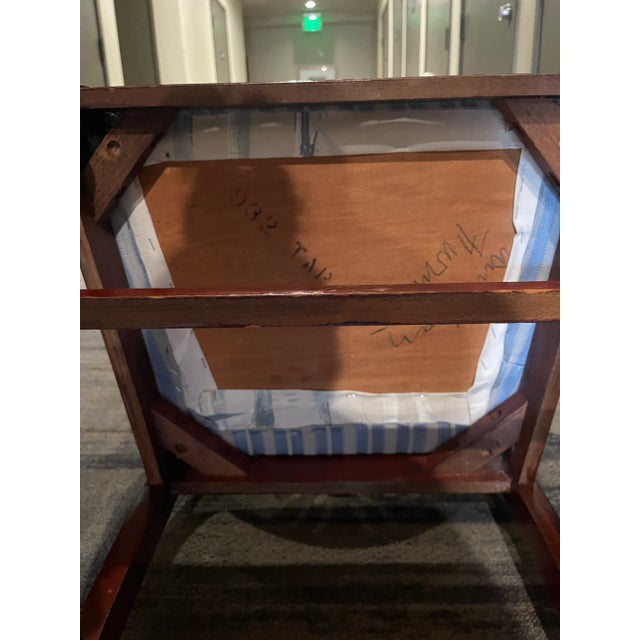
- This is an antique chair with signs of use and wear on the wood. The fabric has likely been reupholstered, … moreThis is an antique chair with signs of use and wear on the wood. The fabric has likely been reupholstered, and looks nice (though the edges are unfinished underneath, typical of a home-sewn job). It has a lovely look and style. The wood is marked in many areas and is likely in need of some sanding and refinishing work. less
Starting at 70% Off
Sale Ends Today! - Shop Now
Questions about the item?
Returns & Cancellations
Return Policy - All sales are final 48 hours after delivery, unless otherwise specified in the description of the product.
Cancellation Policy - Prior to shipping or local pickup, buyers may cancel an order for up to 48 hours, unless otherwise specified.
Related Collections
- Designmaster Furniture Dining Chairs
- Joe and Linda Ricchio Dining Chairs
- Medium-Density Fibreboard Dining Chairs
- Mid-Century Modern Dining Chairs in Los Angeles
- Sergio Rodrigues Dining Chairs
- Rancho Monterey Dining Chairs
- Laverne International Dining Chairs
- Katavolos, Littel, and Kelly Dining Chairs
- Ello Dining Chairs
- Giuseppe Scapinelli Dining Chairs
- R. J. Horner and Co. Dining Chairs
- Baker, Knapp and Tubbs Dining Chairs
- Art Deco Leather Dining Chairs
- Aksel Bender Madsen Dining Chairs
- Restoration Hardware Dining Chairs
- Thomasville Dining Chairs
- Ethan Allen Dining Chairs
- McGuire Dining Chairs
- Bentwood Dining Chairs
- Dining Chairs in New York
- Henredon Dining Chairs
- Wrought Iron Dining Chairs
- Hitchcock Dining Chairs
- French Country Dining Chairs
- Drexel Heritage Dining Chairs