







Details
Description
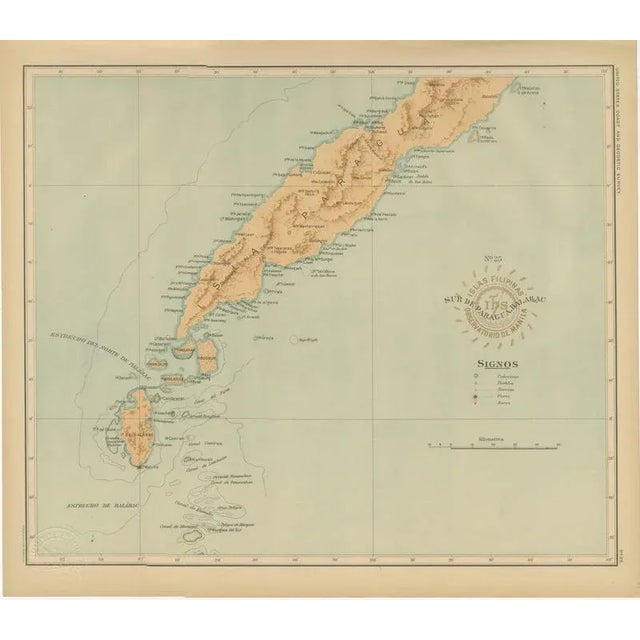
This original chromolithograph titled “islas filipinas – sur de paragua y balabac” was produced under the direction of rev. José …
Read more
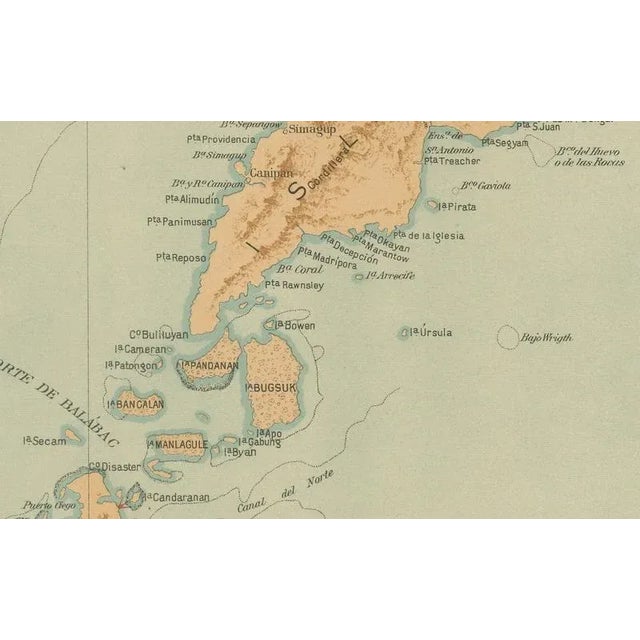
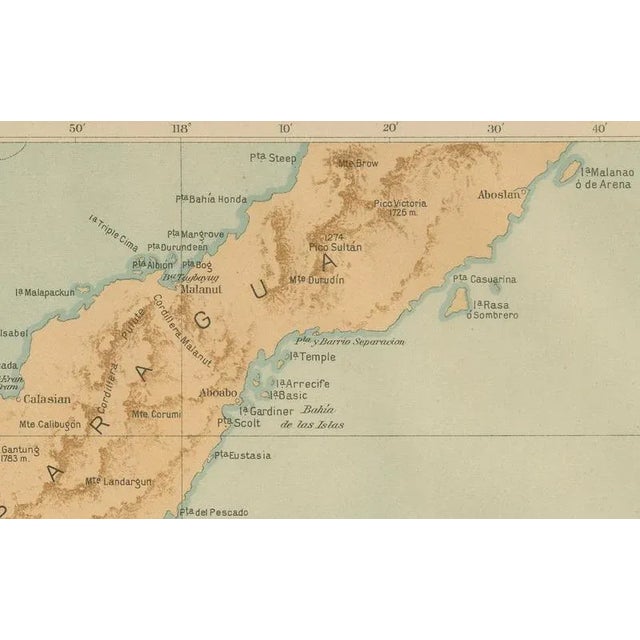
This original chromolithograph titled “islas filipinas – sur de paragua y balabac” was produced under the direction of rev. José algué, s.j., director of the observatorio de manila, and published in 1899 as plate no. 25 from the atlas de filipinas. It depicts the southern portion of palawan (then known as paragua) along with the remote balabac islands, situated at the southwestern edge of the philippine archipelago near borneo. The map captures the long, tapering form of palawan’s southern peninsula in remarkable detail, with finely shaded relief illustrating its mountainous interior and intricate coastal geography. Numerous settlements, bays, and small offshore islands are precisely identified, including the key towns of quezon, brooke’s point, and balabac. Maritime features such as the *estrecho del norte de balabac* and *estrecho de balábac* (the balabac strait) are clearly labeled, marking one of the main sea passages between the philippines and northern borneo. The legend (“signos”) identifies symbols for capitals, pueblos, barrios, and meteorological observatories, reflecting the jesuit observatory’s scientific methodology. The warm brown and soft aqua tones of the chromolithography create an elegant visual balance, highlighting both the rugged topography and surrounding marine environment. Stamped with the distinctive circular seal of the “observatorio de manila” and bearing the embossed emblem of the “u.s. Coast and geodetic survey,” this plate later appeared in the 1900 *atlas of the philippine islands*, published in washington by the u.s. Government printing office. The collaboration between filipino draftsmen and jesuit scientists produced what remains one of the finest examples of late 19th-century philippine scientific cartography.
condition: excellent, with bright original color, clean paper, and faint toning to the outer margins. Both embossed and inked institutional seals are sharp and legible.
technique: chromolithograph on paper maker: rev. José algué, s.j., observatorio de manila, 1899
See less
- Dimensions
- 14.57ʺW × 12.6ʺH
- Period
- Late 19th Century
- Country of Origin
- Philippines
- Item Type
- Vintage, Antique or Pre-owned
- Materials
- Paper
- Condition
- Good Condition, Unknown, Some Imperfections
- Color
- Brown
- Condition Notes
- Very Good — This vintage item has no defects, but it may show slight traces of use\. Condition: Excellent, with … moreVery Good — This vintage item has no defects, but it may show slight traces of use\. Condition: Excellent, with bright original color, clean paper, and faint toning to the outer margins. Both embossed and inked institutional seals are sharp and legible. less
Returns & Cancellations
Return Policy - All sales are final 48 hours after delivery, unless otherwise specified in the description of the product.
Cancellation Policy - Prior to shipping or local pickup, buyers may cancel an order for up to 48 hours, unless otherwise specified.