




Details
Description
Title: map of southern luzon and camarines provinces – observatorio de manila, 1899 : this chromolithographed map titled “islas filipinas …
Read more
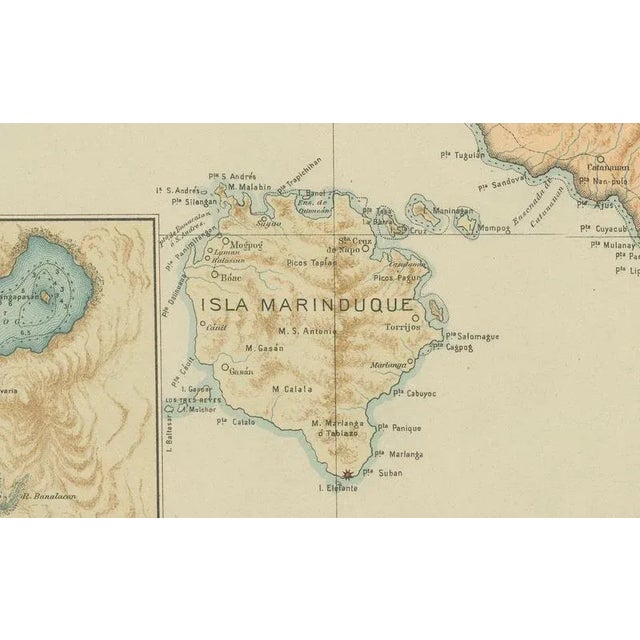
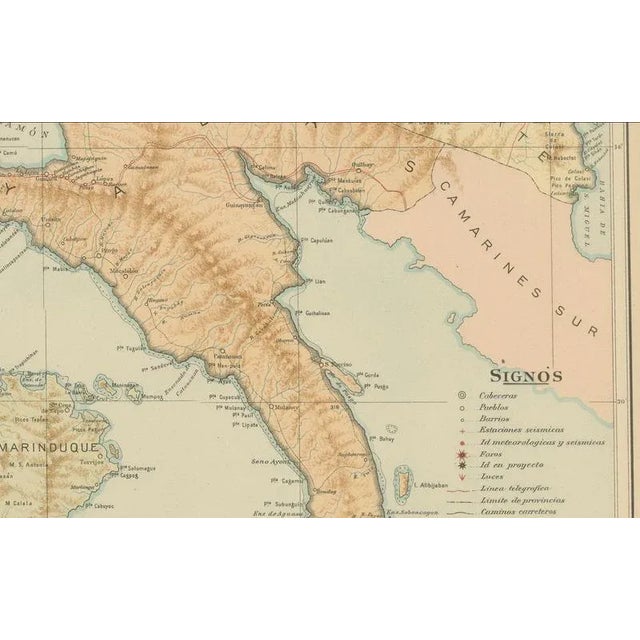
Title: map of southern luzon and camarines provinces – observatorio de manila, 1899 : this chromolithographed map titled “islas filipinas – luzón” was published in 1899 under the supervision of rev. José algué, s.j., director of the observatorio de manila, as plate no. 10 from the *atlas de filipinas*. It presents a finely detailed survey of southern luzon, focusing on the provinces of batangas, tayabas (now quezon), and the bicol region, including camarines norte and camarines sur. The map vividly portrays the topography of the region, with brown relief shading emphasizing the mountain ranges and volcanic terrain that dominate this part of the island. Key geographic features include the rugged bicol peninsula, the fertile plains of tayabas, and the surrounding coastal areas that open toward the sibuyan sea and the pacific ocean. The inset at the lower left provides a detailed view of isla marinduque and its surrounding waters, complete with depth markings and coastal soundings. Settlements, ports, and communication routes are clearly labeled, illustrating the extent of spanish colonial infrastructure and early american surveying efforts. The legend (“signos”) indicates the cartographic symbols used for observatories, telegraph lines, seismic and meteorological stations, and provincial boundaries. The red circular stamp of the “observatorio de manila” and the embossed seal of the “u.s. Coast and geodetic survey” confirm the official nature of this plate, later reissued in 1900 by the u.s. Government printing office in washington. This map exemplifies the scientific precision and aesthetic excellence of late 19th-century jesuit cartography. It combines rigorous geographic documentation with refined design, executed entirely by filipino draftsmen under jesuit direction. As part of the *atlas de filipinas*, it contributed significantly to modern geographical understanding of the philippine archipelago at the turn of the century.
condition: excellent, with strong original color and minimal toning to the wide margins. The paper is clean and supple, with crisp impressions of both embossed and inked institutional seals.
technique: chromolithograph on paper maker: rev. José algué, s.j., observatorio de manila, 1899
See less
- Dimensions
- 14.57ʺW × 12.6ʺH
- Period
- Late 19th Century
- Country of Origin
- Philippines
- Item Type
- Vintage, Antique or Pre-owned
- Materials
- Paper
- Condition
- Good Condition, Unknown, Some Imperfections
- Color
- Beige
- Condition Notes
- Very Good — This vintage item has no defects, but it may show slight traces of use\. Condition: Excellent, with … moreVery Good — This vintage item has no defects, but it may show slight traces of use\. Condition: Excellent, with strong original color and minimal toning to the wide margins. The paper is clean and supple, with crisp impressions of both embossed and inked institutional seals. less
Returns & Cancellations
Return Policy - All sales are final 48 hours after delivery, unless otherwise specified in the description of the product.
Cancellation Policy - Prior to shipping or local pickup, buyers may cancel an order for up to 48 hours, unless otherwise specified.