



Details
Description
This beautifully detailed chromolithographed map titled “islas filipinas – isla de leyte” was created under the supervision of rev. José …
Read more
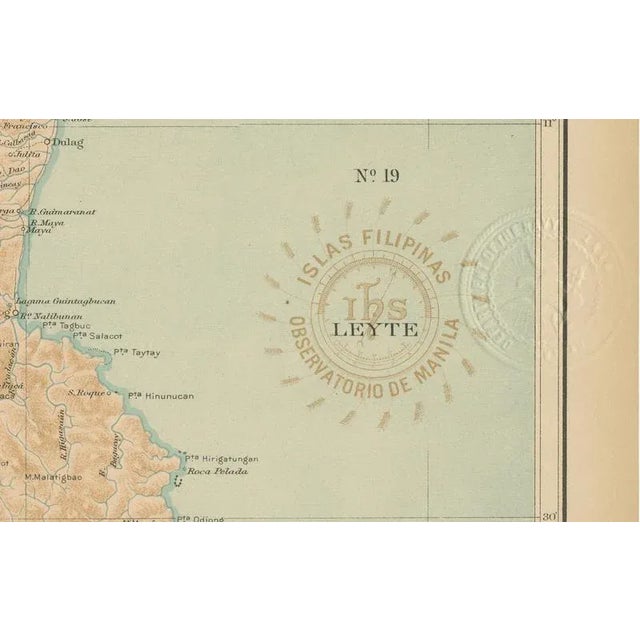
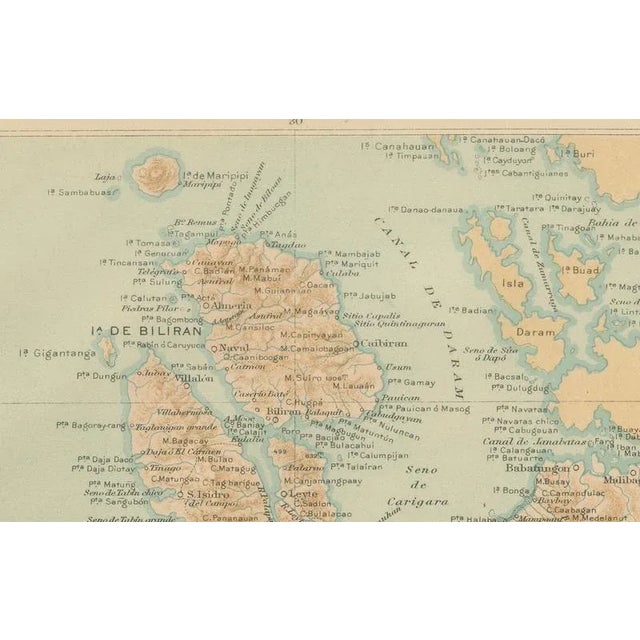
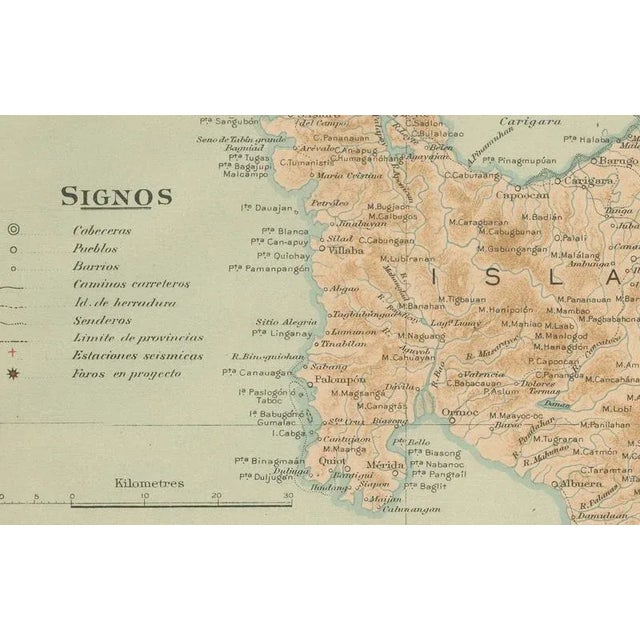
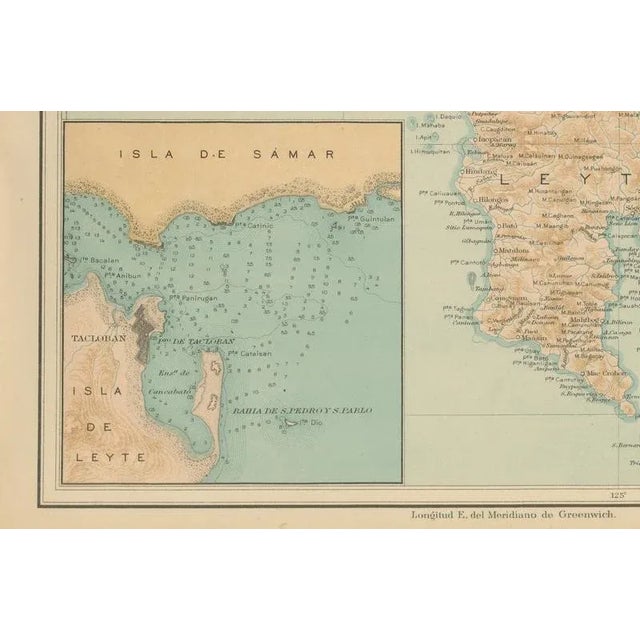
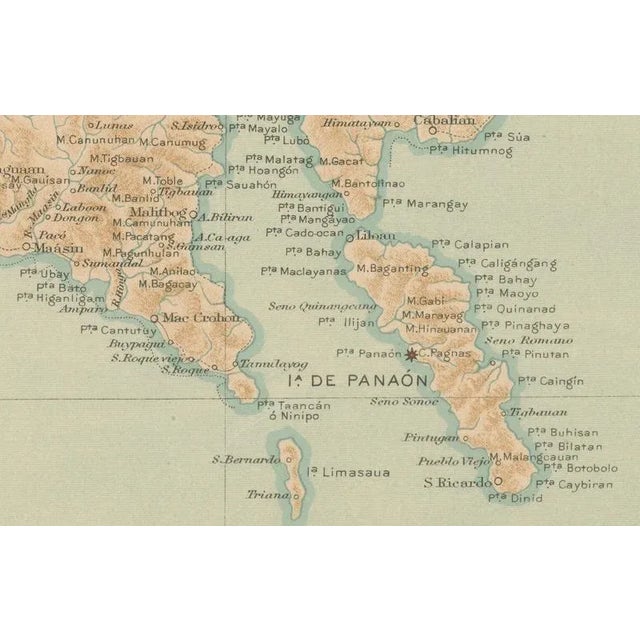
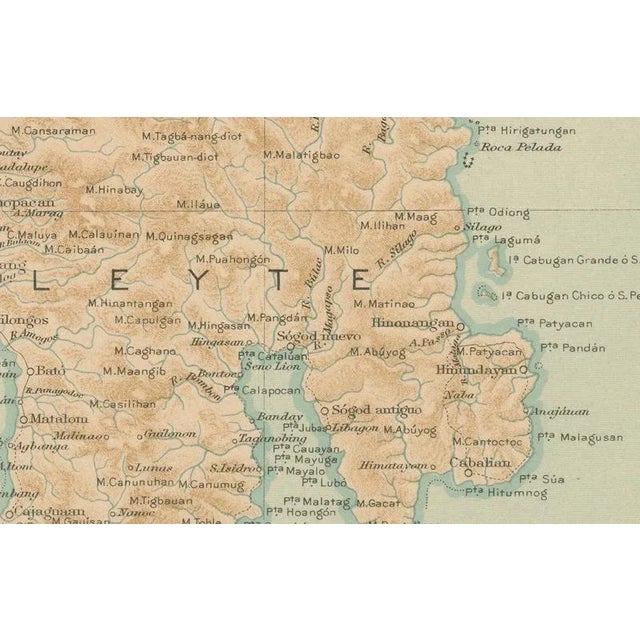
This beautifully detailed chromolithographed map titled “islas filipinas – isla de leyte” was created under the supervision of rev. José algué, s.j., director of the observatorio de manila, and published in 1899 as plate no. 19 from the atlas de filipinas. It depicts the island of leyte in remarkable topographical and hydrographic detail, along with adjacent islands including biliran, the camotes group, and parts of samar to the north and east.
the map’s composition reflects the hallmark precision of the jesuit observatory’s cartography, combining scientific clarity with visual elegance. Brown-shaded relief illustrates the mountainous interior of leyte, while river systems, towns, and coastal settlements are finely labeled in black. The surrounding seas are rendered in soft aqua tones, accentuating the island’s intricate coastline and maritime geography. An inset at the lower left offers a close-up view of the channel between samar and leyte, focusing on tacloban bay and the strait of san juanico, famous today for its bridge linking the two islands. The map’s legend (“signos”) identifies administrative centers, towns, barrios, and planned meteorological stations, all part of the jesuits’ early efforts to combine geography with meteorology and seismology. Stamped with the circular insignia of the “observatorio de manila” and embossed with the seal of the “u.s. Coast and geodetic survey,” this plate formed part of the 1900 *atlas of the philippine islands*, published by the u.s. Government printing office in washington. Originally drawn by native filipino draftsmen under jesuit direction, this work bridges spanish colonial science and early american administrative mapping, offering one of the most accurate late-19th-century depictions of leyte and its surrounding islands.
condition: excellent, with bright original color, clean margins, and light toning consistent with age. Embossed and inked institutional seals remain crisp and fully legible.
technique: chromolithograph on paper maker: rev. José algué, s.j., observatorio de manila, 1899
See less
- Dimensions
- 12.6ʺW × 14.57ʺH
- Period
- Late 19th Century
- Country of Origin
- Philippines
- Item Type
- Vintage, Antique or Pre-owned
- Materials
- Paper
- Condition
- Good Condition, Unknown, Some Imperfections
- Color
- Black
- Condition Notes
- Very Good — This vintage item has no defects, but it may show slight traces of use\. Condition: Excellent, with … moreVery Good — This vintage item has no defects, but it may show slight traces of use\. Condition: Excellent, with bright original color, clean margins, and light toning consistent with age. Embossed and inked institutional seals remain crisp and fully legible. less
Returns & Cancellations
Return Policy - All sales are final 48 hours after delivery, unless otherwise specified in the description of the product.
Cancellation Policy - Prior to shipping or local pickup, buyers may cancel an order for up to 48 hours, unless otherwise specified.