




Details
Description
A striking Bandaji from Nothern part of the Korean peninsula circa 19th century of late Joseon Dynasty. Bandaji is known …
Read more
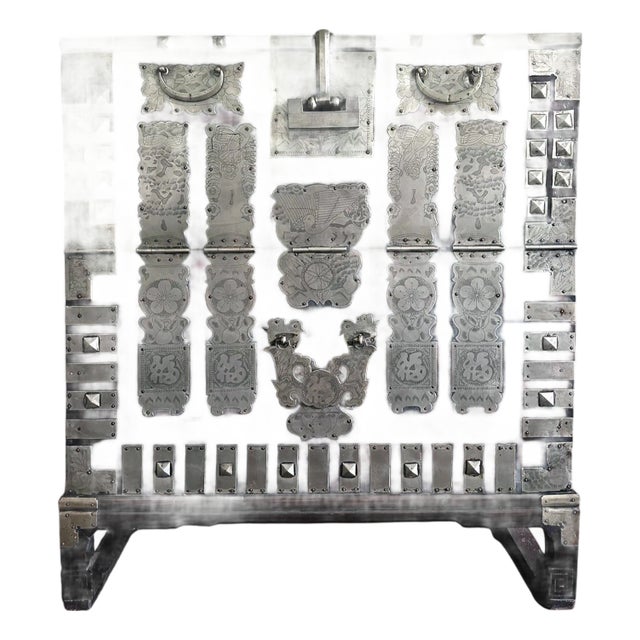
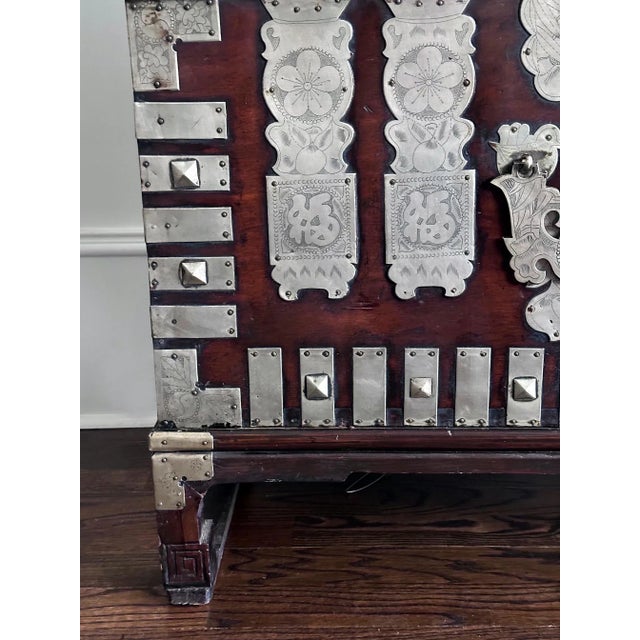
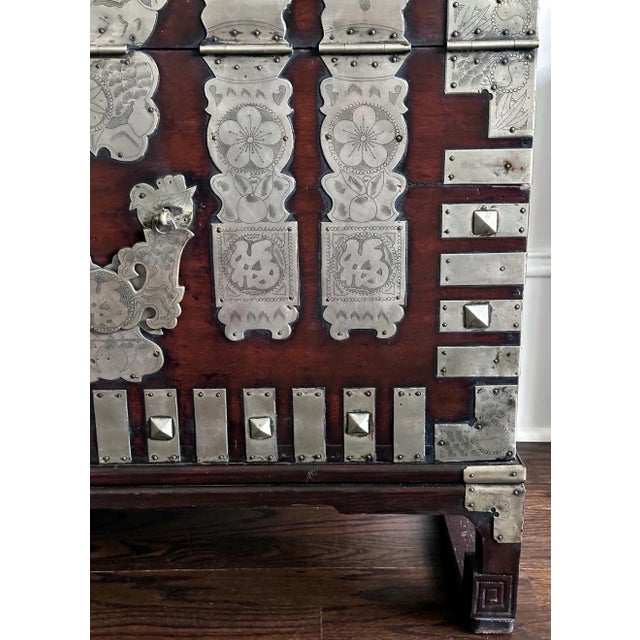
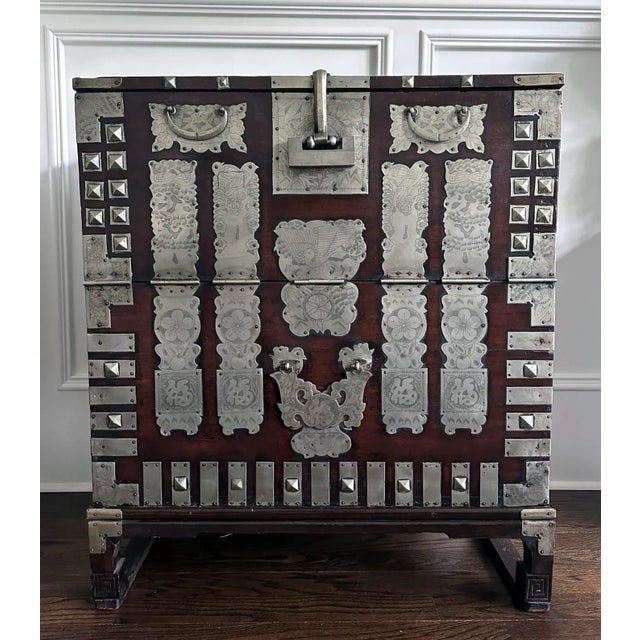
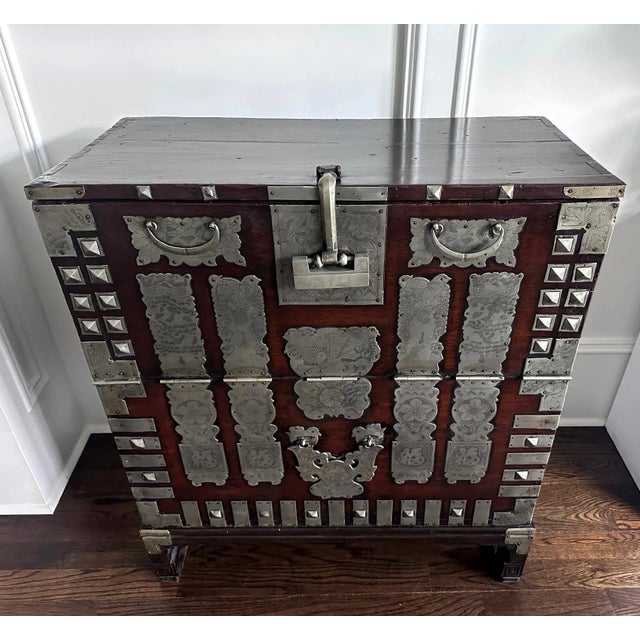
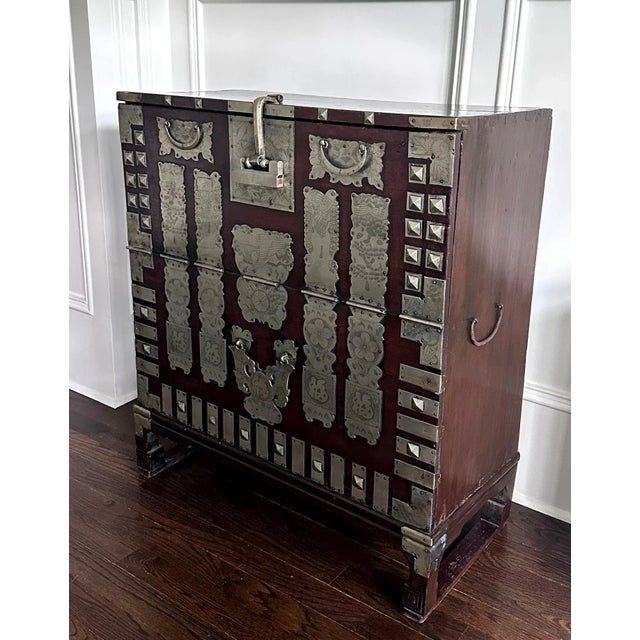
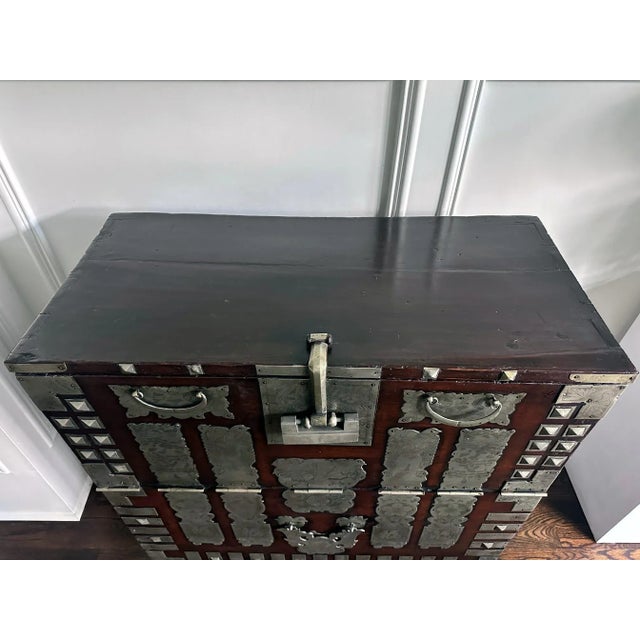
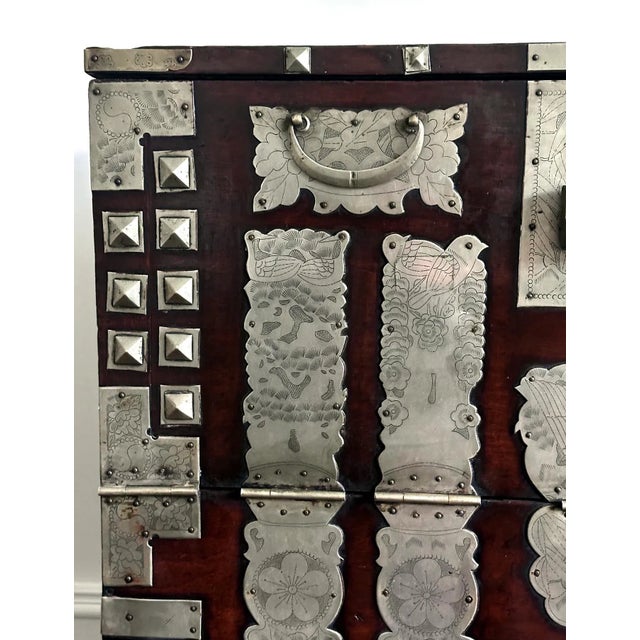
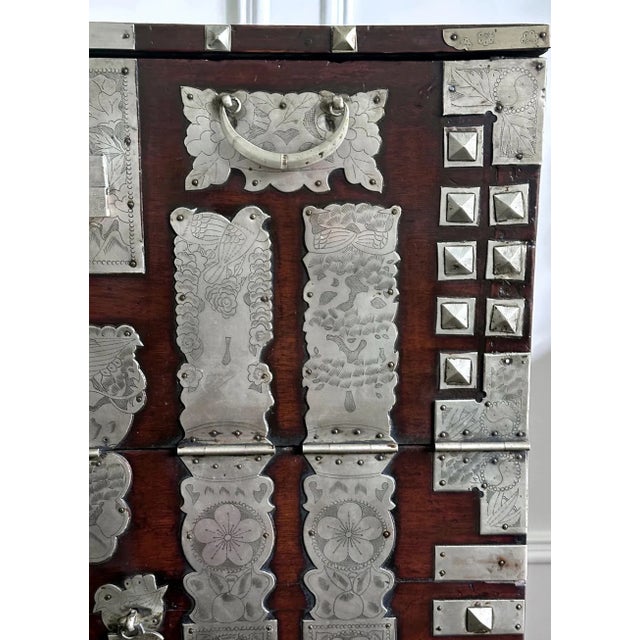
A striking Bandaji from Nothern part of the Korean peninsula circa 19th century of late Joseon Dynasty. Bandaji is known as drop front half-opening chest that was used in traditional Korean households to store family valuables and beddings. This large Bandaji was made in Pyongyang area in now North Korea. Constructed in limewood, which is rather plain and lacks prominent grains, the chest was instead sumptuously decorated with nickel-copper (Paktong) plates, stripes and studs. Covering nearly the entire front of the cabinet, the metal plates were placed with eye-pleasing symmetry in mind. The surface of the eight large vertical plates was etched with motifs of floral and bird motifs on the top rows and Chinese character Fu "Good Fortune" in a roundel on the bottom row. Similar designs were also placed on the large lock plate and the center plate with a large pendant. The chest has iron handle on the sides and is supported by a base with conforming decorative metal plates and hoof feet carved with archaic key pattern connected with horizontal bars. The interior retains most paper lining. There is an inner shelf, but no drawers as shown. The lock and key are present and in working order.
Examining the piece, it is evident that it is in its original condition with all metal pieces intact. It was probably taken from North to South Korean before it travelled with the owner to America. It is an antique piece that shows deep patina with evidence of being used extensively, and in our opinion, that is where the beauty truly lies. It presents with a strong sense of history and human stories.
Among the collection of the Korean furniture, the largest in the world, in Weisman Art Museum at the University of Minnesota in Minneapolis, Minnesota, there is a nearly identical Bandaji (shown in the last picture; item no.1987.22.47). The placement of all the metal plates and the detailed decoration on the plates are very much comparable. It is likely that they share a very similar if not the same origin and maker.
The same chest is also illustrated on plate 32 on page 52 in the book "Traditional Korean Furniture" by Edward Reynolds Wright and Man Sill Pai.
See less
- Dimensions
- 36ʺW × 17ʺD × 41.5ʺH
- Styles
- Asian Antique
- Period
- 19th Century
- Country of Origin
- Korea, Republic of
- Item Type
- Vintage, Antique or Pre-owned
- Materials
- Metal
- Wood
- Condition
- Good Condition, Unknown, Some Imperfections
- Color
- Silver
- Condition Notes
- Fair Wear consistent with age and use. Original, pervasive, attractive patina with old bumps, nicks and scratches. Top, back and … moreFair Wear consistent with age and use. Original, pervasive, attractive patina with old bumps, nicks and scratches. Top, back and front with old crack line and gouges. All metal parts are original/intact and with verdigris at places, Interior retains residues of old degrading paper lining. less
Questions about the item?
Returns & Cancellations
Return Policy - All sales are final 48 hours after delivery, unless otherwise specified in the description of the product.
Cancellation Policy - Prior to shipping or local pickup, buyers may cancel an order for up to 48 hours, unless otherwise specified.
Related Collections
- Trunks and Blanket Chests in Santa Fe
- Minimalism Trunks and Blanket Chests
- Hide Trunks and Blanket Chests
- Steamer Trunks
- Wicker Trunks and Blanket Chests
- Antique Trunks
- Mid-Century Modern Trunks and Blanket Chests
- Asian Trunks and Blanket Chests
- Storage Trunks
- Italian Trunks and Blanket Chests
- Dark Green Trunks and Blanket Chests
- Trunks and Blanket Chests in Chicago
- Antique Brass Finish Trunks and Blanket Chests
- Khaki Trunks and Blanket Chests