

Details
Description
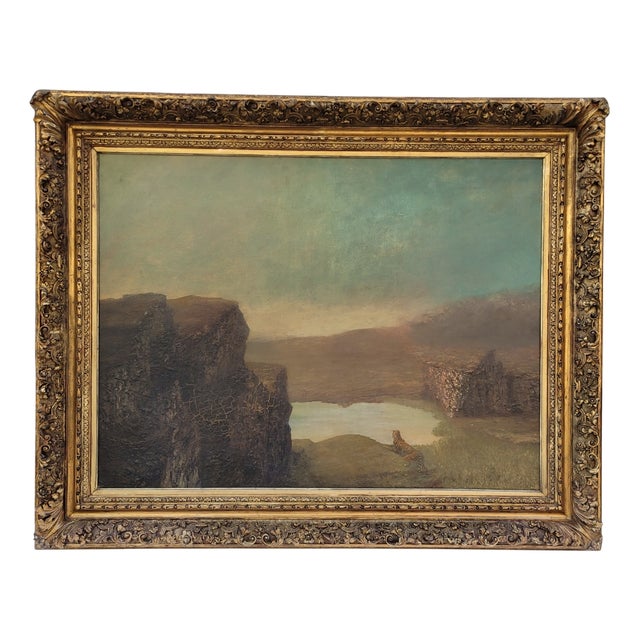
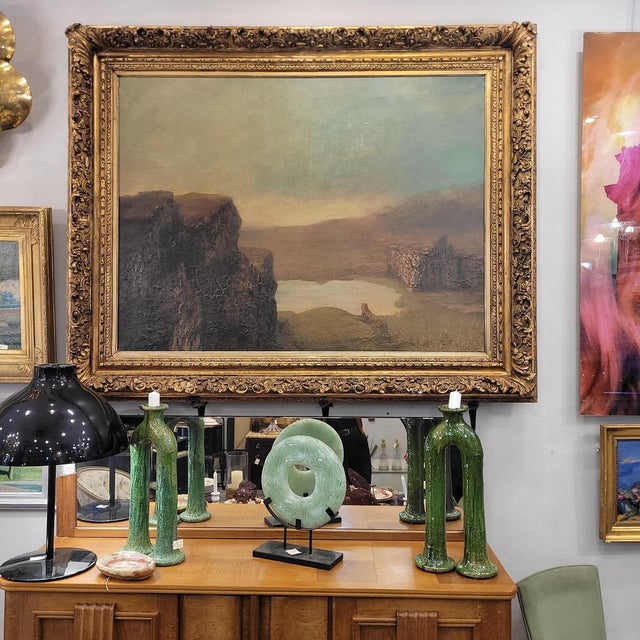
“Tiger before a Dreamlike Landscape,” Romanticism, 19th Century – England
Media: Oil on canvas
Title of the work: “Tiger in …
Read more
“Tiger before a Dreamlike Landscape,” Romanticism, 19th Century – England
Media: Oil on canvas
Title of the work: “Tiger in a Romantic Landscape”
Period: 19th Century
Country of Origin: England
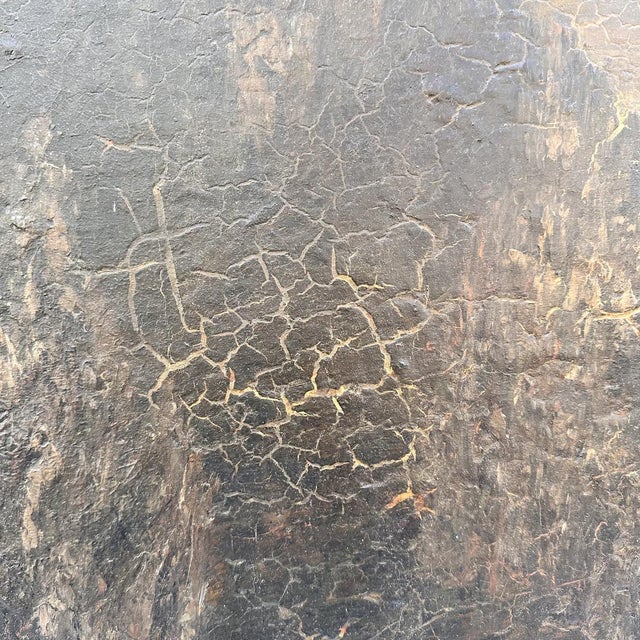
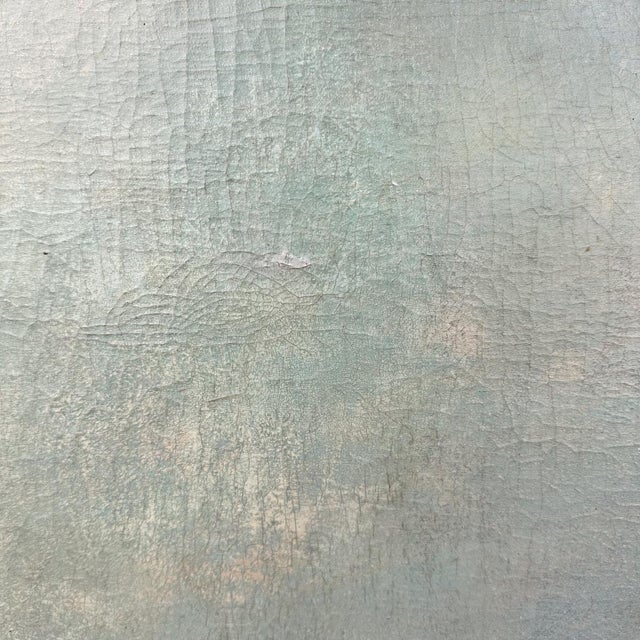
Good condition commensurate with age and use / Frame recently restored
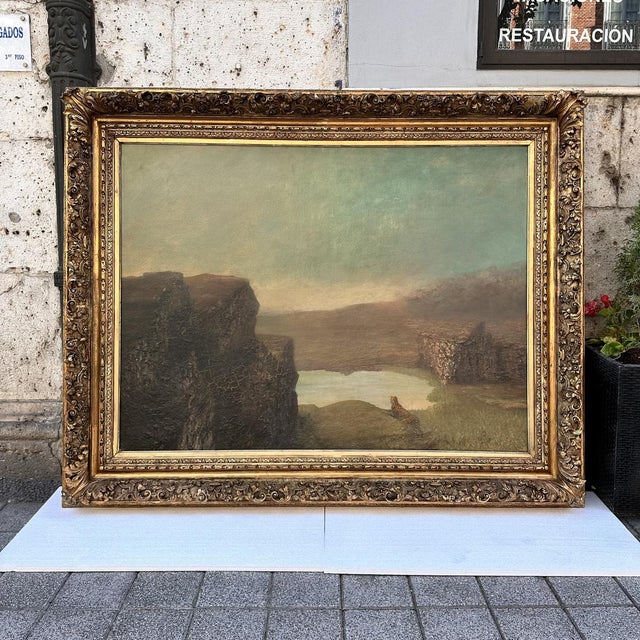
Overall dimensions: 150 x 184 x 12 cm
Unframed dimensions: 110 x 145 cm
Exceptional large-format English Romantic landscape. This is a very powerful work, with a melancholic and contemplative character, in which nature takes center stage, characteristic of the Romantic spirit.
The emergence of Romantic painting is framed as a response to the rationalism of the Enlightenment and the academic rigidity of Neoclassicism. Inspired by the ideals of freedom, the exaltation of the individual, and the power of the imagination, Romantic artists sought to express intense and subjective emotions, moving away from formal perfection to exalt the dramatic, the sublime, and the spiritual. Nature became a setting charged with symbolism, and painting became a medium for exploring both the grandeur and fragility of the human condition.
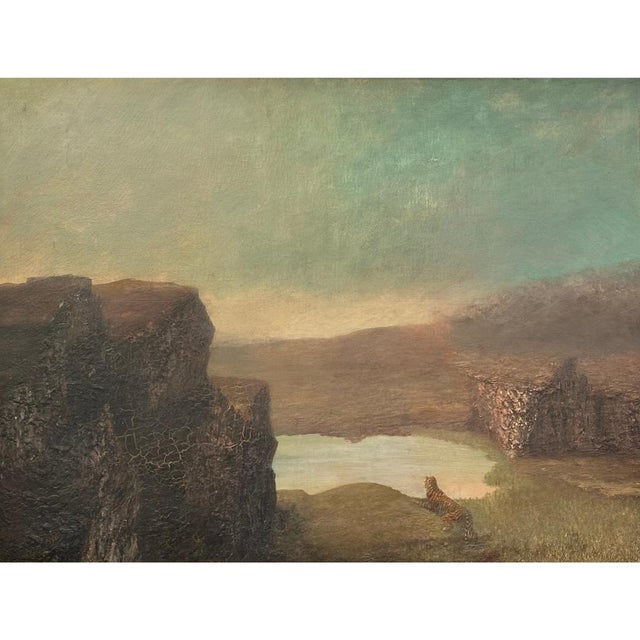
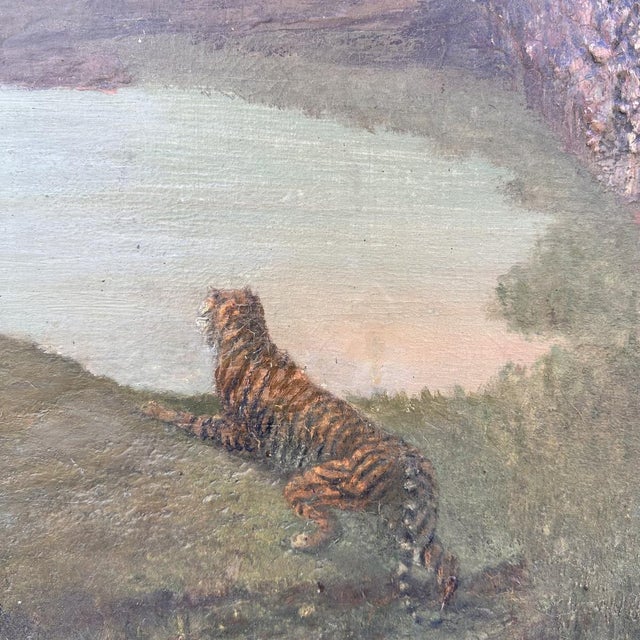
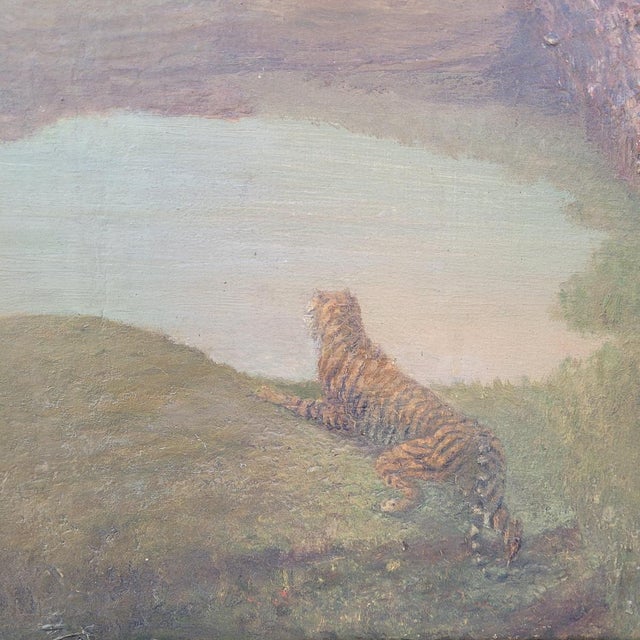
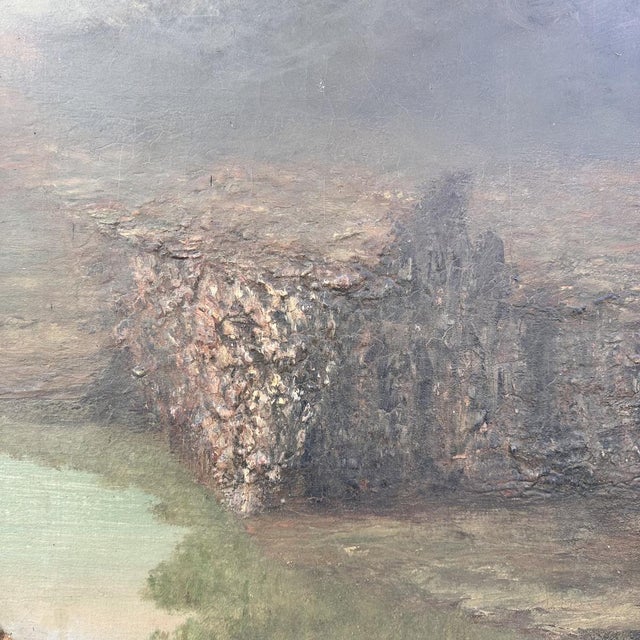
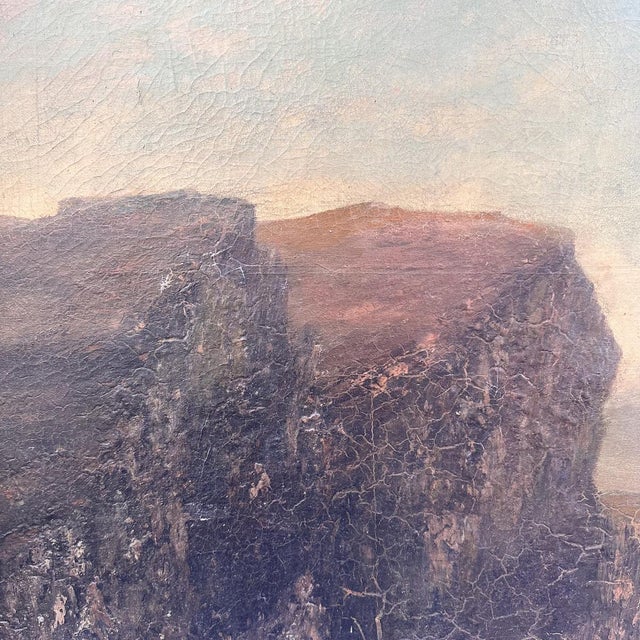
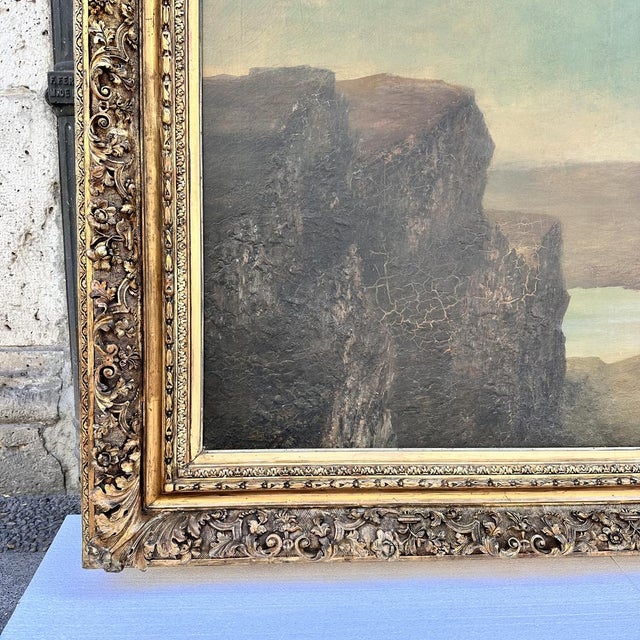
In this case, the composition is organized around a foreground dominated by rock formations that open onto a dimly lit valley, where a small lake appears. Near the brightest area by the water, the figure of a recumbent tiger can be distinguished. The horizon, bathed in golden tones that blend with a blue-green sky, suggests a transient moment in the day, likely sunrise or sunset, which contributes to the Romantic vision of the landscape as an emotional and spiritual space. The contrast between the shadows of the cliffs and the clarity of the horizon is also striking.
As for the color scheme, an earthy and sober palette predominates, based on earth tones, ochres, and muted or undersaturated greens, which contrast with the soft luminosity of the sky, where a diffuse, golden atmosphere can be appreciated, reinforcing the introspective and melancholic character of the scene. This creates an even dreamlike landscape. The brushstrokes are soft, diffused in the sky and denser in the rock formations, creating a balance between the solid and the ethereal. This gives a very realistic sense of spatial depth that requires great skill on the part of the painter.
A particularly significant detail is the presence of the tiger, whose incorporation transforms the interpretation of the work. Far from being a simple naturalistic element, the animal introduces a symbolic nuance: it represents the wild and the instinctive, forces that coexist with the apparent calm of the landscape. This device intensifies the mysterious and allegorical character of the scene, inviting the viewer to reflect on (perhaps) human fragility in the face of the untamable and wild.
At this point, it's important to note that during Romanticism (late 18th to mid-19th centuries), literature and painting were deeply connected, sharing themes, styles, and a worldview marked by emotion and subjectivity, inspiring each other. Many painters were inspired by literary works (especially those of Shakespeare, Goethe, and Byron), while painters described their landscapes or scenes with an almost pictorial tone. Both relied on symbolic and subjective representation.
There are several literary passages that mention a tiger in a landscape and could have inspired this work, but William Blake's "The Tyger" (1794) is the most famous poem about a tiger in English literature. Also worth mentioning is Jorge Luis Borges's "Tigers' Gold," which describes a tiger in a dreamlike setting that could be reminiscent of this painting.
For all these reasons, the work primarily belongs to Romanticism, as it exalts nature as a sublime force and creates a melancholic atmosphere that transcends . However, the inclusion of the tiger introduces a symbolic component, functioning as a metaphor for the hidden and the instinctive, very much in keeping with the spirit of that period. This painting invites the viewer to pause and contemplate the immensity of the landscape, evoking feelings of human insignificance in the face of nature's grandeur.
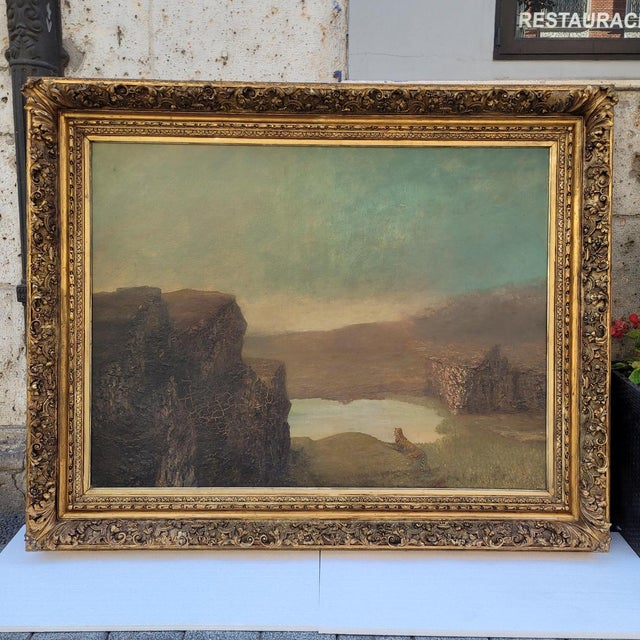
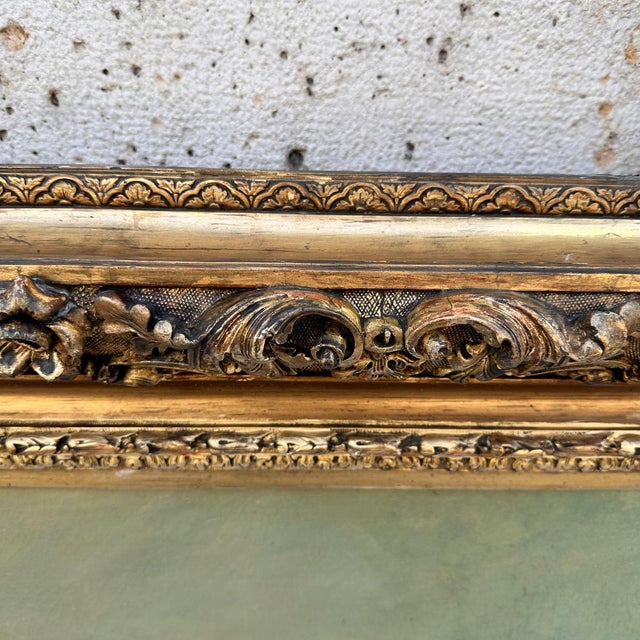
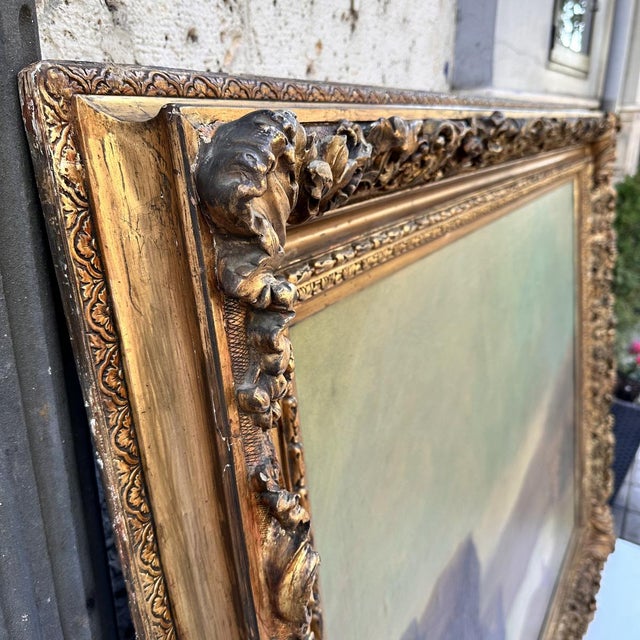
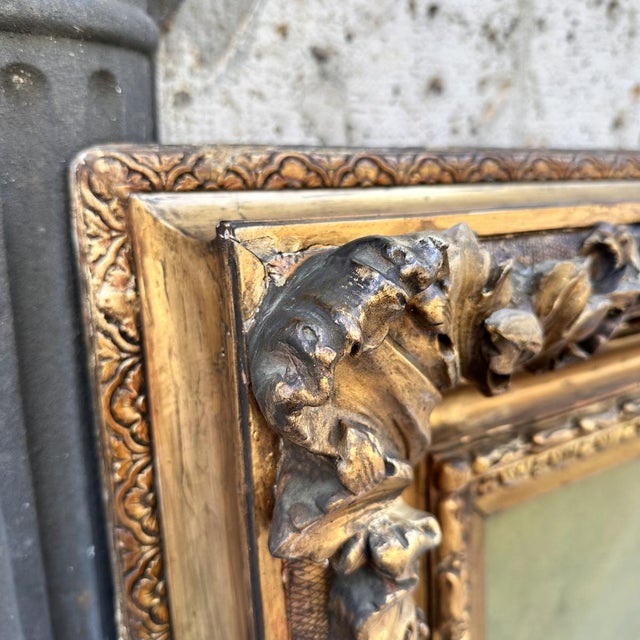
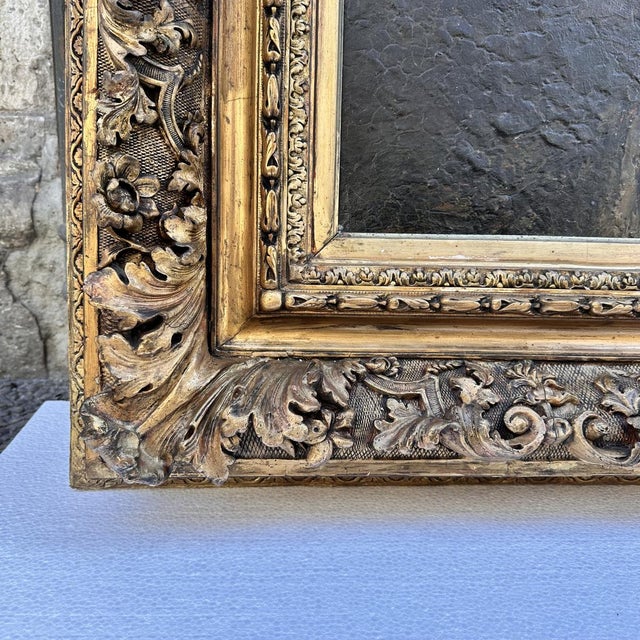
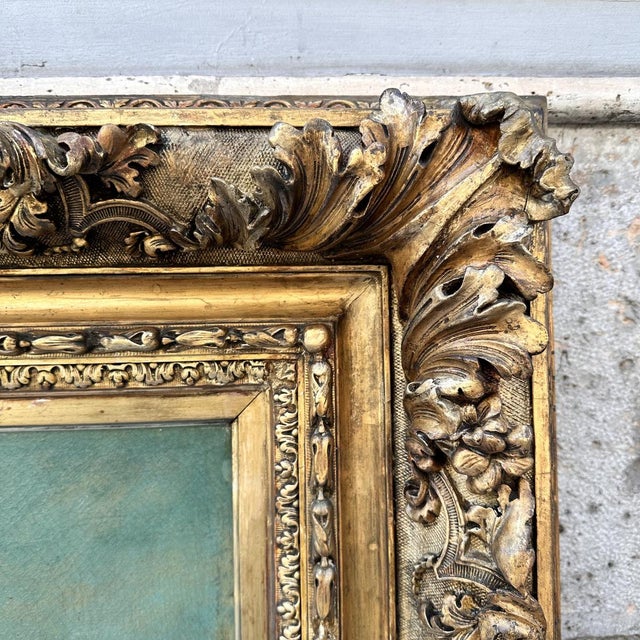
The ornate frame emphasizes the work's importance. It has been recently restored to its original gilding.
The frame protecting the work is offered as a gift, but it has value in itself. This frame is provided at no additional cost so that when your artwork arrives at your home or destination, it can be displayed immediately. Any damage to the frame itself, which does not affect the integrity of the artwork, cannot be accepted as a valid reason to open a claim or request a cancellation.
See less
- Dimensions
- 72.44ʺW × 4.72ʺD × 59.06ʺH
- Period
- 19th Century
- Country of Origin
- United Kingdom
- Item Type
- Vintage, Antique or Pre-owned
- Condition
- Good Condition, Unknown, Some Imperfections
- Color
- Brown
- Condition Notes
- Partially Restored Partially Restored less
Returns & Cancellations
Return Policy - All sales are final 48 hours after delivery, unless otherwise specified in the description of the product.
Cancellation Policy - Prior to shipping or local pickup, buyers may cancel an order for up to 48 hours, unless otherwise specified.
Related Collections
- Ralph Lauren Paintings
- Ed Ruscha Paintings
- Photorealism Canvas Paintings
- Photorealism Paintings in New York
- Silk Velvet Paintings
- Herman Miller Paintings
- Louise Nevelson Paintings
- Richard Serra Paintings
- Jaanika Peerna Paintings
- Jo Baskerville Paintings
- Jean-Paul Barray Paintings
- Hans Andersen Paintings
- Johannes Andersen Paintings
- Peter Behrens Paintings
- Raphael Paintings
- Photorealism Paintings in Los Angeles
- Carl-Axel Acking Paintings
- Joseph Stella Paintings
- Karl-Erik Ekselius Paintings
- Pedro Friedeberg Paintings
- Piet Hein Eek Paintings
- Black Photorealism Paintings
- Cassina Paintings
- BDDW Paintings
- James McCray Paintings