



Details
Description
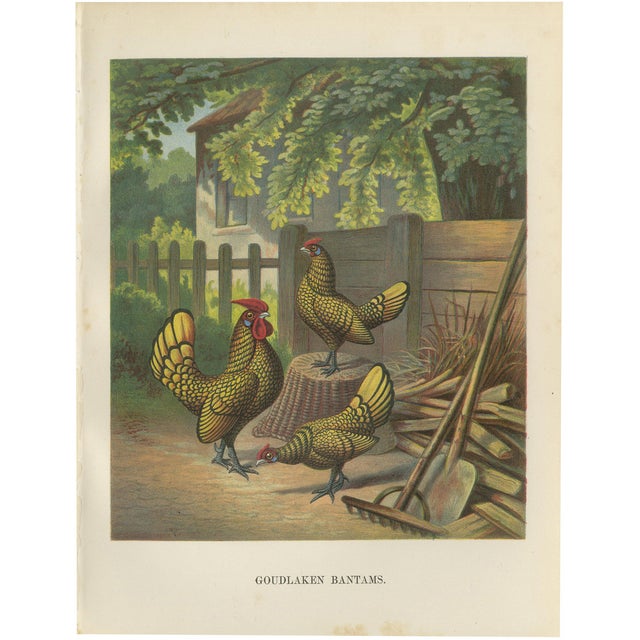
The golden-laced bantam a rare 19th century poultry lithograph this beautifully detailed 19th-century chromolithograph depicts a charming group of golden-laced … Read more The golden-laced bantam a rare 19th century poultry lithograph this beautifully detailed 19th-century chromolithograph depicts a charming group of golden-laced bantams, a breed known for its striking golden plumage outlined with black lacing. The print, titled goudlaken bantams, originates from geïllustreerd hoenderboek, an illustrated poultry book published in 1888 by elsevier. Compiled by julius volschau and adapted for dutch readers by dr. A. C. Oudemans jzn., this book provided an extensive guide to poultry breeding, focusing on both productive and ornamental breeds. Golden-laced bantams, often associated with the sebright breed, are one of the most visually striking chicken varieties. Their compact size, refined body shape, and intricate feather patterning make them highly desirable among poultry enthusiasts. The precise black lacing on their golden feathers creates a stunning contrast, giving them a jewel-like appearance. These birds were bred primarily for ornamental purposes, valued for their elegance rather than egg production or meat yield. In this lithograph, a proud rooster stands with an upright posture, displaying his full plumage while two hens and a young bird forage nearby. The rural background, featuring a fenced garden, rustic tools, and a thatched-roof cottage, enhances the pastoral charm of the scene. This idyllic setting reflects the traditional farmyard environment where such birds would have been cherished for their beauty and lively nature. This lithograph was created using chromolithography, a sophisticated 19th-century printing process that allowed for richly detailed and vividly colored illustrations. The artwork is based on an original drawing by christian förster, a renowned animal illustrator of the period. Chromolithography involved layering multiple colors, each applied with a separate stone plate, to achieve depth, shading, and intricate feather details. The level of detail in rendering the delicate lacing and smooth color transitions in this lithograph showcases the mastery of this printing technique. Condition summary the print is in very good condition, with its colors remaining vibrant and well-preserved. Some minor age-related toning and light foxing are visible along the edges, a common characteristic of lithographs from this period. The paper remains stable, with minimal signs of wear, making this an excellent collectible for antique poultry print enthusiasts and historical agricultural collectors. Framing tips to best preserve and display this lithograph, consider the following framing techniques - use acid-free matting to prevent long-term deterioration. A warm cream or soft gold mat will enhance the golden tones of the birds' feathers - choose uv-protective glass to safeguard the colors from fading due to light exposure - a wooden frame in rich mahogany, antique gold, or classic black will complement the intricate feather lacing and rustic farm setting - float mounting can be used if the original paper edges are to be highlighted, adding a historical and museum-quality presentation this lithograph is an exceptional example of 19th-century poultry illustration, capturing the elegance and refinement of one of the most ornamental chicken breeds. Whether displayed in a farmhouse, study, or antique print collection, it remains a timeless and historically significant piece of agricultural art. See less
- Dimensions
- 7.87ʺW × 10.63ʺH
- Art Subjects
- Animals
- Period
- Late 19th Century
- Item Type
- Vintage, Antique or Pre-owned
- Materials
- Paper
- Condition
- Good Condition, Unknown, Some Imperfections
- Color
- Black
- Condition Notes
- Very Good — This vintage item has no defects, but it may show slight traces of use\. The print is … moreVery Good — This vintage item has no defects, but it may show slight traces of use\. The print is in very good condition, with its colors remaining vibrant and well-preserved. Some minor age-related toning and light foxing are visible along the edges, a common characteristic of lithographs from this period. less
Returns & Cancellations
Return Policy - All sales are final 48 hours after delivery, unless otherwise specified in the description of the product.
Cancellation Policy - Prior to shipping or local pickup, buyers may cancel an order for up to 48 hours, unless otherwise specified.
Related Collections
- Reproduction Prints in Panama City, FL
- Alvar Aalto Reproduction Prints
- Daylight Dream Editions Reproduction Prints
- Polychrome Reproduction Prints
- Gold-Plate Reproduction Prints
- William Hogarth Reproduction Prints
- Sam Francis Reproduction Prints
- Leather Reproduction Prints
- Jute Reproduction Prints
- Utagawa Kunisada (Toyokuni Iii) Reproduction Prints
- Reproduction Prints in Mobile
- Ethan Allen Reproduction Prints
- Paule Marrot Reproduction Prints
- Jim Dine Reproduction Prints
- Qing Reproduction Prints
- Francis Orpen Morris Reproduction Prints