



Details
Description
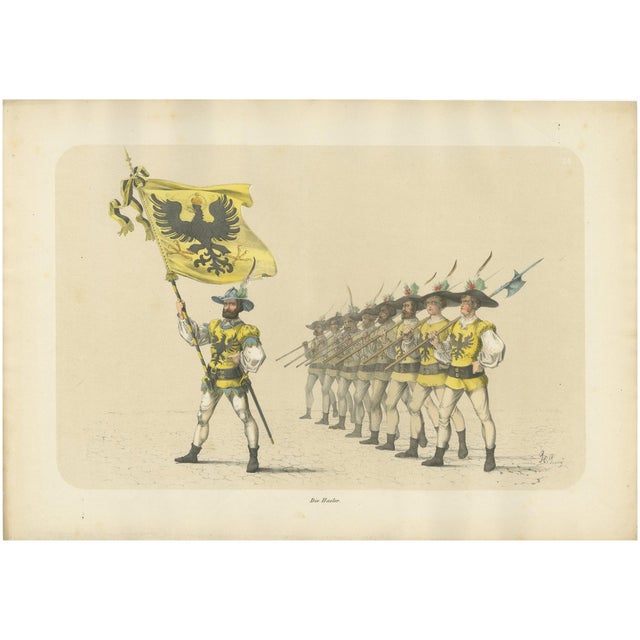
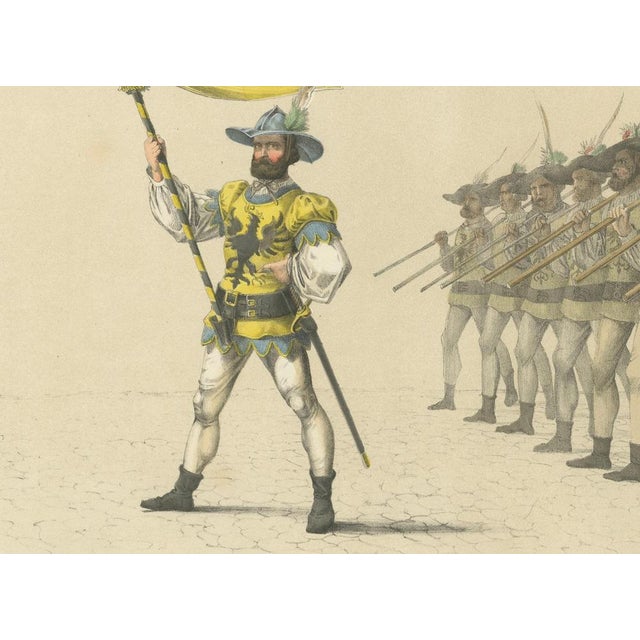
March of the Imperial Guards in the Bernese Festive Procession This exquisite hand-colored lithograph is part of the 'Fest Album … Read more March of the Imperial Guards in the Bernese Festive Procession This exquisite hand-colored lithograph is part of the 'Fest Album Celebrating Bern’s Entry into the Swiss Confederation on March 6, 1353', a commemorative work published in Bern and Zurich in 1855. This large folio series was produced to mark the 500th anniversary of Bern’s alliance with the Swiss Confederation, visually chronicling the grand historical pageant held in its honor. The album showcases a magnificent festival procession featuring historical figures, cantonal representatives, and prominent guild groups, each rendered in splendid period costume. This particular lithograph, created by H. Jenny and lithographed by Kümmerly and Wittmer, presents a disciplined march of imperial guards, known as "die Hasler." The men are dressed in striking yellow tunics emblazoned with the double-headed black eagle, an unmistakable symbol of the Holy Roman Empire. This imagery reflects Bern’s historical ties with the Empire, an affiliation that played a crucial role in shaping the city’s political and military standing during the late medieval period. Leading the march is a standard-bearer, confidently holding aloft a large imperial banner featuring the crowned double-headed eagle on a rich golden background. His attire, which includes a plumed hat and a finely detailed tunic, underscores his rank and role as the flag carrier. Behind him, the guards march in perfect unison, carrying halberds on their shoulders. The carefully composed scene conveys a sense of military order and grandeur, with the soldiers’ uniformity emphasizing the disciplined and formidable presence of Bern’s defenders. The depiction of the imperial eagle is a testament to Bern’s long-standing relationship with the Holy Roman Empire. In the medieval period, Bern was granted imperial immediacy, meaning it was directly under the Emperor’s authority rather than a local feudal lord. This privileged status contributed to the city’s autonomy and strategic importance in the region. Over time, Bern asserted its independence, ultimately aligning itself with the Swiss Confederation, an alliance commemorated in this remarkable festival. Condition: This print is in excellent condition, with only minor signs of age, including occasional light foxing along the margins. The hand-coloring remains vibrant, particularly in the golden hues of the banners and uniforms, which contrast beautifully with the pale background. Framing Tips: To best showcase this lithograph, a dark wood or gold-gilded frame would be ideal, complementing the imperial color scheme. A neutral or cream-colored museum mat will enhance the contrast between the artwork and the frame, ensuring the fine details stand out. Using UV-protective glass is highly recommended to preserve the richness of the hand-applied colors over time. This print is a valuable historical piece, reflecting Bern’s deep-rooted ties to the Holy Roman Empire and the grandeur of its commemorative celebrations. It is an outstanding addition for collectors of Swiss history, military pageantry, and historical costume studies. See less
- Dimensions
- 19.29ʺW × 13.39ʺH
- Art Subjects
- Figure
- Period
- Mid 19th Century
- Item Type
- Vintage, Antique or Pre-owned
- Materials
- Paper
- Condition
- Good Condition, Unknown, Some Imperfections
- Color
- Black
- Condition Notes
- Very Good — This vintage item has no defects, but it may show slight traces of use\. This print is … moreVery Good — This vintage item has no defects, but it may show slight traces of use\. This print is in excellent condition, with only minor signs of age, including occasional light foxing along the margins. The hand-coloring remains vibrant, particularly in the golden hues of the banners and uniforms. less
Returns & Cancellations
Return Policy - All sales are final 48 hours after delivery, unless otherwise specified in the description of the product.
Cancellation Policy - Prior to shipping or local pickup, buyers may cancel an order for up to 48 hours, unless otherwise specified.
Related Collections
- Patrick Nagel Reproduction Prints
- Reproduction Prints in Panama City, FL
- Sam Francis Reproduction Prints
- Jute Reproduction Prints
- Leather Reproduction Prints
- Utagawa Kunisada (Toyokuni Iii) Reproduction Prints
- Reproduction Prints in Mobile
- Daylight Dream Editions Reproduction Prints
- Alvar Aalto Reproduction Prints
- William Hogarth Reproduction Prints
- Tuscan Reproduction Prints
- Gold-Plate Reproduction Prints
- Polychrome Reproduction Prints
- Ethan Allen Reproduction Prints
- Paule Marrot Reproduction Prints
- Jim Dine Reproduction Prints
- Qing Reproduction Prints
- Francis Orpen Morris Reproduction Prints