




Details
Description
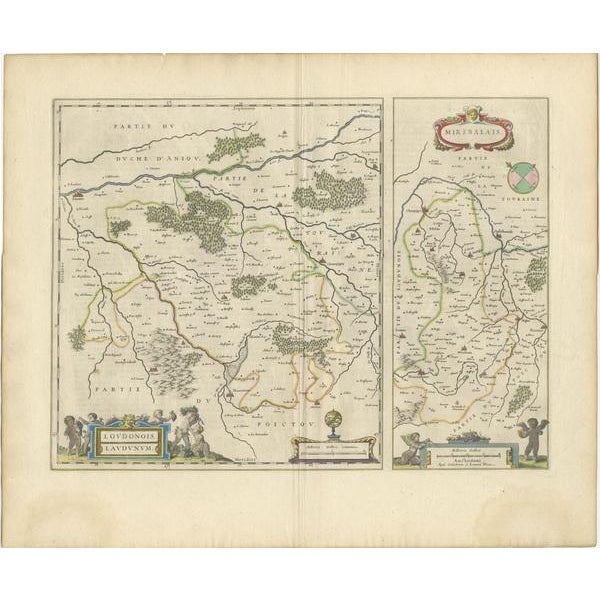
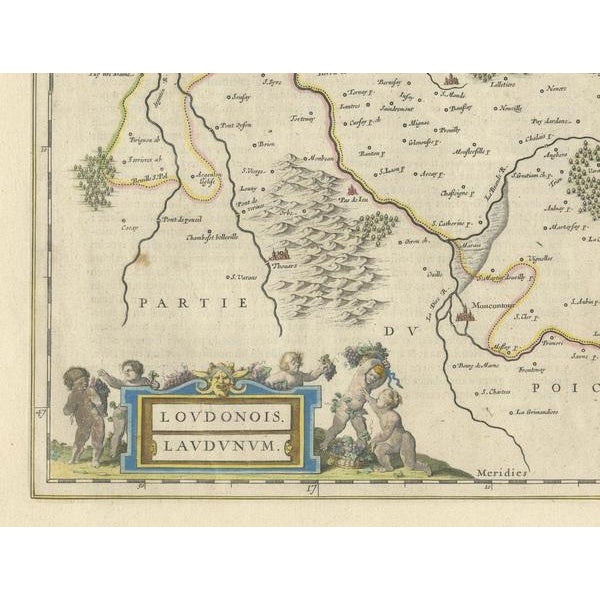
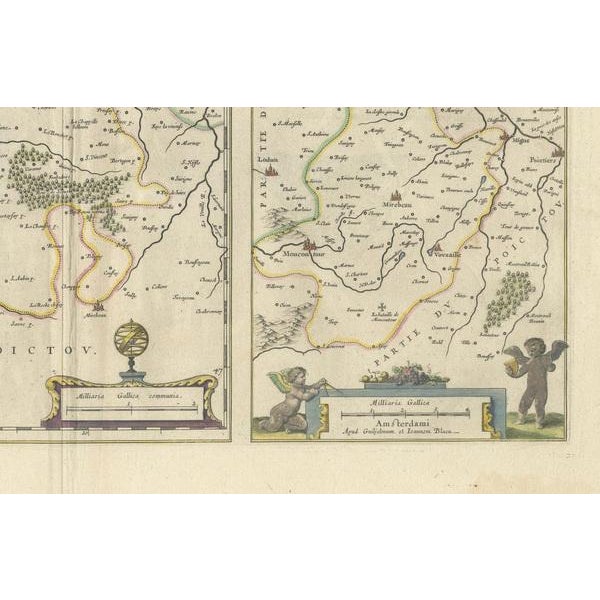
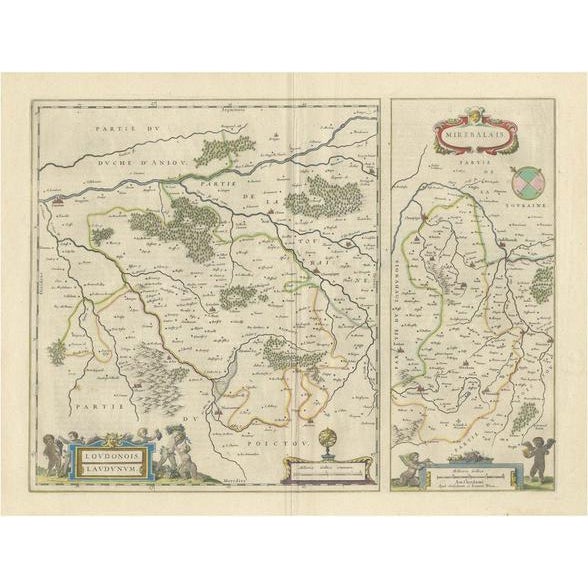
Cartography, 17th century. Willem (1571-1638) and Joan Blaeu (1596-1673), Theatrum Orbis Terrarum sive Atlas Novus\., 1635. Figure: Loudonois. Laudunum (Loudun); … Read more Cartography, 17th century. Willem (1571-1638) and Joan Blaeu (1596-1673), Theatrum Orbis Terrarum sive Atlas Novus\., 1635. Figure: Loudonois. Laudunum (Loudun); Mirebalais (Mirebeau) The image uploaded is an original antique map titled "Loudonois - Mirebalais," created by Willem Janszoon Blaeu, a renowned Dutch cartographer and publisher. This map was produced between 1642 and 1661. The map is a copper engraving, a common and highly detailed method of mapmaking during the 17th century, and it features text on the verso in French, which would have provided additional information about the regions depicted on the map. "Loudonois" refers to the Loudun area, and "Mirebalais" refers to the Mirebeau area, both located in France. The area of Loudun is part of the Vienne department in the Nouvelle-Aquitaine region, which is known for its rich history and architecture. Mirebeau is also situated in the same department and shares similar historical significance. The map includes several cartographic features common for the time, such as decorative cartouches, which contain the title and possibly other information, such as a scale of miles or a dedication. The artistry in the cartouches and along the borders, where figures can often be seen, is indicative of the era's style. Blaeu's maps are known for their accuracy and detail as well as their beauty, and they contributed significantly to the body of cartographic knowledge in Europe during the Golden Age of Dutch mapmaking. The Blaeu family, comprising Willem Janszoon, Cornelis, and Joan, were preeminent figures in 17th-century cartography and publishing. Willem Janszoon Blaeu, born in 1571 near Alkmaar, Netherlands, was an accomplished student of mathematics and astronomy under Tycho Brahe. He established himself in Amsterdam in 1596, becoming a noted globe, instrument, and map-maker. His significant contributions to maritime cartography began with a globe in 1599 and expanded to include the pilot guide "Het Licht der Zeevaert" and an appointment as Hydrographer to the V.O.C. by 1633. His establishment of the Blaeu publishing house marked a new era of atlas-making, beginning with the "Atlas Appendix" in 1630. Competition with neighbor and fellow mapmaker Johannes Janssonius in Amsterdam prompted Willem to adopt his grandfather's nickname 'Blaeu' to distinguish himself. After his death in 1638, his sons Cornelis (whose contributions are lesser-known) and Joan continued the business. Joan, succeeding his father at the V.O.C., became famous for the "Atlas Major" and extensive town-books of the Netherlands and Italy, cementing the Blaeu legacy in cartography. Tragedy struck in 1672 when a fire destroyed the Blaeu business, and Joan Blaeu died a year later. The remnants of their extensive collection were auctioned off, ending up in the hands of various Amsterdam booksellers and publishers. The Blaeu printing house, once a towering name in cartographic publishing, concluded its operations with a final auction in 1695. See less
- Dimensions
- 23.62ʺW × 20.08ʺH
- Item Type
- Vintage, Antique or Pre-owned
- Materials
- Paper
- Condition
- Unknown, Some Imperfections
- Color
- Copper
- Condition Notes
- Very Good — This vintage item has no defects, but it may show slight traces of use\. Condition: Good, given … moreVery Good — This vintage item has no defects, but it may show slight traces of use\. Condition: Good, given age, general age-related soiling and toning but mostly outside the image. Folding line as issued. French text on the reverse. Please study scan carefully. less
Returns & Cancellations
Return Policy - All sales are final 48 hours after delivery, unless otherwise specified in the description of the product.
Cancellation Policy - Prior to shipping or local pickup, buyers may cancel an order for up to 48 hours, unless otherwise specified.