




Details
Description
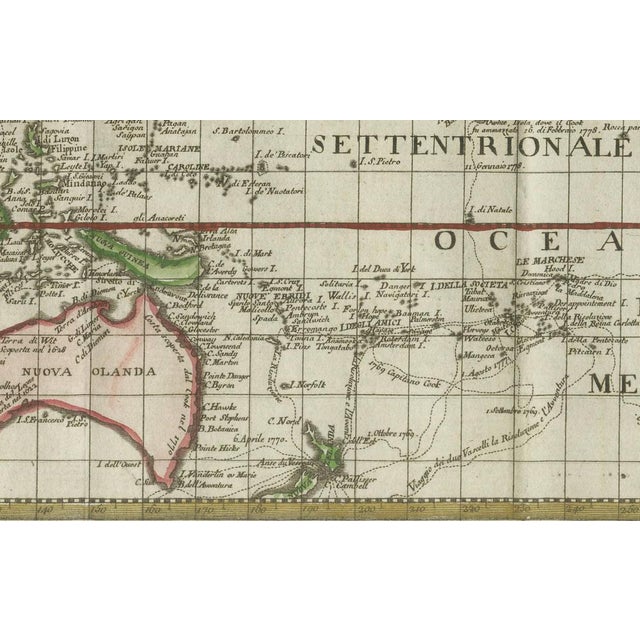
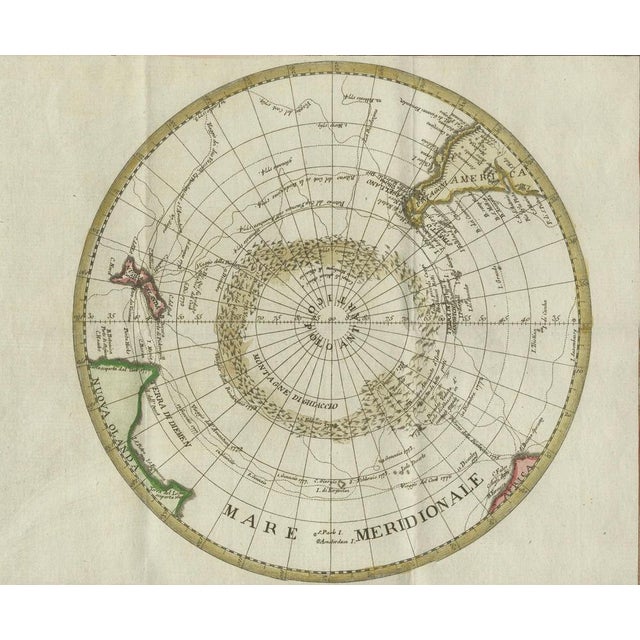
1786 World Map with Polar Projections - "Globo Terrestre" by Giovanni Maria Cassini This 1786 map titled "Globo Terrestre" by … Read more 1786 World Map with Polar Projections - "Globo Terrestre" by Giovanni Maria Cassini This 1786 map titled "Globo Terrestre" by Giovanni Maria Cassini offers a fascinating and detailed representation of the world using two polar projections and an equatorial projection. It was published by the Reale Accademia delle Scienze di Torino (Royal Academy of Sciences of Turin) and provides a comprehensive view of the Earth's geography as known in the late 18th century, enhanced by the latest discoveries, including Captain Cook's expeditions. The map features: - Two polar projections showing the North and South Poles with remarkable detail. These projections emphasize exploration routes and areas that were of great interest during that time. - An equatorial projection at the bottom depicting Africa, Asia, Australia, and the Americas. Notable features include Australia depicted as "Nuova Olanda" (New Holland), reflecting the geographical knowledge of the region during the late 18th century. - This map captures details such as Captain Cook's routes, highlighting the progress in geographic exploration. The map features the routes of Captain James Cook's expeditions, which were some of the most significant voyages of exploration during the 18th century. Cook's routes are clearly marked, showcasing his extensive travels across the Pacific Ocean, including the exploration of Australia, New Zealand, and the west coast of North America. This engraving is particularly interesting due to several factors: - The double polar projections offer a unique view of the world that was not commonly used in other maps of the era. This type of projection emphasizes the poles, which were areas of active exploration and mystery during the 18th century. - The hand-colored outlines add a decorative and artistic touch to the map, making it visually appealing for display. - The map is from the Reale Accademia delle Scienze di Torino, indicating its academic and historical value. It reflects the scientific and exploratory spirit of the Enlightenment period, with geographical information being updated based on the latest discoveries. - Giovanni Maria Cassini, the cartographer, was known for his detailed and precise maps, which makes this piece a valuable collectible for those interested in historical cartography. - The map provides a snapshot of world geography just before the major transformations brought by the late 18th and early 19th centuries, making it an important historical document. Condition Report: - Paper Quality: Overall good, with some light age-related toning and a few minor creases. - Coloring: Hand-colored borders to differentiate continents, still vivid. - Edges and Margins: Minor wear along the edges, with some slight folding visible in the lower section. - Print Quality: Clear and crisp impression, with legible names and routes. Summary Condition: The map is in good condition with minimal age wear. The colors are vibrant, and the print impression remains strong. The minor folds and creases do not detract from its overall appearance. A historical piece that offers insight into 18th-century global exploration and cartography. See less
- Dimensions
- 20.08ʺW × 16.93ʺH
- Period
- Late 18th Century
- Item Type
- Vintage, Antique or Pre-owned
- Materials
- Paper
- Condition
- Good Condition, Unknown, Some Imperfections
- Color
- Condition Notes
- Very Good — This vintage item has no defects, but it may show slight traces of use\. Summary Condition: The … moreVery Good — This vintage item has no defects, but it may show slight traces of use\. Summary Condition: The map is in good condition with minimal age wear. The colors are vibrant, and the print impression remains strong. The minor folds and creases do not detract from its overall appearance. A historical piece. less
Returns & Cancellations
Return Policy - All sales are final 48 hours after delivery, unless otherwise specified in the description of the product.
Cancellation Policy - Prior to shipping or local pickup, buyers may cancel an order for up to 48 hours, unless otherwise specified.