




Details
Description
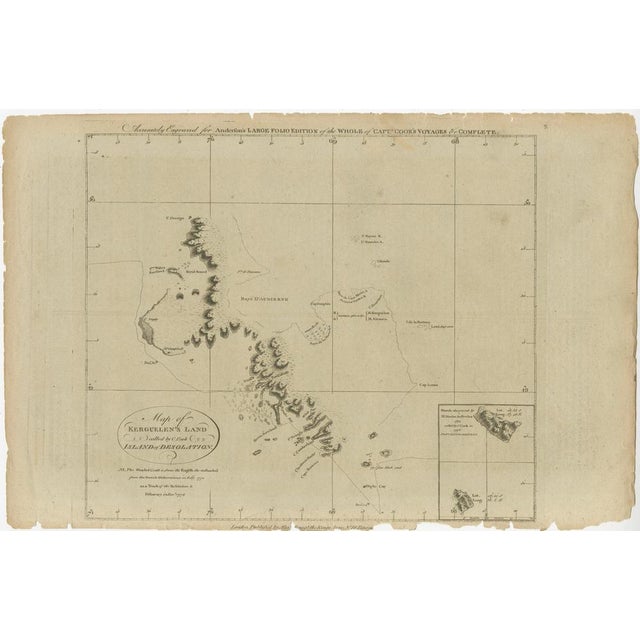
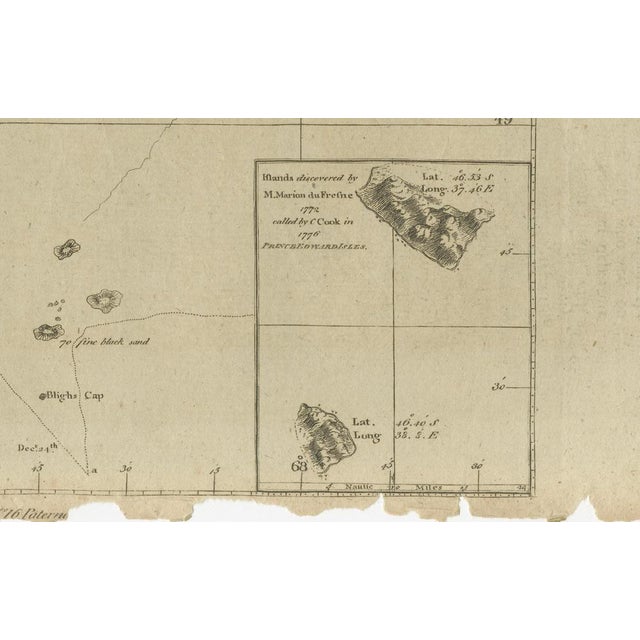
This map is titled "Map of Kerguelen’s Land, called by Cook Island of Desolation." It represents the geographic layout of … Read more This map is titled "Map of Kerguelen’s Land, called by Cook Island of Desolation." It represents the geographic layout of Kerguelen Island, also known as the Island of Desolation, located in the southern Indian Ocean. This remote and uninhabited island was discovered by French navigator Yves-Joseph de Kerguelen-Trémarec in 1772 and later visited by Captain James Cook during his second voyage in 1776. This 18th-century map was carefully engraved for Anderson’s Large Folio Edition of the Whole of Capt. Cook's Voyages. It offers a detailed geographic layout of Kerguelen’s Land (now Kerguelen Island) in the Southern Ocean, a desolate and harsh environment. The map includes important landmarks such as Royal Sound and Baye d’Audierne and notes both the French and British exploration efforts. Captain James Cook visited the island during his third Pacific expedition (1776-1779) and referred to it as the Island of Desolation, due to its barren landscape and inhospitable climate. The island had previously been charted by the French expedition under Yves-Joseph de Kerguelen, who claimed it for France in 1772. Cook’s subsequent exploration and observations contributed to refining the map of this remote island, and his experience here was part of the broader narrative of his voyages to explore the southern hemisphere. This map was part of a publication documenting the explorations of Captain Cook, with a specific focus on the uncharted or scarcely known territories. Kerguelen Island was significant as a potential stopover for explorers searching for resources or new landmasses in the southern oceans. However, its lack of resources and harsh environment made it unattractive for settlement or extended exploration. Significance: - Kerguelen Island holds importance in the history of exploration as one of the most remote islands in the world, reflecting the extent to which explorers like Cook ventured into uncharted territories. - The map shows the rugged coastline, bays, and anchorages used by explorers and notes the tracks of the Resolution, Cook’s ship, during his 1776 voyage. - It also highlights the ongoing French-British competition for territorial claims in the 18th century. Interesting Aspects: - The map is not only a geographic tool but also a historical record, showing the interaction between French and British exploratory efforts. - The use of both French and British names on the map emphasizes the competing claims and contributions of both nations in the exploration of the Southern Ocean. - The notation of islands discovered by Mr. Marion du Fresne highlights additional French contributions to Pacific exploration, particularly those of Marc-Joseph Marion du Fresne, who explored parts of the Indian and Pacific Oceans. This map provides an intriguing glimpse into the process of 18th-century exploration and mapping, reflecting the collaborative and competitive nature of European expeditions during the age of discovery. It also serves as a reminder of the harsh and desolate environments that explorers like Cook encountered in their quest for new lands and trade routes. See less
- Dimensions
- 14.96ʺW × 9.45ʺH
- Item Type
- Vintage, Antique or Pre-owned
- Materials
- Paper
- Condition
- Unknown, Some Imperfections
- Color
- Gold
- Condition Notes
- Good — This vintage item remains fully functional, but it shows sign of age through scuffs, dings, faded finishes, minimal … moreGood — This vintage item remains fully functional, but it shows sign of age through scuffs, dings, faded finishes, minimal upholstery defects, or visible repairs\. Condition: fair, given age. With soiling and overall a brownish hue. General age-related toning and defects from handling. Lower border cut off rough, touching the image. A patina rich map. Study images carefully. less
Returns & Cancellations
Return Policy - All sales are final 48 hours after delivery, unless otherwise specified in the description of the product.
Cancellation Policy - Prior to shipping or local pickup, buyers may cancel an order for up to 48 hours, unless otherwise specified.