




Details
Description
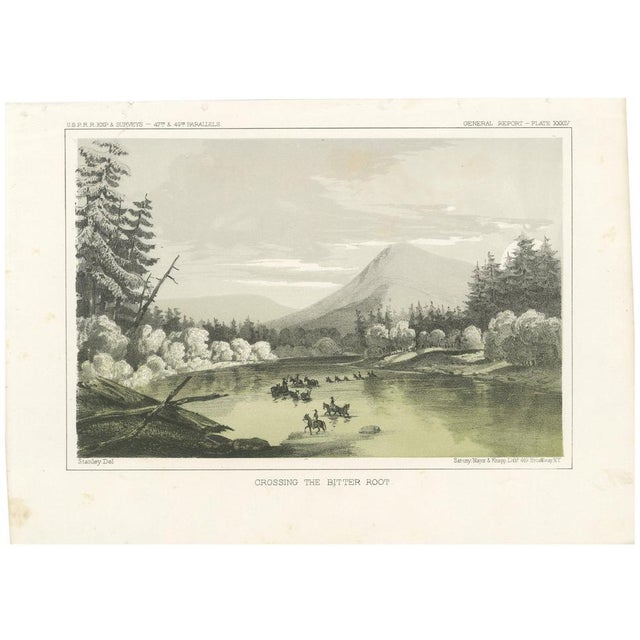
Title: Crossing the Bitter Root River - Tinted Lithograph from the Pacific Railroad Survey, 1856 : This striking lithograph, "Crossing … Read more Title: Crossing the Bitter Root River - Tinted Lithograph from the Pacific Railroad Survey, 1856 : This striking lithograph, "Crossing the Bitter Root River," captures a moment of exploration and movement in the American West. Published as General Report – Plate XXXIV in the Pacific Railroad Exploration Survey reports of 1856, the artwork showcases a group of travelers on horseback and pack animals as they ford the Bitter Root River, surrounded by dense forests and towering mountains. The composition highlights the dramatic interaction between the rugged wilderness and the human element, with the river reflecting the surrounding trees and distant mountain peaks. The foreground features a fallen tree, emphasizing the raw and untamed nature of the landscape. This lithograph offers a vivid glimpse into the challenges and beauty encountered during westward exploration. Created by Sarony, Major & Knapp, the lithograph is rendered in delicate tints and detailed linework, exemplifying the craftsmanship of 19th-century lithography. The play of light and shadow, combined with the soft color palette, gives depth and realism to the scene, making it both a historical document and a work of art. The Bitter Root refers to the Bitterroot River and the Bitterroot Valley, located in western Montana. The river flows south to north through the valley, which is nestled between the Bitterroot Range of the Rocky Mountains to the west and the Sapphire Mountains to the east. The Bitterroot Range also forms part of the boundary between Montana and Idaho. The area is named after the bitterroot plant (Lewisia rediviva), which was a significant food source for Native American tribes in the region. The valley and river hold historical significance, as they were part of the route used by the Lewis and Clark Expedition in 1805 and 1806, and later became a key location for westward migration. Today, the Bitterroot Valley is known for its scenic beauty, outdoor recreation opportunities, and historical sites, including the location of Fort Owen, which was Montana's first permanent white settlement. The area remains a symbol of the rugged frontier and the spirit of exploration. Condition: Very good, with minimal foxing on the margins. The image remains vibrant, with no visible damage or fading. Framing Tip: Use a matte in a soft green or gray tone to enhance the natural hues of the lithograph. A rustic wooden frame or a simple metallic finish would complement the piece, making it a beautiful addition to any collection of Western Americana or historical landscapes. See less
- Dimensions
- 11.02ʺW × 7.87ʺH
- Period
- 19th Century
- Item Type
- Vintage, Antique or Pre-owned
- Materials
- Paper
- Condition
- Good Condition, Unknown, Some Imperfections
- Color
- Gold
- Condition Notes
- Very Good — This vintage item has no defects, but it may show slight traces of use\. Condition: Very good, … moreVery Good — This vintage item has no defects, but it may show slight traces of use\. Condition: Very good, with minimal foxing at the margins. The image is crisp, and the colors remain vivid and well-preserved. less
Returns & Cancellations
Return Policy - All sales are final 48 hours after delivery, unless otherwise specified in the description of the product.
Cancellation Policy - Prior to shipping or local pickup, buyers may cancel an order for up to 48 hours, unless otherwise specified.
Related Collections
- Patrick Nagel Reproduction Prints
- William Hogarth Reproduction Prints
- Hable Reproduction Prints
- Reproduction Prints in Panama City, FL
- Alvar Aalto Reproduction Prints
- Daylight Dream Editions Reproduction Prints
- Polychrome Reproduction Prints
- Dorothy Draper Reproduction Prints
- Restoration Hardware Reproduction Prints
- Lauren Ralph Lauren Reproduction Prints
- Reproduction Prints in Mobile
- Gold-Plate Reproduction Prints
- Ralph Lauren Home Reproduction Prints
- Serena and Lily Reproduction Prints
- Bunny Williams Home Reproduction Prints
- Ralph Lauren Reproduction Prints
- Sister Parish Reproduction Prints
- Jonathan Adler Reproduction Prints
- Tuscan Reproduction Prints
- Leather Reproduction Prints
- Edward S. Curtis Reproduction Prints
- Mark D. Sikes Reproduction Prints
- Port 68 Reproduction Prints
- Jute Reproduction Prints
- Sam Francis Reproduction Prints