






Details
Description
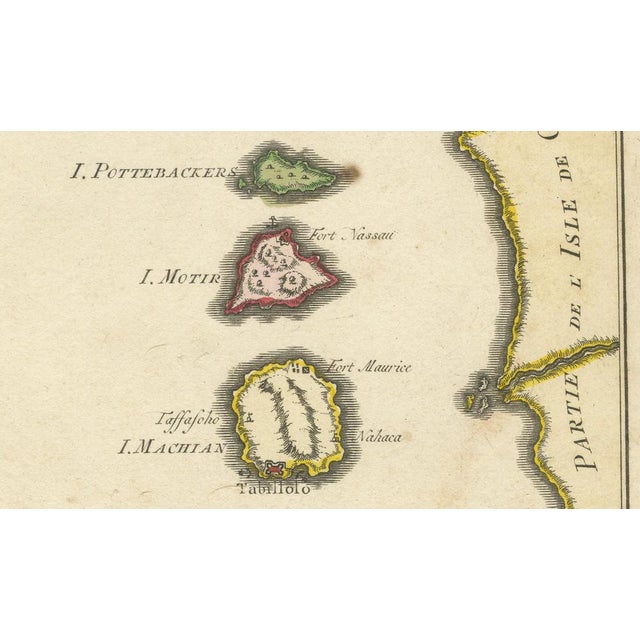
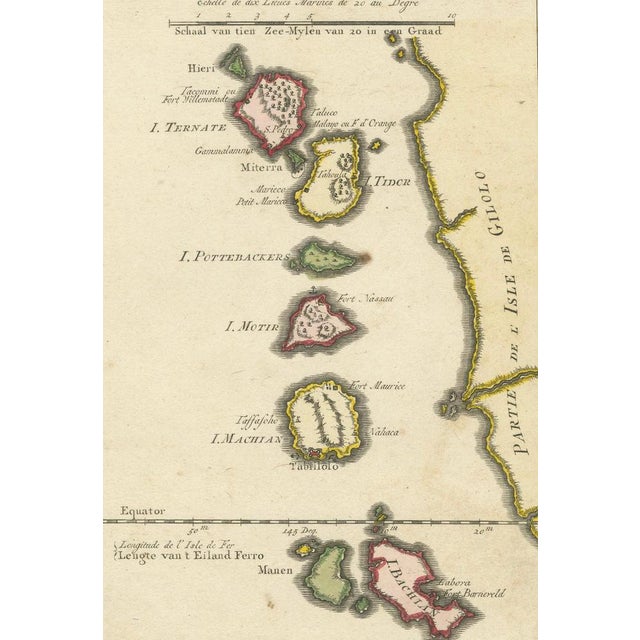
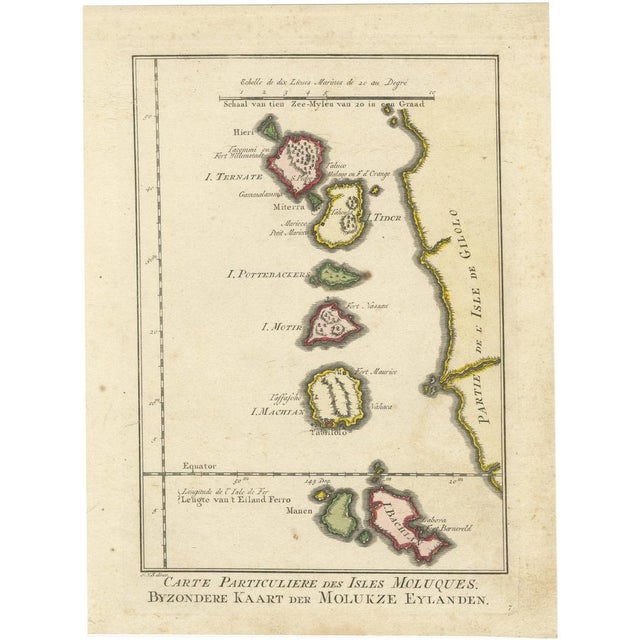
Title: 1771 Jacques-Nicolas Bellin Map of the Moluccas, the Spice Islands of Indonesia : This finely engraved eighteenth-century map, titled … Read more Title: 1771 Jacques-Nicolas Bellin Map of the Moluccas, the Spice Islands of Indonesia : This finely engraved eighteenth-century map, titled Carte Particulière des Isles Moluques and Byzondere Kaart der Molukze Eylanden, was published in 1771 by the renowned French cartographer Jacques-Nicolas Bellin. The map offers a detailed depiction of the Moluccas, also known as the Spice Islands, a region in present-day Indonesia that was of immense economic and strategic importance during the European colonial period. The Moluccas were highly sought after by European powers due to their monopoly on valuable spices such as nutmeg, cloves, and mace. The islands were central to the conflicts between the Portuguese, Dutch, and British, as they all sought control over the lucrative spice trade. This map specifically highlights the key islands of the northern Moluccas, including Ternate, Tidore, Motir, Machian, and Bacan, along with a portion of Gilolo, now known as Halmahera. The region's significance in the global spice trade made it one of the most contested territories in the East Indies. The map includes various fortifications, settlements, and European trading posts. Among the notable features are Ternate, where Fort Williamstadt is labeled, a major trading hub controlled by the Dutch East India Company. Tidore, historically governed by a powerful sultanate allied with the Spanish and later the Dutch, is also marked with important settlements. The islands of Motir and Machian are identified with key forts such as Fort Nassau and Fort Maurice, which were used to secure Dutch interests in the region. Bacan, another major island in the chain, is labeled with locations including Taboua and Barneveld. The map also depicts the coastline of Gilolo, showing the limited settlements on this large but sparsely populated island. The cartography reflects Bellin’s meticulous attention to detail, incorporating place names in both French and Dutch, highlighting the region’s European influence. The inclusion of a double-scale bar in both French and Dutch nautical miles demonstrates the map’s practical use for navigation. The careful engraving of coastlines, islands, and settlements showcases the high-quality craftsmanship of Bellin’s work, produced at a time when European knowledge of Southeast Asia was rapidly expanding. This map is an excellent representation of the geopolitical significance of the Moluccas during the eighteenth century. It provides valuable insight into European exploration, colonial ambitions, and maritime trade networks that shaped global commerce. Cartographer and Source: Jacques-Nicolas Bellin, who lived from seventeen hundred three to seventeen hundred seventy-two, was a French hydrographer and cartographer serving as the chief cartographer for the French Navy’s Dépôt des Cartes et Plans de la Marine. His maps were widely published in maritime atlases and travel accounts, providing some of the most detailed contemporary representations of colonial territories and trade routes. This map was created as part of a larger effort to document French naval and commercial interests in the East Indies. Condition Report: The paper is well-preserved, exhibiting the fine laid texture and visible chain lines characteristic of eighteenth-century French printing. The engraving remains sharp, with clear labels and finely detailed coastlines. There is light age-toning, particularly along the edges, which is common for maps of this period. The original hand-coloring remains vibrant, with carefully applied shading distinguishing the individual islands. The map has no significant stains, tears, or repairs, making it a fine and collectible example of an early European map of the Moluccas. Framing Recommendations: To properly preserve and display this antique map, archival-quality materials are recommended. For matting and backing, use acid-free, museum-grade board to prevent deterioration. A double mat with a neutral outer mat and a soft beige or pale gold inner accent will highlight the delicate coloring of the engraving. A classic dark walnut, black, or gilded wooden frame will enhance the historical nature of the piece. A simple yet elegant frame will help maintain focus on the map’s fine details and artistic engraving. To ensure longevity, UV-resistant museum glass or acrylic is recommended to prevent fading while maintaining clarity. Anti-reflective glass allows for optimal viewing without glare. For mounting, avoid adhesives that can damage the paper. Instead, use archival-quality corner mounts or Japanese paper hinges to secure the map safely. The framed map should be displayed in a stable environment, away from direct sunlight, humidity, and extreme temperature changes. See less
- Dimensions
- 7.48ʺW × 10.24ʺH
- Period
- 18th Century
- Item Type
- Vintage, Antique or Pre-owned
- Materials
- Paper
- Condition
- Good Condition, Unknown, Some Imperfections
- Color
- Beige
- Condition Notes
- Very Good — This vintage item has no defects, but it may show slight traces of use\. Goodf with light … moreVery Good — This vintage item has no defects, but it may show slight traces of use\. Goodf with light age-toning, particularly along the edges. The original hand-coloring remains vibrant, with carefully applied shading distinguishing the individual islands. The map has no significant stains, tears or repairs. less
Returns & Cancellations
Return Policy - All sales are final 48 hours after delivery, unless otherwise specified in the description of the product.
Cancellation Policy - Prior to shipping or local pickup, buyers may cancel an order for up to 48 hours, unless otherwise specified.