




Details
Description
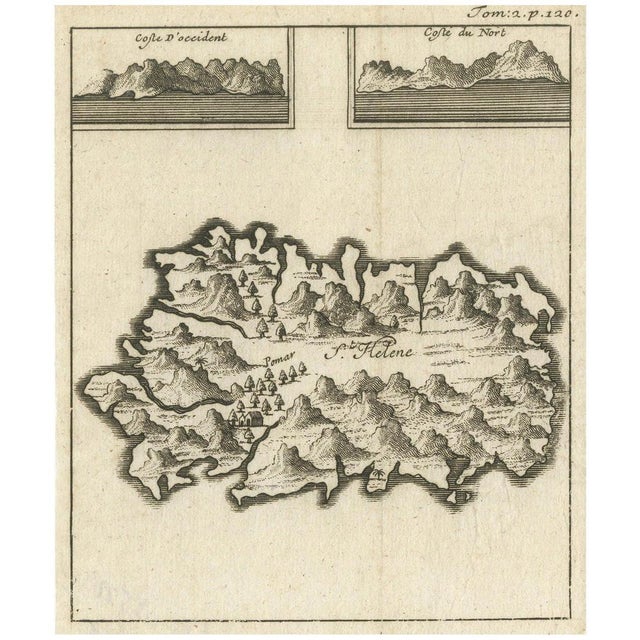
Map of Saint Helena Island: Early 18th-Century Copper Engraving by F. Bernard This rare and beautifully detailed copper engraving of … Read more Map of Saint Helena Island: Early 18th-Century Copper Engraving by F. Bernard This rare and beautifully detailed copper engraving of Saint Helena Island dates from around 1722 and was published in Amsterdam by F. Bernard as part of the renowned atlas *Recueil des voyages qui ont servi à\.*. This work is a compilation of travel accounts and geographical discoveries, reflecting the growing European fascination with distant and isolated places during the Age of Exploration. Saint Helena, a remote volcanic island in the South Atlantic Ocean, gained significant historical importance as a strategic stopover point for ships sailing between Europe and Asia. Most famously, it later became the place of exile for Napoleon Bonaparte from 1815 until his death in 1821. The map’s design reflects the early cartographic style of the period, with the island’s rugged terrain depicted through bold line work and finely engraved mountain symbols. The interior of the island is dominated by a complex array of hills and peaks, giving the viewer a sense of its dramatic and varied landscape. Sparse clusters of trees and small symbols representing buildings, labeled as 'Pomar,' are scattered across the terrain, indicating settlements or cultivated areas. At the top of the map are two inset profiles depicting the island as seen from the sea: 'Coste D’occident' (West Coast) and 'Coste du Nord' (North Coast). These coastal profiles were commonly included in early maps to aid navigators in identifying land from a distance. The simplistic and almost schematic representation of the coastlines reflects the limited geographical knowledge of the time, yet the engraver has meticulously crafted these views to offer practical guidance. This map exemplifies the craftsmanship of early 18th-century cartography, with a distinct artistic touch that enhances its historical value. The title inscription at the top right, 'Tomi:2.p.120.', indicates that it comes from the second volume of the atlas, pointing to the structured compilation of explorative narratives and geographical representations. Condition: The engraving is in good condition for its age, with clear, sharp lines and minimal signs of wear. The paper shows only light toning and a few minor foxing spots, typical of early 18th-century prints. Framing tips: To display this rare and historically significant piece, consider framing it with a classic dark wood or ebony frame and a neutral or cream-colored mat to highlight the fine details and antique charm. See less
- Dimensions
- 5.12ʺW × 5.91ʺH
- Item Type
- Vintage, Antique or Pre-owned
- Materials
- Paper
- Condition
- Unknown, Some Imperfections
- Color
- Copper
- Condition Notes
- Very Good — This vintage item has no defects, but it may show slight traces of use\. The engraving is … moreVery Good — This vintage item has no defects, but it may show slight traces of use\. The engraving is in good condition for its age, with clear, sharp lines and minimal signs of wear. The paper shows only light toning and a few minor foxing spots, typical of early 18th-century prints. less
Returns & Cancellations
Return Policy - All sales are final 48 hours after delivery, unless otherwise specified in the description of the product.
Cancellation Policy - Prior to shipping or local pickup, buyers may cancel an order for up to 48 hours, unless otherwise specified.