


Details
Description
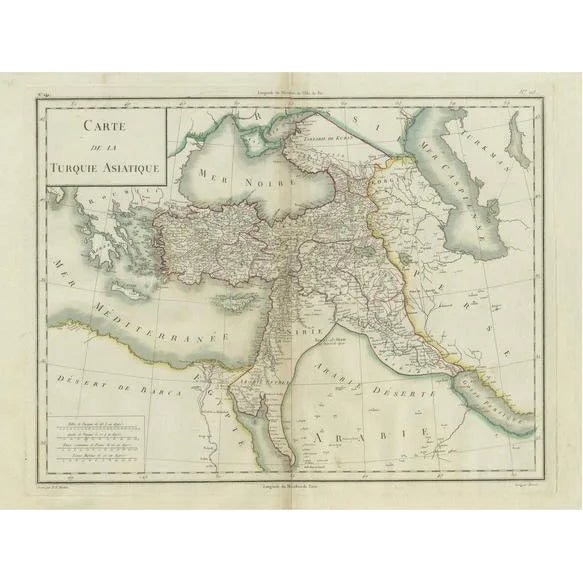
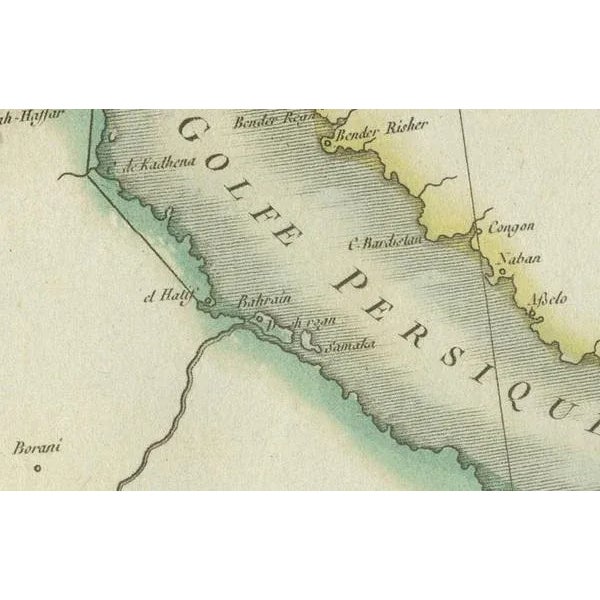
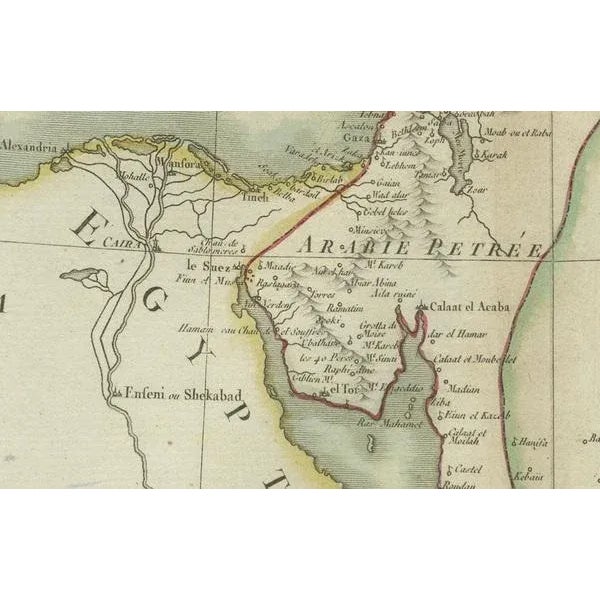
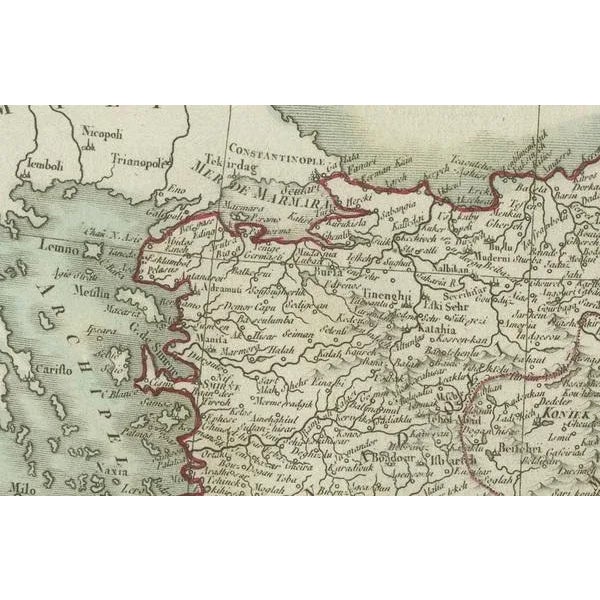
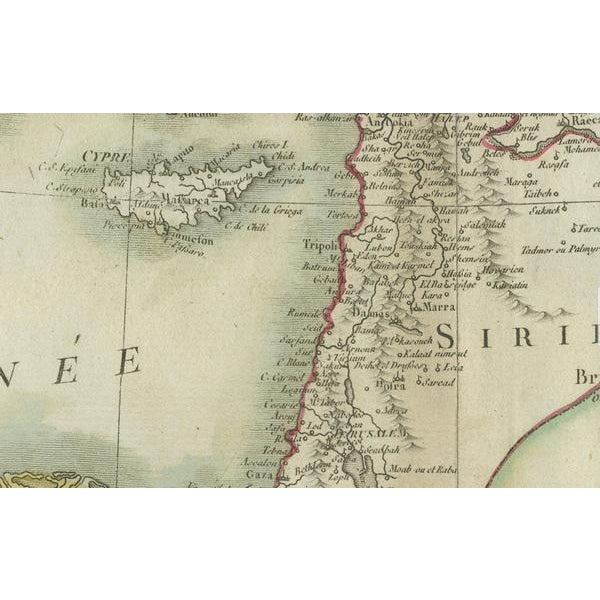
This is an original antique map titled "Carte de la Turquie Asiatique," depicting the Asian territories of the Ottoman Empire. … Read more This is an original antique map titled "Carte de la Turquie Asiatique," depicting the Asian territories of the Ottoman Empire. Created by Pierre Antoine Tardieu, this map illustrates the vast expanse of the Ottoman Empire in Asia, including modern-day Turkey, the Levant, parts of the Arabian Peninsula, and adjacent regions. Map Details: - **Title**: Carte de la Turquie Asiatique - **Creator**: Pierre Antoine Tardieu (1784-1869) - **Publication Date**: Early 19th century - **Dimensions**: Approximately 34.5 x 43.5 cm (13.5 x 17.25 inches) - **Features**: The map provides a detailed depiction of the Ottoman territories in Asia, highlighting various regions, cities, rivers, and mountain ranges. The title cartouche is located in the upper left corner, and the outlines are hand-colored to distinguish different areas. Bahrein is also mentioned. Condition Overview: 1. **Paper Quality**: The paper shows typical signs of aging, such as slight yellowing, but remains in good condition without major tears or damage. 2. **Edges and Corners**: The edges are slightly worn, with minor fraying and small tears, particularly near the center fold. These imperfections do not significantly impact the overall readability or aesthetic value. 3. **Center Fold**: A center fold is present, which is common for maps of this period that were often folded for storage or publication. The fold appears intact but without separation at both ends. 4. **Color and Print Quality**: The hand-colored outlines remain vibrant and clear, highlighting the borders of different regions. The print quality is excellent, with sharp, legible text and detailed illustrations. 5. **Staining and Spots**: There are a few spots and stains, particularly near the edges and along the fold. These do not obscure any critical details of the map. Historical Context Around 1800, the Asian territories of the Ottoman Empire were diverse and strategically important. Here’s an overview of the region during that period: Political Landscape 1. **Ottoman Administration**: - The Ottoman Empire governed its Asian territories through a system of provinces (vilayets) and smaller administrative units (sanjaks). These regions included Anatolia (modern-day Turkey), the Levant (Syria, Lebanon, Israel, Jordan), Mesopotamia (Iraq), and parts of the Arabian Peninsula. - Key cities like Constantinople (Istanbul), Baghdad, Damascus, and Aleppo were significant centers of administration, trade, and culture. 2. **Neighboring Powers**: - The Persian Empire (Qajar Dynasty) to the east was a significant neighbor and occasional rival. - The Russian Empire was also expanding southward into the Caucasus, posing a threat to Ottoman territories. Socio-Economic Conditions 1. **Trade and Commerce**: - The region was a crucial link in trade routes connecting Europe with Asia. The cities of the Levant and Mesopotamia were bustling centers of commerce, facilitating trade in goods like spices, textiles, and precious metals. - The port cities along the Mediterranean and the Red Sea played vital roles in international trade networks. 2. **Agriculture and Resources**: - Agriculture was a primary economic activity, with fertile lands in Mesopotamia and the Levant supporting diverse crops. The Arabian Peninsula, though largely desert, was significant for its trade routes and resources like incense and spices. 3. **Cultural and Religious Diversity**: - The region was home to a mosaic of cultures and religions, including Muslims (Sunni and Shia), Christians (various denominations), Jews, and other smaller religious communities. - This diversity was reflected in the cultural, architectural, and intellectual life of the region. Conflicts and Changes 1. **Internal Struggles**: - The Ottoman Empire faced internal challenges, including administrative inefficiency, corruption, and local uprisings. Efforts to modernize the military and bureaucracy were ongoing but met with mixed success. 2. **Napoleonic Wars**: - The Napoleonic Wars (1799-1815) had indirect effects on the region, with shifting alliances and the involvement of European powers impacting the geopolitical landscape. 3. **Regional Revolts**: - Local revolts and uprisings, often driven by nationalist or sectarian sentiments, were common. These were sometimes suppressed by the central Ottoman authority, but they also indicated the underlying tensions within the empire. Summary The Asian territories of the Ottoman Empire around 1800 were a vital part of a vast and diverse empire, characterized by significant economic activity, cultural richness, and strategic importance. The region was a crossroads of civilizations, influenced by internal dynamics and external pressures that would shape its history in the 19th century and beyond. See less
- Dimensions
- 22.05ʺW × 16.14ʺH
- Period
- 19th Century
- Item Type
- Vintage, Antique or Pre-owned
- Materials
- Paper
- Condition
- Good Condition, Unknown, Some Imperfections
- Color
- Gold
- Condition Notes
- Very Good — This vintage item has no defects, but it may show slight traces of use\. Good condition with … moreVery Good — This vintage item has no defects, but it may show slight traces of use\. Good condition with minor age-related wear. Hand-colored boundaries are well-preserved, enhancing the clarity of regions and features. Fold lines with split at ends . Edge wear due to handling and age visible. Study the images carefully. less
Returns & Cancellations
Return Policy - All sales are final 48 hours after delivery, unless otherwise specified in the description of the product.
Cancellation Policy - Prior to shipping or local pickup, buyers may cancel an order for up to 48 hours, unless otherwise specified.