





Details
Description
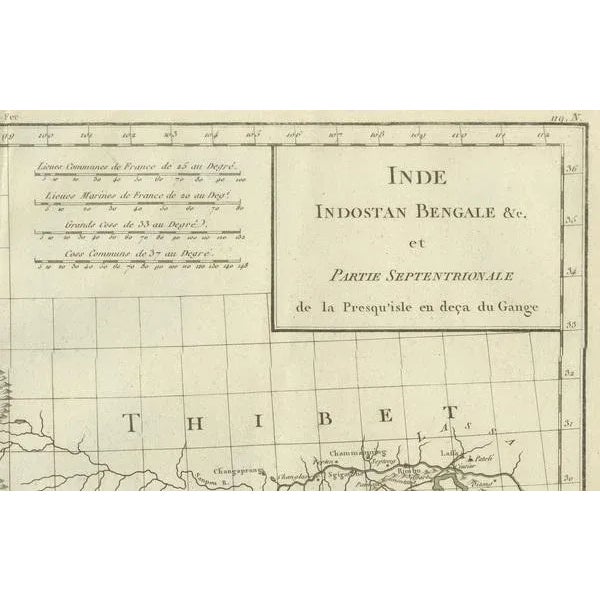
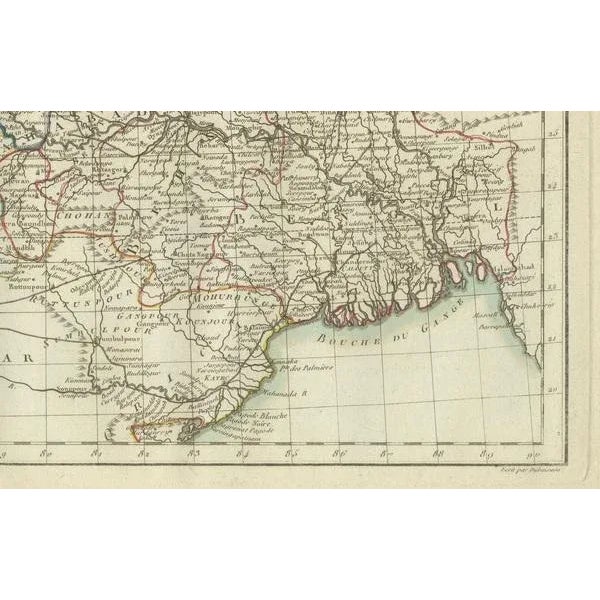
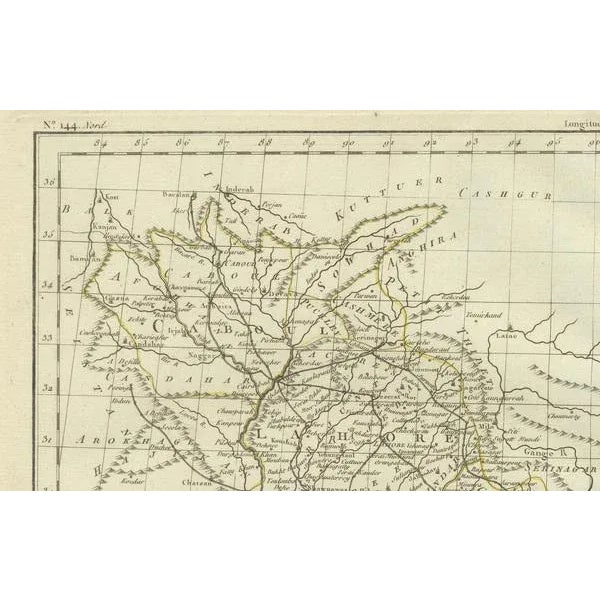
This is an original antique map titled "Inde, Indostan Bengale &c. et Partie Septentrionale de la Presqu'isle en deça du … Read more This is an original antique map titled "Inde, Indostan Bengale &c. et Partie Septentrionale de la Presqu'isle en deça du Gange," depicting the northern part of the Indian subcontinent including parts of modern-day India, Bangladesh, and surrounding areas. This map was created by Pierre Antoine Tardieu, a prominent French engraver and cartographer. Map Details: - Title: Inde, Indostan Bengale &c. et Partie Septentrionale de la Presqu'isle en deça du Gange - Creator: Pierre Antoine Tardieu (1784-1869) - Publication Date: Early 19th century - Dimensions: Approximately 34.5 x 43.5 cm (13.5 x 17.25 inches) - Features: The map provides detailed geographical and political features, showing various regions, cities, rivers, and mountain ranges. The title cartouche is located in the upper right corner, and the outlines are hand-colored to distinguish different territories. Condition Overview: 1. **Paper Quality**: The paper shows some signs of aging, such as slight yellowing, but remains in good condition without major tears or damage. 2. **Edges and Corners**: The edges are slightly worn, with minor fraying and small tears, particularly near the center fold. These imperfections do not significantly impact the overall readability or aesthetic value. 3. **Center Fold**: A center fold is present, which is common for maps of this period that were often folded for storage or publication. The fold appears intact without significant separation or damage. 4. **Color and Print Quality**: The hand-colored outlines remain vibrant and clear, highlighting the borders of different regions. The print quality is excellent, with sharp, legible text and detailed illustrations. 5. **Staining and Spots**: There are a few spots and stains, particularly near the edges and along the fold. These do not obscure any critical details of the map. Historical Context Around the year 1800, the Indian subcontinent was undergoing significant changes under British colonial influence. Here’s an overview of the region during that period: Political Landscape 1. British East India Company: - The British East India Company was expanding its control over the Indian subcontinent, establishing dominance in Bengal, Bihar, and parts of the southern and western regions. - Major battles, such as the Battle of Plassey (1757) and the Battle of Buxar (1764), had already established British supremacy in key areas. 2. Local Kingdoms and Empires: - The Mughal Empire, once the dominant power, was in decline, with its authority largely reduced to the area around Delhi. - Various regional powers such as the Maratha Confederacy, the Sikh Empire, the Kingdom of Mysore, and the Nizam of Hyderabad were influential and often in conflict with the British or each other. Socio-Economic Conditions 1. Agriculture: - The economy was primarily agrarian, with agriculture being the main occupation. Key crops included rice, wheat, cotton, and indigo. - The British East India Company’s policies had significant impacts on agriculture, often leading to exploitation and economic changes. 2. Trade and Commerce: - The Indian subcontinent was a major hub for trade in spices, textiles, and other goods. Key cities like Calcutta (Kolkata), Bombay (Mumbai), and Madras (Chennai) were significant ports. - Inland trade routes were also important, connecting various regions through rivers and roads. Cultural and Social Aspects 1. Diversity: - The region was characterized by immense cultural, linguistic, and religious diversity, including Hindus, Muslims, Sikhs, Christians, and others. - This diversity was reflected in the social structure, festivals, languages, and traditions. 2. British Influence: - British colonial rule brought significant changes, including the introduction of Western education, legal systems, and administrative practices. - There was also cultural exchange, with British and Indian influences intermingling in various aspects of life. Conflicts and Changes 1. Anglo-Mysore Wars: - The British fought a series of wars with the Kingdom of Mysore under rulers like Hyder Ali and Tipu Sultan, leading to British dominance in southern India by the end of the 18th century. 2. Anglo-Maratha Wars: - Conflicts with the Maratha Confederacy also marked this period, with the British eventually defeating the Marathas and consolidating control over large parts of India. Summary The northern part of the Indian subcontinent around 1800 was a region of great political, economic, and cultural significance, undergoing profound changes under British colonial influence. The map by Pierre Antoine Tardieu offers a detailed and historically valuable representation of this dynamic region. See less
- Dimensions
- 22.05ʺW × 16.14ʺH
- Period
- 19th Century
- Item Type
- Vintage, Antique or Pre-owned
- Materials
- Paper
- Condition
- Good Condition, Unknown, Some Imperfections
- Color
- Gold
- Condition Notes
- Very Good — This vintage item has no defects, but it may show slight traces of use\. Good condition with … moreVery Good — This vintage item has no defects, but it may show slight traces of use\. Good condition with minor age-related wear. Hand-colored boundaries are well-preserved, enhancing the clarity of regions and features. Fold lines as issued . Edge wear due to handling and age visible. Study the images carefully. less
Returns & Cancellations
Return Policy - All sales are final 48 hours after delivery, unless otherwise specified in the description of the product.
Cancellation Policy - Prior to shipping or local pickup, buyers may cancel an order for up to 48 hours, unless otherwise specified.