




Details
Description
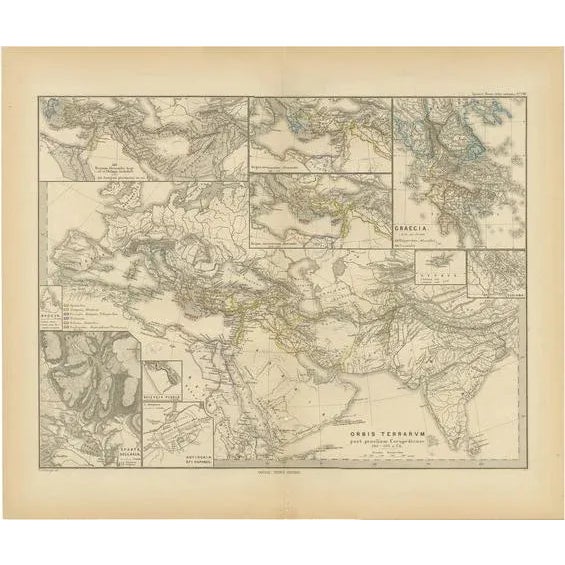
The map is titled "ORBIS TERRARUM post proelium Corupedinse," which translates to "The World after the Battle of Corupedium." This … Read more The map is titled "ORBIS TERRARUM post proelium Corupedinse," which translates to "The World after the Battle of Corupedium." This battle, which took place in 281 BC in Lydia, was the final encounter of the Wars of the Diadochi, fought between the armies of Lysimachus and Seleucus, two of Alexander the Great's successors. The outcome led to the establishment of the Seleucid Empire's dominance over Anatolia. Features that make this map interesting: 1. **Historical Transition**: The map captures a moment of transition after Alexander the Great's empire was divided, marking the end of the Wars of the Diadochi and the beginning of the Hellenistic period in earnest. 2. **Geographical Coverage**: It spans a vast area covering the territories impacted by Alexander's campaigns and their subsequent division among his generals. 3. **Inset Maps**: The map includes inset maps of regions and cities of historical significance during the Hellenistic period, such as Rhodes, Sparta, and Antioch. 4. **Political Boundaries**: The delineation of political boundaries reflects the division of Alexander's empire into the realms controlled by his successors. 5. **Military History**: It provides a geographical context for understanding the military movements and territorial changes resulting from the Diadochi's conflicts. 6. **Latin Nomenclature**: The use of Latin reflects the scholarly approach of the period when the map was created, catering to the educational and research needs of the time. 7. **Topographical Features**: It details the topography of the region, including mountain ranges, rivers, and plains that would have influenced the outcome of the battle. This map is from the "Spruner-Menke Atlas Antiquus," created by Karl Spruner von Merz and edited by Theodorus Menke. The atlas is known for its detailed and historically accurate maps of ancient geographies, used extensively for educational purposes in the 19th century. The period depicted on the map was crucial for shaping the political and cultural landscape of the Hellenistic world, influencing the development of the cultures and conflicts that would play out over the centuries in these regions. See less
- Dimensions
- 18.5ʺW × 15.35ʺH
- Period
- 19th Century
- Item Type
- Vintage, Antique or Pre-owned
- Materials
- Paper
- Condition
- Good Condition, Unknown, Some Imperfections
- Color
- Condition Notes
- Very Good — This vintage item has no defects, but it may show slight traces of use\. Good, given age. … moreVery Good — This vintage item has no defects, but it may show slight traces of use\. Good, given age. General age-related toning, especially around the edges. The vertical folding line is a bit rough with a small hole in the lower part. Please study scan carefully. less
Returns & Cancellations
Return Policy - All sales are final 48 hours after delivery, unless otherwise specified in the description of the product.
Cancellation Policy - Prior to shipping or local pickup, buyers may cancel an order for up to 48 hours, unless otherwise specified.