



Details
Description
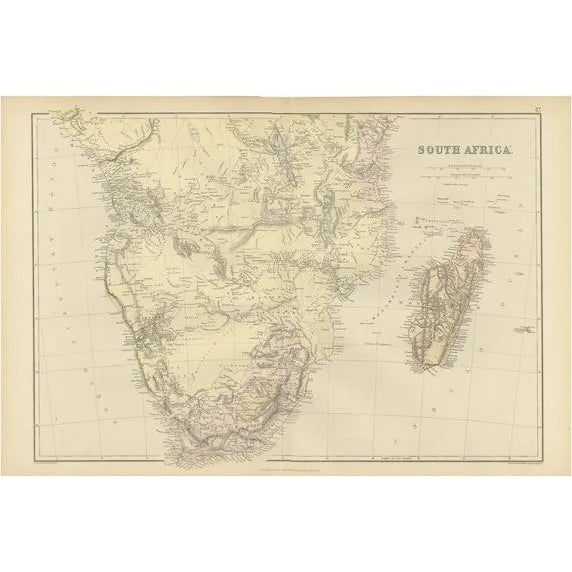
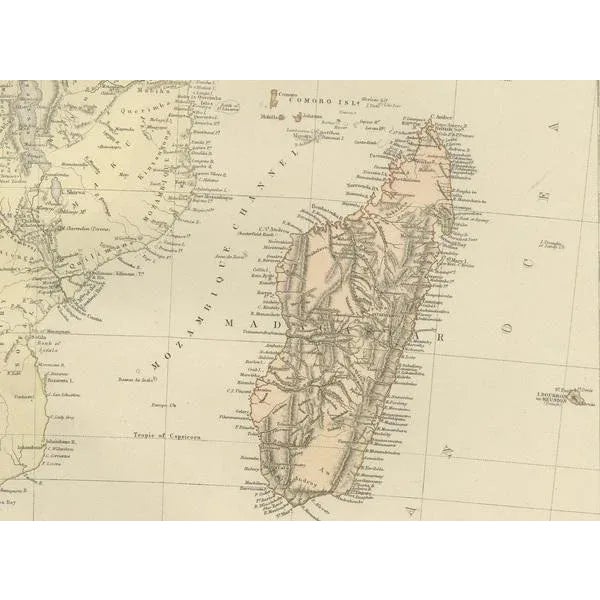
The map of South Africa is from the Blackie & Son Atlas, published in 1882. This historical map is quite … Read more The map of South Africa is from the Blackie & Son Atlas, published in 1882. This historical map is quite interesting for several reasons: 1. **Historical Period**: This map was created during a significant period in South African history, just before the discovery of gold and diamonds led to the rapid economic development of the region and, subsequently, to the conflicts of the Anglo-Boer Wars at the end of the 19th century. 2. **Geographical Detail**: It displays the topographical features of South Africa, including mountain ranges such as the Drakensberg, and major rivers. It would also possibly show the distribution of the colonial possessions and the independent African states at the time, like the Zulu Kingdom, which had significant historical implications. 3. **Colonial Impact**: The map reflects the territorial knowledge and the extent of colonial impact before the major changes that would come with the mineral revolution and the subsequent scramble for Africa. 4. **Portrayal of the Terrain**: South Africa’s diverse terrain, from the coastal regions to the interior highveld and the arid regions of the northwest, would be depicted, offering insight into the challenges of settlement and development in the region. 5. **Transportation**: Any rail lines, roads, ports, and other infrastructure depicted on the map would show the development of transportation networks critical for colonial expansion and exploitation of natural resources. 6. **Cultural and Political Boundaries**: The map may show the boundaries of different cultural and political entities as they were understood by Europeans at the time, which could differ significantly from today's boundaries. 7. **Cartographic Techniques**: The map showcases the cartographic techniques and styles of the era, including the use of color, shading, and symbols to represent geographical features and political boundaries. 8. **Maritime Details**: Given South Africa’s position on the trade route to Asia, maritime details such as currents and harbors along the coastline would be important for navigation and trade. Maps from this era are valuable for the historical insights they provide and for understanding the world view and knowledge at the time of their creation. See less
- Dimensions
- 22.44ʺW × 14.96ʺH
- Period
- Late 19th Century
- Item Type
- Vintage, Antique or Pre-owned
- Materials
- Paper
- Condition
- Good Condition, Unknown, Some Imperfections
- Color
- Gold
- Condition Notes
- Very Good — This vintage item has no defects, but it may show slight traces of use\. Good condition, folding … moreVery Good — This vintage item has no defects, but it may show slight traces of use\. Good condition, folding line in the middle. The outer borders are slightly discolored due to age, but not the image. One small tear in the lower margin, not affecting the image. Study the image carefully. less
Returns & Cancellations
Return Policy - All sales are final 48 hours after delivery, unless otherwise specified in the description of the product.
Cancellation Policy - Prior to shipping or local pickup, buyers may cancel an order for up to 48 hours, unless otherwise specified.