





Details
Description
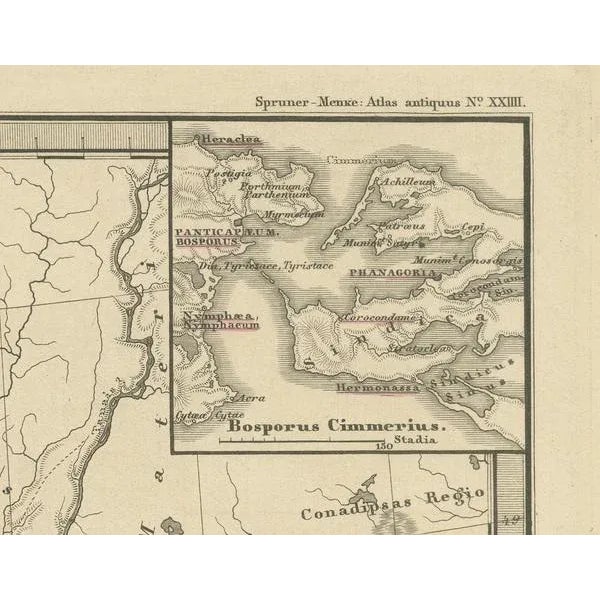
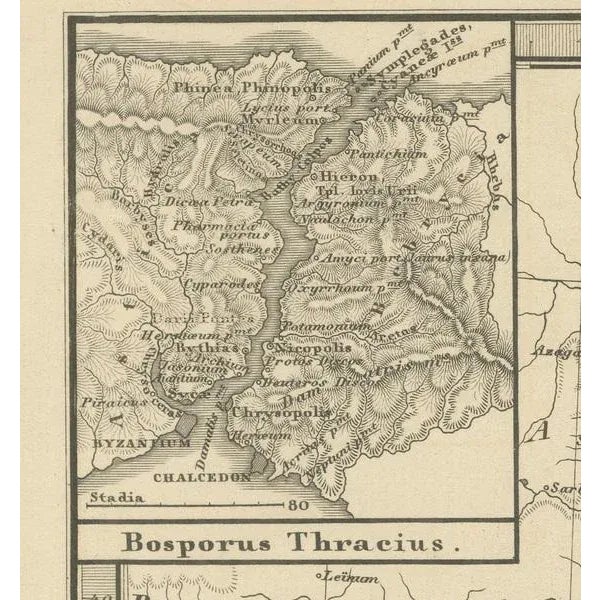
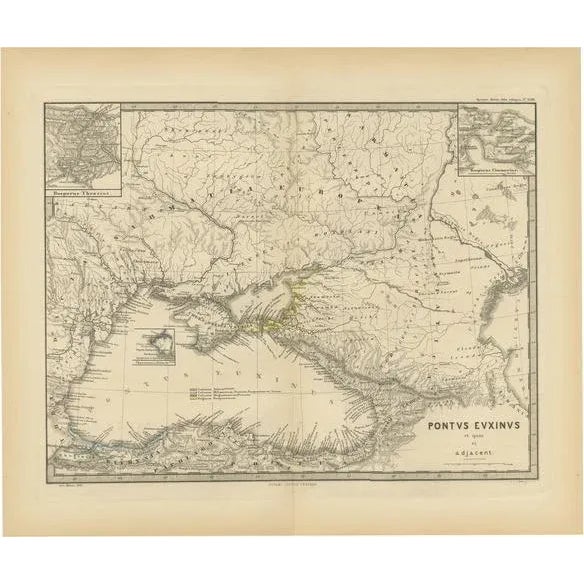
This map, titled "pontus euxinus," depicts the black sea region, historically known as the pontus euxinus. The black sea was … Read more This map, titled "pontus euxinus," depicts the black sea region, historically known as the pontus euxinus. The black sea was central to ancient trade routes and cultural exchange, bordered by several important ancient empires and peoples. **features of the map include:** 1. **regional focus**: it focuses on the area surrounding the black sea, including parts of modern-day turkey, russia, ukraine, georgia, bulgaria, and romania. 2. **topography**: the map renders the region's complex topography with detailed depictions of mountain ranges, rivers, and the coastline. 3. **settlements and cities**: various symbols and labels indicate the locations of ancient cities, settlements, and other significant sites. 4. **political divisions**: different territories might be color-coded to show the various tribal or political entities that historically bordered the black sea. 5. **insets**: two inset maps are included: - the upper left shows the bosporus thracius (the strait of istanbul), a crucial waterway connecting the black sea to the sea of marmara. - the upper right features the bosporus cimmerius (the strait of kerch), connecting the black sea to the sea of azov. 6. **annotations**: there are annotations and labels in latin, which provide historical context, names of regions, and s of the geographic features. This map is a valuable historical document, capturing the geography of a region that was a crossroads of commerce, culture, and conflict in antiquity. The detailed cartography would have been especially useful for educational purposes in the late 19th century, when the map was likely published as part of the "spruner-menke atlas antiquus." more about pontus: the historical region of pontus is situated on the southern coast of the black sea, corresponding to the modern-day northeastern turkish coast. Here are some key points about its history and significance: 1. **ancient kingdom**: in the hellenistic period, after the fall of the middle eastern empire, pontus emerged as an independent kingdom. It was initially part of the middle eastern satrapy of cappadocia and later achieved full independence under the mithridatic dynasty, especially during the reign of mithridates vi, also known as mithridates the great. 2. **roman conflict**: mithridates vi expanded the kingdom significantly, which eventually led to conflict with rome. The mithridatic wars were a series of three wars fought between rome and the kingdom of pontus in the 1st century bc. 3. **cultural melting pot**: the region was a melting pot of greek, middle eastern, and indigenous cultures. Pontus was notably hellenized, meaning that greek cultural and linguistic influences were strong, but it also retained much of its middle eastern and local heritage. 4. **geopolitical importance**: due to its location, pontus controlled important trade routes and had access to rich resources, making it economically significant in the ancient world. 5. **roman province**: after the final defeat of mithridates vi by pompey, the region was incorporated into the roman empire as the province of bithynia et pontus, and later as the separate provinces of pontus polemoniacus and pontus galaticus. 6. **byzantine era**: in the byzantine period, pontus remained important due to its strategic location, serving as a buffer zone against invasions from the east and playing a role in trade routes between the black sea and the mediterranean. 7. **cultural heritage**: pontus was also a significant center for early christianity. The region's mountainous terrain allowed for the establishment of monastic traditions that played a vital role in the spiritual and cultural life of the byzantine empire. 8. **modern significance**: today, the historical legacy of pontus is evident in the architectural ruins, linguistic traces, and cultural practices found in the northeastern region of turkey. In summary, pontus was a region of great strategic, economic, and cultural importance throughout ancient and medieval history, serving as a crossroads between east and west and a bridge between various civilizations. See less
- Dimensions
- 18.5ʺW × 15.35ʺH
- Period
- Late 19th Century
- Item Type
- Vintage, Antique or Pre-owned
- Materials
- Paper
- Condition
- Good Condition, Unknown, Some Imperfections
- Color
- Condition Notes
- Very Good — This vintage item has no defects, but it may show slight traces of use\. Good, given age. … moreVery Good — This vintage item has no defects, but it may show slight traces of use\. Good, given age. General age-related toning, especially around the edges. Vertical folding line as issued. Please study scan carefully. less
Returns & Cancellations
Return Policy - All sales are final 48 hours after delivery, unless otherwise specified in the description of the product.
Cancellation Policy - Prior to shipping or local pickup, buyers may cancel an order for up to 48 hours, unless otherwise specified.