






Details
Description
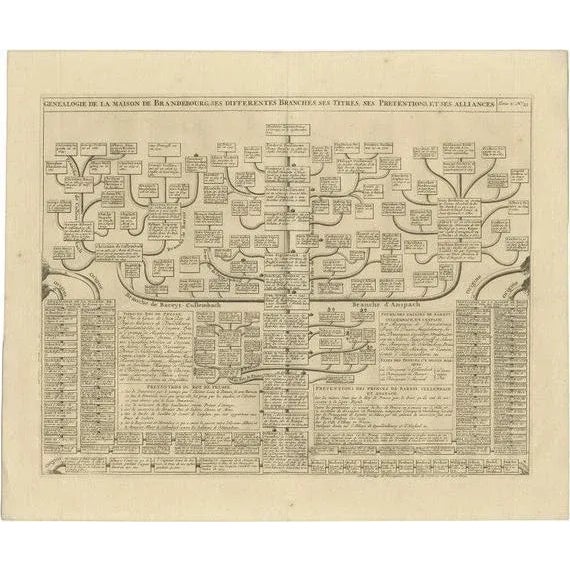
Antique print titled 'Genealogie de la Maison de Brandebourg (\.)'. Genealogy of the rulers of the Margraviate Brandenburg. This print … Read more Antique print titled 'Genealogie de la Maison de Brandebourg (\.)'. Genealogy of the rulers of the Margraviate Brandenburg. This print orginates from 'Atlas Historique'. The Margraviate of Brandenburg (German: Markgrafschaft Brandenburg) was a major principality of the Holy Roman Empire from 1157 to 1806 that played a pivotal role in the history of Germany and Central Europe. Brandenburg developed out of the Northern March founded in the territory of the Slavic Wends. It derived one of its names from this inheritance, the March of Brandenburg (Mark Brandenburg). Its ruling margraves were established as prestigious prince-electors in the Golden Bull of 1356, allowing them to vote in the election of the Holy Roman Emperor. The state thus became additionally known as Electoral Brandenburg or the Electorate of Brandenburg (Kurbrandenburg or Kurfürstentum Brandenburg). The House of Hohenzollern came to the throne of Brandenburg in 1415. In 1417, Frederick I moved its capital from Brandenburg an der Havel to Berlin. By 1535, the electorate had an area of some 10,000 square miles and a population of 400,000. Under Hohenzollern leadership, Brandenburg grew rapidly in power during the 17th century and inherited the Duchy of Prussia. The resulting Brandenburg-Prussia was the predecessor of the Kingdom of Prussia, which became a leading German state during the 18th century. Although the electors' highest title was "King in/of Prussia", their power base remained in Brandenburg and its capital Berlin. The Margraviate of Brandenburg ended with the dissolution of the Holy Roman Empire in 1806. It was replaced after the Napoleonic Wars with the Prussian Province of Brandenburg in 1815. The Hohenzollern Kingdom of Prussia achieved the unification of Germany and the creation of the German Empire in 1871. As Prussia was the legal predecessor of the united German Reich of 1871–1945, and as such a direct ancestor of the present-day Federal Republic of Germany, Brandenburg is one of the earliest linear ancestors of present-day Germany. Artists and Engravers: Henri Abraham Chatelain (1684-1743), his father Zacharie Chatelain (d.1723) and Zacharie Junior (1690-1754), worked as a partnership publishing the Atlas Historique. Condition: Very good, general age-related toning. Please study image carefully. Date: 1732 Overall size: 52.9 x 44.1 cm. Image size: 45.4 x 35.3 cm. See less
- Dimensions
- 20.47ʺW × 17.32ʺH
- Period
- Early 18th Century
- Country of Origin
- France
- Item Type
- Vintage, Antique or Pre-owned
- Materials
- Paper
- Condition
- Good Condition, Unknown, Some Imperfections
- Color
- Gold
- Condition Notes
- Very Good — This vintage item has no defects, but it may show slight traces of use. Very Good — This vintage item has no defects, but it may show slight traces of use. less
Returns & Cancellations
Return Policy - All sales are final 48 hours after delivery, unless otherwise specified in the description of the product.
Cancellation Policy - Prior to shipping or local pickup, buyers may cancel an order for up to 48 hours, unless otherwise specified.