






Details
Description
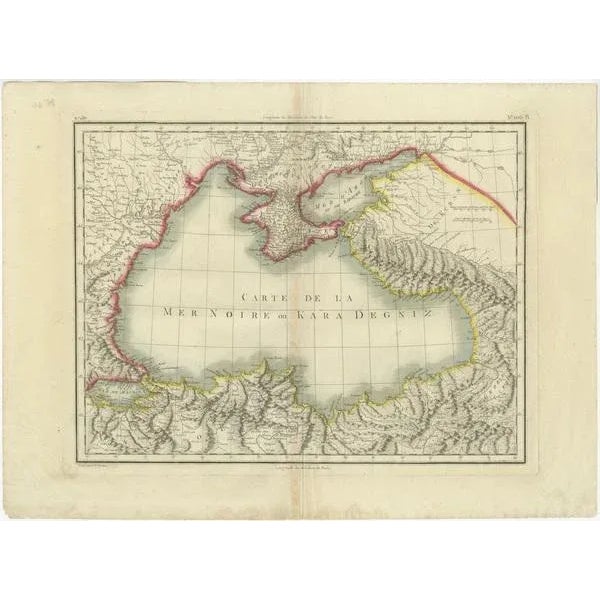
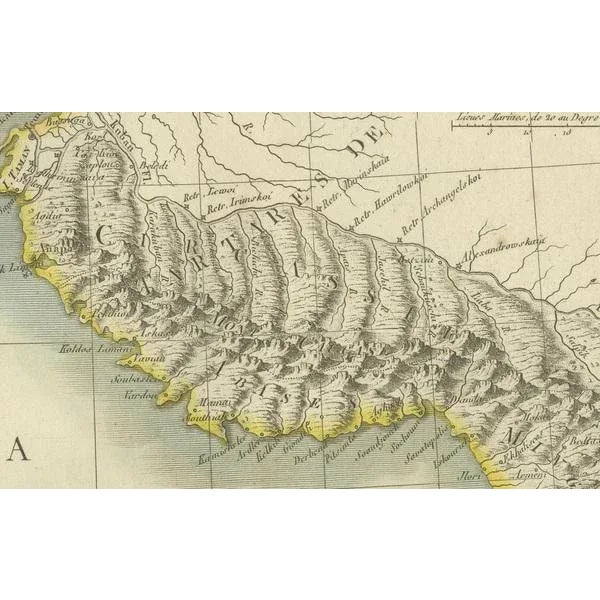
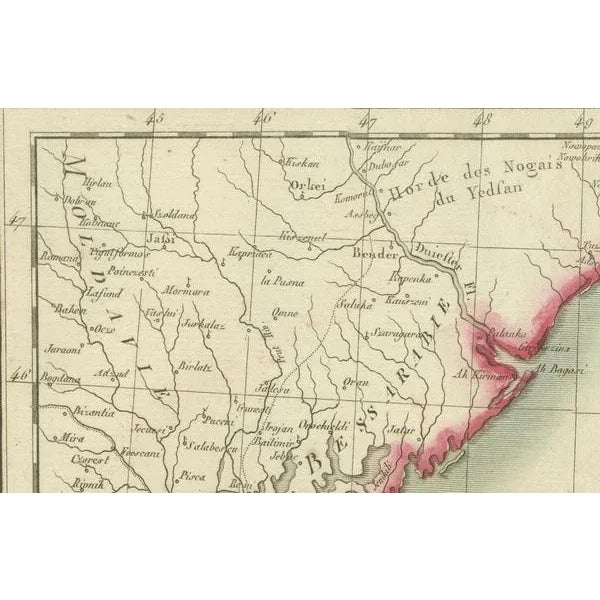
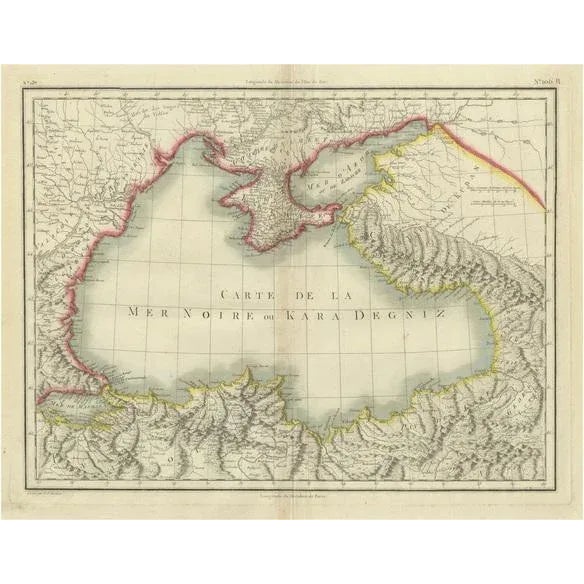
This is an original antique map titled "Carte de la Mer Noire ou Kara Degniz," depicting the Black Sea region. … Read more This is an original antique map titled "Carte de la Mer Noire ou Kara Degniz," depicting the Black Sea region. This map, created by Pierre Antoine Tardieu, highlights the geographical and political features surrounding the Black Sea, including parts of modern-day Turkey, Romania, Bulgaria, Ukraine, Russia, and Georgia. Map Details: - **Title**: Carte de la Mer Noire ou Kara Degniz - **Creator**: Pierre Antoine Tardieu (1784-1869) - **Publication Date**: Early 19th century - **Dimensions**: Approximately 34.5 x 43.5 cm (13.5 x 17.25 inches) - **Features**: The map showcases the Black Sea with detailed coastlines and significant geographical features such as rivers, mountain ranges, and cities. It includes the Sea of Azov and part of the surrounding territories. The title cartouche is centrally located at the top of the map, and the outlines are hand-colored. Around the year 1800, the region surrounding the Black Sea was a complex and dynamic area influenced by several powerful empires and characterized by a mix of cultures, languages, and religions. Here’s a detailed overview of the region during that period: ### Political Landscape 1. **Ottoman Empire**: - **Territory**: Controlled much of the southern coastline of the Black Sea, including what is now Turkey and parts of modern-day Bulgaria and Romania. - **Influence**: The Ottoman Empire was a dominant force, although it was starting to experience internal decline and external pressures. The region was administratively divided into various provinces, with significant autonomy granted to local rulers. 2. **Russian Empire**: - **Expansion**: The Russian Empire was expanding its territory southward and eastward. The northern coastline of the Black Sea, including parts of modern-day Ukraine and southern Russia, was under Russian control. - **Key Cities**: Important cities like Sevastopol and Odessa began to grow in significance as naval and commercial hubs. 3. **Crimean Khanate**: - **Annexation**: The Crimean Khanate, once a powerful vassal state of the Ottoman Empire, had been annexed by the Russian Empire in 1783. This marked a significant shift in the balance of power in the region. 4. **Habsburg Monarchy**: - **Influence**: While not directly controlling Black Sea territories, the Habsburg Monarchy (Austria) had significant influence in the Balkans, which affected the political dynamics around the western parts of the Black Sea. 5. **Other Regions**: - **Moldavia and Wallachia**: These were semi-autonomous principalities under Ottoman suzerainty, located in modern-day Romania. They played crucial roles as buffer states between the Ottoman and Russian Empires. ### Socio-Economic Conditions 1. **Trade and Commerce**: - The Black Sea was a vital trade route connecting Europe with Asia. Key ports like Istanbul (Constantinople), Varna, and Trabzon were bustling centers of commerce. - The grain trade was particularly important, with Ukrainian and Russian grain being shipped to various parts of Europe and the Mediterranean. 2. **Agriculture and Resources**: - The region was rich in natural resources and fertile land, particularly in the areas surrounding the Danube Delta and the Crimean Peninsula. Agriculture, fishing, and later, mineral extraction were significant economic activities. 3. **Cultural Diversity**: - The Black Sea region was a melting pot of ethnicities and cultures, including Turks, Greeks, Armenians, Bulgarians, Romanians, Tatars, and Slavs. - Religious diversity was also notable, with Islam being predominant in Ottoman territories, Eastern Orthodoxy in Russian and Balkan areas, and smaller communities of Catholics, Jews, and other religious groups. ### Conflicts and Changes 1. **Russo-Turkish Wars**: - The late 18th century saw several Russo-Turkish wars, with significant battles fought around the Black Sea. These conflicts often resulted in territorial changes and shifts in influence. - The Treaty of Jassy (1792) ended one such war, confirming Russian dominance over the northern Black Sea coast and parts of the Caucasus. 2. **Decline of the Ottoman Empire**: - The Ottoman Empire was struggling with internal decay, corruption, and increasing nationalist movements within its European territories. - Reforms and attempts to modernize the military and administration were ongoing but faced significant resistance and mixed success. 3. **Napoleonic Wars**: - The early 19th century was marked by the Napoleonic Wars, which had indirect effects on the Black Sea region through shifting alliances and the involvement of European powers. ### Summary The Black Sea region around 1800 was a strategically important and culturally diverse area at the crossroads of several powerful empires. It was characterized by significant political changes, economic activity centered on trade and agriculture, and a rich tapestry of ethnic and religious communities. The interplay between the Ottoman and Russian Empires, along with the influence of other European powers, set the stage for the geopolitical dynamics that would continue to shape the region in the 19th century and beyond. Condition Overview: 1. **Paper Quality**: The paper shows some signs of aging, such as slight yellowing, which is typical for antique maps. There are no major tears or damage visible. 2. **Edges and Corners**: The edges are slightly worn, with minor fraying and small tears, especially near the center fold. These imperfections do not significantly impact the overall readability or aesthetic value. 3. **Center Fold**: A center fold is present, which is common for maps of this period that were often folded for storage or publication. The fold appears intact without significant separation or damage. 4. **Color and Print Quality**: The hand-colored outlines remain vibrant and clear, highlighting the borders of different regions. The print quality is excellent, with sharp, legible text and detailed illustrations. 5. **Staining and Spots**: There are a few spots and stains, particularly near the edges and along the fold. These do not obscure any critical details of the map. Historical and Artistic Value: Pierre Antoine Tardieu was a renowned French engraver and cartographer, known for his detailed and high-quality maps. His use of steel engraving allowed for greater precision and detail compared to earlier methods. Tardieu's maps were well-regarded and often used for educational and reference purposes. See less
- Dimensions
- 21.26ʺW × 16.14ʺH
- Period
- Early 19th Century
- Item Type
- Vintage, Antique or Pre-owned
- Materials
- Paper
- Condition
- Good Condition, Unknown, Some Imperfections
- Color
- Black
- Condition Notes
- Very Good — This vintage item has no defects, but it may show slight traces of use\. Good condition with … moreVery Good — This vintage item has no defects, but it may show slight traces of use\. Good condition with minor age-related wear. Hand-colored boundaries are well-preserved, enhancing the clarity of regions and features. Fold lines and edge wear are visible. Study the images carefully. less
Returns & Cancellations
Return Policy - All sales are final 48 hours after delivery, unless otherwise specified in the description of the product.
Cancellation Policy - Prior to shipping or local pickup, buyers may cancel an order for up to 48 hours, unless otherwise specified.