




Details
Description
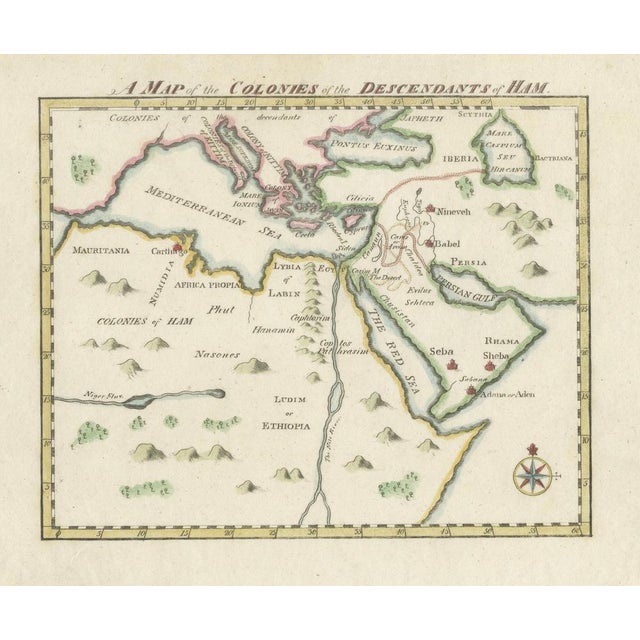
This map, titled "A Map of the Colonies of the Descendants of Ham," dates to around 1790. It illustrates regions … Read more This map, titled "A Map of the Colonies of the Descendants of Ham," dates to around 1790. It illustrates regions in Africa, the Middle East, and parts of Europe that were traditionally believed to be settled by the descendants of Ham, one of Noah's sons, according to the Book of Genesis and to biblical tradition. The map's style, with speculative geographic features, is reminiscent of the work of the polymath Athanasius Kircher. It was created for an English biblical history and likely drawn by Lodge. This map reflects early cartographic attempts to merge religious stories with geographic understanding. ### Key Features and Analysis: 1. Regions Depicted: - North Africa: The map shows the regions of Mauritania, Carthage, Numidia, and "Africa Propria." These areas align with modern-day North Africa, including Libya, Tunisia, and parts of Algeria. - Egypt and Ethiopia: The map highlights Egypt and regions labeled "Ludim or Ethiopia," which corresponds to ancient Cush. The Red Sea and the Nile River are prominently depicted, emphasizing their significance in ancient history and biblical narratives. - Persia and Mesopotamia: Mesopotamian cities like Nineveh and Babel (Babylon) are marked, along with Persia, underlining their importance in biblical accounts. - Arabian Peninsula: The Arabian Peninsula is labeled with places such as Sheba and Seba, areas famously connected to the Queen of Sheba in biblical texts. - Southern Europe: Parts of Southern Europe, such as Iberia (Spain) and regions around the Mediterranean, are shown as the extent of these "colonies." 2. Colonies of Ham: According to biblical tradition, the descendants of Ham are thought to have settled in Africa and parts of the Middle East, and this map reflects the traditional geographic distribution based on religious interpretations. Ham's sons, such as Cush, Mizraim (Egypt), and Phut, are represented by the areas where their descendants were believed to have settled. 3. Map Aesthetic: The map uses a simplistic style with soft pastel colors to differentiate regions. The place names are written in a mix of Latin and English, indicative of the European cartographic traditions of the period. It features a decorative compass rose in the bottom right, which adds a classic touch to the historical design. 4. Historical Context: This map is part of a tradition in which European cartographers combined biblical narratives with contemporary geographic knowledge. These maps were not intended to be accurate representations of geography but rather visualizations of religious or historical interpretations. They were popular in the 17th and 18th centuries, especially among audiences interested in biblical history. See less
- Dimensions
- 11.02ʺW × 9.06ʺH
- Item Type
- Vintage, Antique or Pre-owned
- Materials
- Paper
- Condition
- Unknown, Some Imperfections
- Color
- Gold
- Condition Notes
- Very Good — This vintage item has no defects, but it may show slight traces of use\. Condition: good, given … moreVery Good — This vintage item has no defects, but it may show slight traces of use\. Condition: good, given age. General age-related toning and/or occasional minor defects from handling. The paper is light. Please study scan carefully. less
Returns & Cancellations
Return Policy - All sales are final 48 hours after delivery, unless otherwise specified in the description of the product.
Cancellation Policy - Prior to shipping or local pickup, buyers may cancel an order for up to 48 hours, unless otherwise specified.