




Details
Description
Jean spath
19th-century history painter
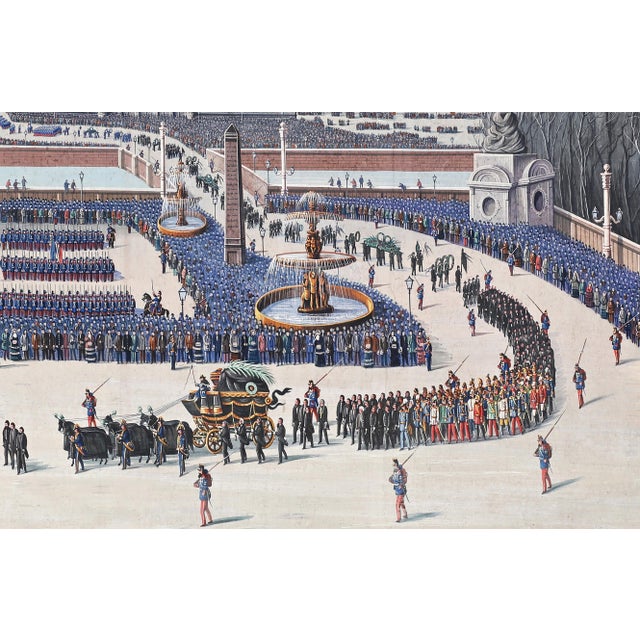
state funeral of léon gambetta on january 6, 1883, at the place de la concorde
…
Read more
Jean spath
19th-century history painter
state funeral of léon gambetta on january 6, 1883, at the place de la concorde
mixed media on canvas
size: 125 x 185 cm
frame: 130 x 190 cm
original condition, replaced stretcher, minor damage (see photos)
authenticity will be confirmed in writing.
léon michel gambetta (april 2, 1838 in cahors; december 31, 1882 in ville-d'avray near paris) was a french politician. He was one of the founding fathers of the third republic and prime minister from 1881 to 1882.
gambetta was the son of a merchant who, as a child, immigrated with his parents from liguria to the small town of cahors in southern france, where he ran a small grocery store. His mother was from gascony. Due to his father's origins, léon gambetta was initially a subject of the kingdom of sardinia-piedmont. He attended the minor seminary in montfaucon, then the lycée in cahors. At the age of 15, gambetta lost his right eye while watching a cutler and was struck by a broken drill bit. Gambetta became a french citizen in 1859. From 1857 to 1860, he studied law in paris, received his license en droit, and became a lawyer. When he defended the journalist charles delescluze in a court case in 1868, he became known as an opponent of the second empire. In 1869, he was admitted to the freemasons' association at the la réforme lodge in marseille.
in 1869, he won a seat in the national assembly. During the election campaign, he helped formulate the "belleville program," which, with its far-reaching demands for civil liberties, became the fundamental manifesto of the radical left. In parliament, gambetta joined the republican minority that opposed the franco-prussian war of 1870.
with jules favre, léon gambetta proclaimed the third republic in paris on september 4, 1870, after the defeat at sedan and the abdication of emperor napoleon iii, and became its first minister of the interior. On october 7, 1870, he was commissioned by the government of national defense to lead the war in the provinces. Gambetta then left besieged paris in a balloon, but his plan to liberate the capital failed. In tours, he organized a new government that would convene in bordeaux.
when paris capitulated on january 28, 1871, gambetta advocated continuing the war. Adolphe thiers therefore called him a furious madman. Gambetta was ultimately forced to accept the armistice and resigned from his government office on february 6, 1871. After the war, gambetta was a staunch advocate of revanchism against germany and coined the phrase: "toujours y penser, jamais en parler" ("always think about it, never speak of it!"). In the national assembly, he represented the bas-rhin department in alsace from february 8 to march 1, 1871; after the annexation by the germans, he resigned his seat in protest. He withdrew to spain and switzerland for a few months and was elected as a deputy for the seine department on july 2, 1871. He led the union républicaine, the smaller and more radical of the two republican factions. In the parliament, which had a monarchist majority, he was the most important representative of the republican opposition. He increasingly adopted more moderate positions, thereby contributing to the passage of the constitutional laws of 1875. Following the republican victory in the 1876 parliamentary election, gambetta orchestrated the overthrow of the royalist president patrice de macmahon in 1877/1878.
from january 1879 to october 1881, gambetta served as president of the chamber of deputies. In the 1881 parliamentary election, the union républicaine, led by gambetta, emerged as the strongest party. Gambetta subsequently served as president of the council of ministers (prime minister) from november 14, 1881, to january 27, 1882, and virtually simultaneously as foreign minister. In addition to his own parliamentary group, gambetta's government also included the moderate-republican gauche républicaine. A coalition of the right and the radical left in parliament ousted gambetta after two and a half months in office because of his attempt to introduce a list voting system. Radicals and socialists accused him of dictatorial tendencies.
gambetta died at the age of 44 from blood poisoning resulting from an injury to his hand. According to official reports, he had accidentally sustained it while repairing his pistol.
in 1888, a 27-meter-high monument in the form of a stone pyramid was unveiled in the jardin des tuileries. However, the bronze allegories were melted down during the german occupation of france. The rest was finally removed in 1954. The remains of gambetta's statue at the stone pyramid were placed in the 20th arrondissement in 1982 on the 100th anniversary of his death.
on november 11, 1920, gambetta's heart was transferred to the panthéon, the same day the tomb of the unknown soldier was erected beneath the arc de triomphe.
gambetta was posthumously honored with numerous monuments and namings. There are 1,501 streets named after him in france, making him the sixth-largest street named after people. A paris métro station also bears his name.
the french navy's armored cruiser léon gambetta was named after him in 1901. The sinking of this ship in 1915, with the loss of nearly 700 lives, is considered one of france's worst naval disasters during the first world war.
source: wikipedia
this piece has an attribution mark,
i am sure that it is completely authentic and take full responsibility for any authenticity
issues arising from misattribution
See less
- Dimensions
- 74.8ʺW × 1.18ʺD × 51.18ʺH
- Art Subjects
- Figure
- Period
- Late 19th Century
- Country of Origin
- France
- Item Type
- Vintage, Antique or Pre-owned
- Condition
- Good Condition, Unknown, Some Imperfections
- Color
- Condition Notes
- Patina Consistent with Age and Use Patina Consistent with Age and Use less
Returns & Cancellations
Return Policy - All sales are final 48 hours after delivery, unless otherwise specified in the description of the product.
Cancellation Policy - Prior to shipping or local pickup, buyers may cancel an order for up to 48 hours, unless otherwise specified.
Related Collections
- Ralph Lauren Paintings
- Ed Ruscha Paintings
- Photorealism Canvas Paintings
- Photorealism Paintings in New York
- Karen Offutt Paintings
- Richard Serra Paintings
- Silk Velvet Paintings
- Jo Baskerville Paintings
- Jeff Slemmons Paintings
- Black Photorealism Paintings
- Herman Miller Paintings
- Cassina Paintings
- Louise Nevelson Paintings
- Vienna Secession Paintings
- Jaanika Peerna Paintings
- Photorealism Paintings in Los Angeles
- BDDW Paintings
- Lee Reynolds Paintings
- Mid-Century Modern Paintings
- Abstract Paintings
- Nautical Paintings
- Velvet Paintings
- Landscape Paintings
- 19th Century Oil Paintings
- Oil Paintings