



Details
Description
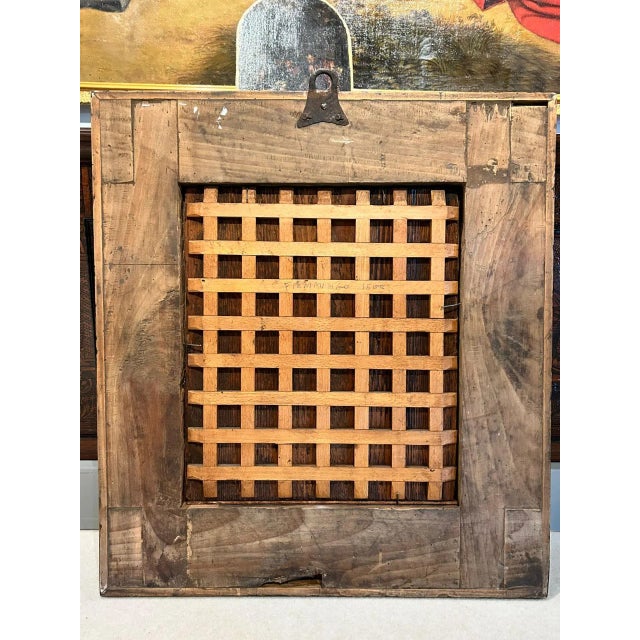
Oil on panel painting from the second half of the 16th century depicting an original representation of a buffoon or … Read more Oil on panel painting from the second half of the 16th century depicting an original representation of a buffoon or other grotesque character. Attributable to niccolò frangipane (documented from 1563 to 1597) or his close circle. Active in northeastern italy in friuli, veneto, and romagna. Panel dimensions: 36cm x 42cm. Dimensions of the 16th-century box frame on which it is mounted: 61 cm x 68 cm. We include a historical certificate of authenticity with the sale. From a typological and stylistic point of view, it is possible to assign this beautiful panel painting to nicolò frangipane, a painter whose place and date of birth are unknown, but who was active and residing in venice from 1563, the year to which a contract for the execution of an altarpiece for the church of sant’eufemia in mazzorbo dates back. In 1564, niccolò appears in the painters' guild of the lagoon city, while his last certain work, autumn, now at the civic museum of udine, is dated 1597. Very few archival documents concern n. F., although numerous signed and dated paintings by the painter are known. De renaldis hypothesizes that there is a “friulian” frangipane, a pupil of titian, some of whose paintings were in friuli at the end of the eighteenth century, different from «the other painter by profession of the same name and surname, who flourished in venice, whose homeland is not known with certainty; and who, among other things, created certain bizarre and burlesque paintings of his own particular invention.» it is now established, however, that the painter n. F. Was not friulian: in a contract of 1563 in which he undertakes to execute a altarpiece for the altar of the church of the convent of s. Eufemia in mazorbo, he is in fact said to be the son of matteo, living in venice in the parish of s. Canzian («maistro nicolò frangipane quondam matheo depentor qual sta in birri in contrà de san canzian»), which leads to excluding his identification with a hypothetical f. “friulian”. It must be said that, given his incomplete biography, it is possible that he may have resided for a period in friuli or spent his last years there after the last bergamasque testimonies of 1597. It is unknown when he died. B. W. Meijer, reconstructing the artistic personality of f. And assigning him a large body of paintings, believes in his apprenticeship with titian. In reality, it is difficult to establish who was the master of our painter, who is influenced by the painting of giorgione as well as that of titian or campagnola, and who, with his painting of archaic flavor, is an interesting link between the giorgionism of the early sixteenth century and the seventeenth-century revival that sees pietro vecchia as the greatest exponent. Defined by marco boschini, who in the seventeenth century was his first biographer, as a «curious painter» who painted «witty and ridiculous things.» he affirmed that the fame achieved by the painter was mainly due to such representations, in which the strongly realistic (sometimes almost caricatured) definition of the characters is accompanied by a comic and often somewhat risqué iconography. F. Can be considered a late giorgionesque, but with nordic suggestions, bizarre and violent in the modeling of the figures, sometimes crude in their forms and postures, and in the drafting of contrasting colors. The civic museum of udine possesses two of his paintings depicting christ carrying the cross (1572, signed) and the allegory of autumn (1597, signed). Other paintings are preserved in the monte di pietà (the holy family with st. John the baptist, formerly brass collection, venice, 1597, signed), in the biasutti collection (penitent magdalene, signed; st. Francis, attr.) and in the collection of the cassa di risparmio di udine e pordenone foundation (the holy family, 1589, signed). His production can be clearly traced back to three distinct categories: religious subjects, characterized by dry and archaic manners, such as the deposition of the frari of 1593; profane representations of evident giorgionesque derivation, such as the young man with hat and flute of charlecote park near statford on avon, and a third group of “comic and bizarre” works, considered his specialty. The bacchanal of the querini stampalia foundation in venice belongs to this group, perhaps identifiable with the “bacchanal concert of buffoons… of frangipani” that appears in an inventory of paintings by francesco querini in san marziale, compiled in 1708 (m. Dazzi, e. Merkel, catalogue of the pinacoteca della fondazione scientifica querini stampalia, venezia 1979, p. 47, n. 27), a version of the subject limited to the presence of only three figures: bacchus, a buffoon and a young woman. A more articulated and complex composition of the same theme, in which the same three figures also appear, albeit in a different position (and with a different hairstyle for the woman), is instead that documented by a nineteenth-century english engraving “with simple outlines” preserved in the witt library in london; entitled a bacchanalian subject, the print bears on the back a pencil inscription, which says it is derived from a painting existing at the time in the castelbarco collection in milan (b.w. Meijer, nicolò frangipane in rimini, in “arte veneta”, xxiv, 1970, pp. 214, 217, note 3). The compositional affinities between the subject of the beautiful panel we present here and the character to the right of bacchus in the bacchanals we have just mentioned are very remarkable: the grinning and satirical figure is entirely analogous, in our case dressed in a bright turquoise jacket with a wide white collar, with his head then covered by a curious mantle and girded in the upper part by a cord, attributes that we often find precisely to characterize court jesters and jester characters and that are also found in the bacchanal in venice, in the engraving of the witt library and in another bacchanal, probably another attribution of the artist, proposed on panel, today in the altomani collection. See less
Returns & Cancellations
Return Policy - All sales are final 48 hours after delivery, unless otherwise specified in the description of the product.
Cancellation Policy - Prior to shipping or local pickup, buyers may cancel an order for up to 48 hours, unless otherwise specified.
Related Collections
- Carrie Bergey Paintings
- Steve Kaufman Paintings
- Limoges, France Paintings
- Lee Krasner Paintings
- George Coggeshall Paintings
- Michelle Arnold Paine Paintings
- Jacobean Paintings
- Damien Hirst Paintings
- Sol LeWitt Paintings
- Nikolaos Schizas Paintings
- Paul Jenkins Paintings
- BandB Italia Paintings
- René Magritte Paintings
- Paintings in Panama City, FL
- Rolph Scarlett Paintings
- Richard Anuszkiewicz Paintings
- Laminate Paintings
- Donald Judd Paintings
- Camille Pissarro Paintings
- Roy Lichtenstein Paintings
- Keith Haring Paintings
- William IV Paintings
- Lee Reynolds Paintings
- Mid-Century Modern Paintings
- Abstract Paintings