





Details
Description
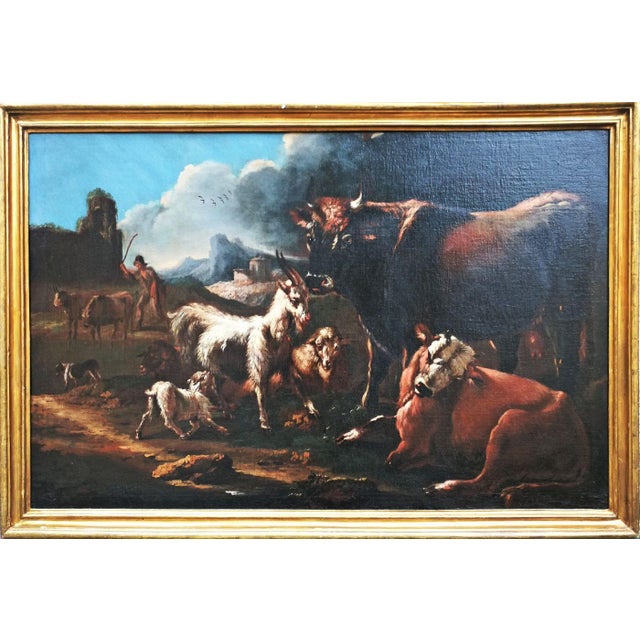
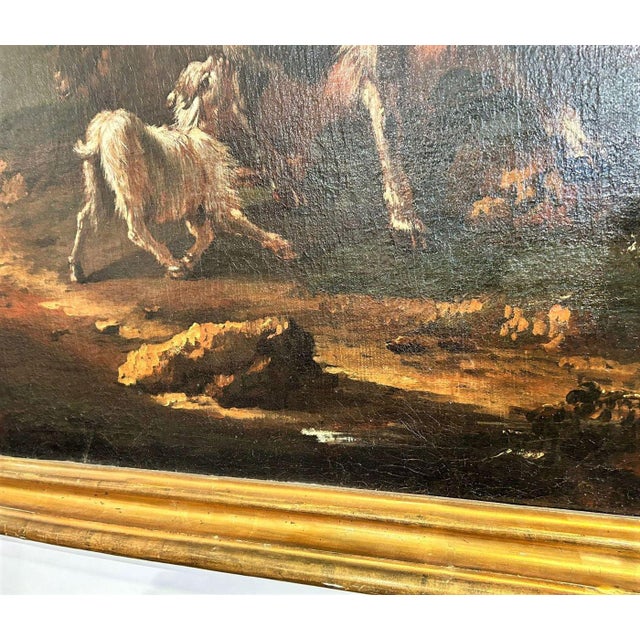
Oil on canvas painting depicting a rural scene and attributed to the hand of the most famous animal painter of … Read more Oil on canvas painting depicting a rural scene and attributed to the hand of the most famous animal painter of his time, Peter Roos, known as Monsù Rosa or Rosa da Tivoli (Sankt Goar, August 30, 1657 – Rome, January 17, 1706). Within their contemporary "Salvador Rosa" leaf-gilded frames, the section of which measures 15-16 cm. The dimensions of the canvases are 145 x 96cm. In this scene, the pictorial peculiarity of the Italo-German master is perfectly expressed; the animals are rendered with graphic and luminescent effectiveness through intense and pasty brushstrokes. The particular plays of chiaroscuro, of Caravaggesque matrix, and the compositional balance give us sensations of peace of the moment and respect for these subjects so dear to the painter. It is possible to make a very valid comparison with the two large canvases attributed to Rosa da Tivoli and exhibited in the section dedicated to seventeenth-century painters of the National Gallery of Parma inside the Pillotta palace, in which we see very similar representations for scenic and figurative setting, but in which some characters vary. The style and pictorial and luminescent quality are very similar, so it could be said that it is a version of the same representation exhibited at the Pillotta palace. Roos was a German painter and engraver of the Baroque period. He belonged to a well-known family of German painters and engravers: his father was Johann Heinrich Roos, the most important German animal painter of the 17th century. He arrived in Italy in 1677, with a scholarship from the Landgrave of Hesse, on condition that he return to his court. However, disregarding the conditions of the Landgrave, he never returned to Germany. He studied in Rome with Giacinto Brandi, whose daughter Maria Isabella he married in 1681, after embracing the Catholic faith. In 1684-1685 he bought a house near Tivoli, which earned him the nickname of Rosa da Tivoli. Roos raised animals and painted them in this ramshackle house, which was therefore called Noah's Ark. from 1691 he lived mainly in Rome, where he became a member of the Schildersbent, with the nickname of Mercurius, for the speed with which he executed his paintings and for the ease with which he painted. This speed of execution was particularly useful to him: in fact, often without money, he painted one or two paintings that he had his servant sell at any price, to pay the inn bill. He lived in a dissolute way and died in misery. As for style, most of his works depict domestic animals, with their herdsmen, in the Roman countryside. The animals are generally painted in the foreground and dominate the scene, while the landscapes with the typical features of the Lazio countryside are seen in the distance. Roos spreads his paint in impasto, rendering his subjects, the position and the movements of each species with great talent through luminescent compositions of great effect. In the years around 1680 the artist generally portrayed small groups of animals (sheep and goats, often led by a goat with curved horns), with the shepherds on the side in rough clothes, next to the animals. Far away, wild valleys alternated with steep walls, illuminated by a yellow-brown light; the distant mountains were rendered in shades of blue. In the background there were often ancient ruins. Around the 1690s, Roos mainly painted landscapes. Overall, his paintings are characterized by a spectral, gloomy and wild tone. Furthermore, Roos managed to transform natural landscape motifs into unusual and dynamic visions. Although this artist generally painted landscapes and animals, he was able to create more complex compositions, as evidenced by the drawing Deposition from the Cross, now at the Jean Paul Getty Museum. Roos's style reflected his way of working. It was in fact characterized by the use of intense, sometimes almost coarse brushstrokes and a strong contrast between light and shadow. This personal manner was quite popular and attracted many imitators. For this reason, works by other animal painters were mistakenly attributed to Roos. Furthermore, the artist's brothers and sons also used to paint the same subjects, contributing to increasing confusion. The canvas is in perfect condition. The same applies to the gilded "Salvador Rosa" frames. We attach a historical guarantee certificate that certifies the authenticity and period of the paintings, accompanied by photographic documentation. See less
- Dimensions
- 37.8ʺW × 37.8ʺD × 57.09ʺH
- Country of Origin
- Germany
- Item Type
- Vintage, Antique or Pre-owned
- Condition
- Unknown, Some Imperfections
- Color
- Blue
- Condition Notes
- Good — This vintage item remains fully functional, but it shows sign of age through scuffs, dings, faded finishes, minimal … moreGood — This vintage item remains fully functional, but it shows sign of age through scuffs, dings, faded finishes, minimal upholstery defects, or visible repairs. less
Returns & Cancellations
Return Policy - All sales are final 48 hours after delivery, unless otherwise specified in the description of the product.
Cancellation Policy - Prior to shipping or local pickup, buyers may cancel an order for up to 48 hours, unless otherwise specified.
Related Collections
- Steve Kaufman Paintings
- Margaret Kennedy Paintings
- Joseph Solman Paintings
- Limoges, France Paintings
- Donald Judd Paintings
- Jacobean Paintings
- Louis Wolchonok Paintings
- Michelle Arnold Paine Paintings
- Mark Lewis Paintings
- Mark Lewis Art Paintings
- Paul Jenkins Paintings
- Black Photorealism Paintings
- Photorealism Canvas Paintings
- Sol LeWitt Paintings
- Nikolaos Schizas Paintings
- Photorealism Paintings in New York
- Vienna Secession Paintings
- Keith Haring Paintings
- Blown Glass Paintings
- Paintings in Panama City, FL
- Lee Reynolds Paintings
- Mid-Century Modern Paintings
- Abstract Paintings
- Nautical Paintings
- Velvet Paintings