







Details
Description
Title: 1616 Petrus Bertius Map of Cambay and Gujarat, India : This early seventeenth-century map, titled Descriptio Cambaiæ, was published …
Read more
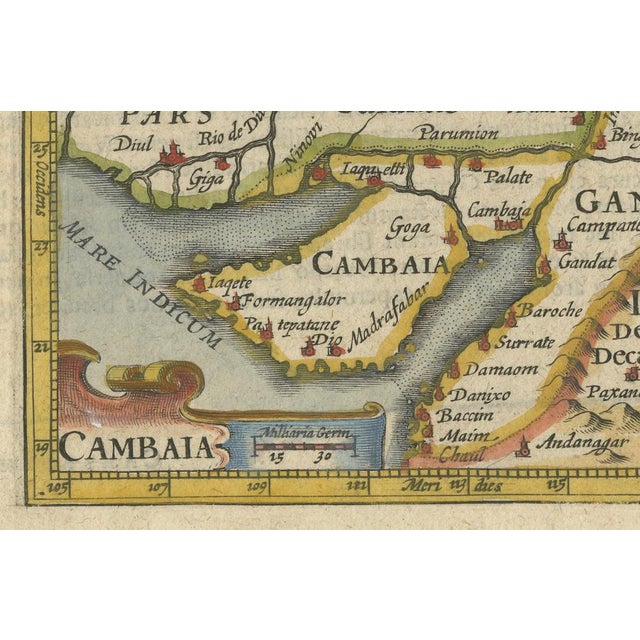
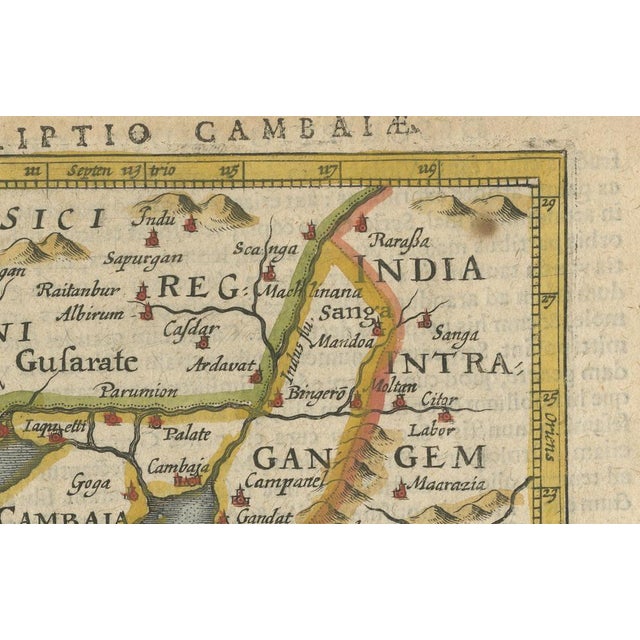
Title: 1616 Petrus Bertius Map of Cambay and Gujarat, India : This early seventeenth-century map, titled Descriptio Cambaiæ, was published in 1616 by Petrus Bertius, a well-known Dutch cartographer and historian. It depicts Cambay, known today as Khambhat, along with the surrounding regions of Gujarat, India, and parts of Rajasthan and Maharashtra. The map was originally based on Barent Langenes' Caert-Thresoor, first published between 1598 and 1600, and was later included in Bertius' 1616 edition of Tabularum Geographicarum Contractarum, a widely circulated geographic atlas of the time. This map provides a detailed view of northwestern India, highlighting significant trade centers, rivers, and coastal ports along the Mare Indicum, or Indian Ocean. The region of Cambay was an important commercial hub during the Mughal period, known for its textile production and extensive maritime trade. The decorative cartouche in the lower-left corner bears the title “Cambaia,” emphasizing the city's significance as a major trading center connecting India with the Middle East and Europe. The map includes various political and geographical details. It marks Pars, which corresponds to the Sindh region in modern-day Pakistan, featuring locations such as Diul, or Diu, Pafpr, or Porbandar, and Giga. The region of Gujsarate, or Gujarat, includes cities like Cambaya, or Khambhat, Goga, or Gogha, and Madrafabar, or Madrafapur. Further inland, the map identifies Delli, or Delhi, and Decan, or the Deccan Plateau, representing the heart of the Mughal Empire. The map also notes Gangem, referring to the Ganges region, highlighting trade connections between western and eastern India. The Gulf of Cambay is prominently depicted with key trading ports such as Damaom, or Daman, and Bacim, or Bassein, which were part of Portuguese-controlled India during the early seventeenth century. Hand-colored details add a vibrant touch, with different regions shaded in yellow, green, and red to distinguish territorial divisions. Small red icons representing fortified cities and ports reflect the strategic importance of various locations in regional and global trade.
Condition Report: The paper is well-preserved, showing the fine laid texture typical of early seventeenth-century Dutch printing. The engraving remains sharp, with clearly legible place names and delicate line work defining rivers, coastlines, and settlements. There is slight age-toning, especially along the edges, which is expected in a map of this period. Minor text bleed-through from the reverse is present but does not interfere with the visual clarity of the map. The original hand-coloring remains vibrant, with only minimal fading. The margins are intact, and there are no significant tears, stains, or restorations, making this a well-preserved and highly collectible example of an early European map of India. Framing Recommendations: To properly protect and display this antique map, archival-quality materials are recommended. For matting and backing, use acid-free, museum-grade board to prevent deterioration. A double mat with a neutral outer mat and a subtle gold or beige inner accent will highlight the fine details and warm tones of the engraving. A dark walnut, black, or gilded wooden frame will complement the historical character of the map. An antique-style frame with subtle carvings can enhance its early seventeenth-century aesthetic. To ensure longevity, UV-resistant museum glass or acrylic is advised to prevent fading from light exposure. Anti-reflective glass will allow clear visibility of the intricate details without glare.
See less
- Dimensions
- 7.09ʺW × 4.72ʺH
- Period
- 17th Century
- Item Type
- Vintage, Antique or Pre-owned
- Materials
- Paper
- Condition
- Good Condition, Unknown, Some Imperfections
- Color
- Beige
- Condition Notes
- Very Good — This vintage item has no defects, but it may show slight traces of use\. Light age-toning particularly … moreVery Good — This vintage item has no defects, but it may show slight traces of use\. Light age-toning particularly along the edges, Slight fading in some areas less
Returns & Cancellations
Return Policy - All sales are final 48 hours after delivery, unless otherwise specified in the description of the product.
Cancellation Policy - Prior to shipping or local pickup, buyers may cancel an order for up to 48 hours, unless otherwise specified.