


Details
Description
Lovis Corinth
Tapiau 1858 - 1925 Zandvoort
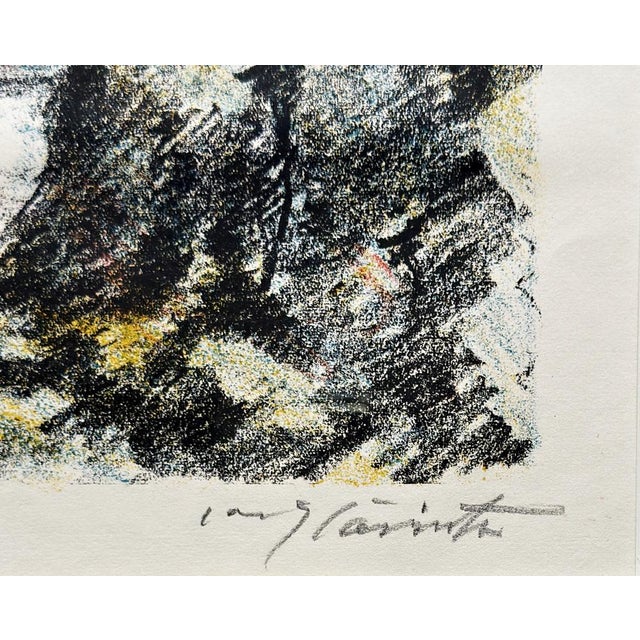
Mountain Lake, 1923
Color lithograph on laid paper
Hand-signed in pencil lower right
…
Read more
Lovis Corinth
Tapiau 1858 - 1925 Zandvoort
Mountain Lake, 1923
Color lithograph on laid paper
Hand-signed in pencil lower right
Sheet 5 of the portfolio "Swiss Landscapes"
One of 75 copies on this paper
Image size: 16.5 x 17.5 cm
Sheet size: 40 x 30 cm
Frame: 43 x 33 cm
Catalogue raisonné Müller 796
Authenticity is confirmed in writing.
Lovis Corinth was born on July 21, 1858, in the town of Tapiau in East Prussia (now Gwardeysk, Russia). While still at high school in Königsberg, his interest in Greek and Roman mythology and the Christian stories of the Bible was awakened. from 1876, Lovis Corinth attended the Königsberg Art Academy, studying under Otto Günther, who introduced him to Weimar plein air painting. In 1880, he transferred to the Munich Academy. Works from his Munich period demonstrate his orientation towards the naturalistic painting style of the circle around Wilhelm Leibl.
In 1883, Lovis Corinth traveled to Italy with his father, and in 1884, he spent three months in Antwerp, where he took painting lessons from Paul Eugène Gorge. from 1884 to 1887, Corinth studied in Paris at the Académie Julian. The artist then traveled to Berlin, where he probably created his first self-portrait in 1887/88, followed by numerous others over the years.
from 1891 to 1899, Corinth lived as a freelance painter in Munich, where he was a member of the Secession. After meeting Max Liebermann and Walter Leistikow in the winter of 1898/99, he decided to move to Berlin, where he settled in 1901. His work "Salomé with the Head of John, Version II" had previously been shown with great success at the second exhibition of the "Berlin Secession."
Lovis Corinth opened a painting school in Berlin. In 1903, he married Charlotte Berend, his first student. A son was born in 1904. The motif of a mother with her child recurred in his works during this period. Corinth's painting style, initially dark and heavy, now began to become looser and lighter, impressionistic. His painting style always featured a powerful brushwork and impasto application of paint. His paintings emerged entirely from the color. In later years, his painting took on increasingly expressive characteristics.
from 1907 to 1911, Lovis Corinth undertook study trips to Belgium and Holland. In 1911, Corinth was elected chairman of the Berlin Secession. That same year, he suffered a stroke and was left paralyzed on one side of his body. During his convalescence from 1912 to 1914, Corinth traveled to the Riviera, South Tyrol, and Italy, recovering sufficiently to be able to paint again. After 1911, Lovis Corinth also turned his attention to graphic art, producing a wealth of etchings and lithographs, as well as book illustrations.
In 1914, the Free Secession split off from the Berlin Secession. Corinth remained in the original Secession and became its chairman again in 1915. In 1916/17, he traveled to Hamburg, the Baltic Sea, and Tapiau. In 1918, Lovis Corinth became a professor at the Academy of Arts in Berlin. In 1919, he and his wife built a country house in Urfeld on Lake Walchensee, which served as an idyllic retreat for the next few years. This is where the "Walchensee" paintings were created.
In June 1925, Lovis Corinth traveled to Amsterdam once again, but he fell seriously ill with pneumonia and died on July 17, 1925, in Zandvoort. This piece has an attribution mark,
I am sure that it is completely authentic and take full responsibility for any authenticity
issues arising from misattribution
See less
- Dimensions
- 12.99ʺW × 0.79ʺD × 16.93ʺH
- Styles
- Modern
- Period
- 1920s
- Country of Origin
- Germany
- Item Type
- Vintage, Antique or Pre-owned
- Condition
- Good Condition, Original Condition Unaltered, Some Imperfections
- Color
Returns & Cancellations
Return Policy - All sales are final 48 hours after delivery, unless otherwise specified in the description of the product.
Cancellation Policy - Prior to shipping or local pickup, buyers may cancel an order for up to 48 hours, unless otherwise specified.
Related Collections
- Patrick Nagel Reproduction Prints
- Reproduction Prints in Panama City, FL
- William Hogarth Reproduction Prints
- Polychrome Reproduction Prints
- Reproduction Prints in Mobile
- Hable Reproduction Prints
- Jute Reproduction Prints
- Sam Francis Reproduction Prints
- Leather Reproduction Prints
- Utagawa Kunisada (Toyokuni Iii) Reproduction Prints
- Reproduction Prints in Boise
- Alvar Aalto Reproduction Prints
- Daylight Dream Editions Reproduction Prints
- Gold-Plate Reproduction Prints
- Tuscan Reproduction Prints
- Port 68 Reproduction Prints
- Ethan Allen Reproduction Prints
- Paule Marrot Reproduction Prints
- Francis Orpen Morris Reproduction Prints