




Details
Description
A pair of companion still lifes from the mid-1700s.
still life with bucchero pottery, recorder, fruit, flowers, porcelain, biscuits, and …
Read more
A pair of companion still lifes from the mid-1700s.
still life with bucchero pottery, recorder, fruit, flowers, porcelain, biscuits, and hanging papers.
still life with mandola, books, fruit, kitchen knife, oval basket, and hanging papers.
the companion piece depicts two tables set in an interior against a wooden wall. Both tables, one square and one hexagonal, feature seemingly chaotic compositions of objects, yet together they form an orderly pyramidal geometry. This pyramidal geometry is in turn traversed by a diagonal beam of light that clearly distinguishes the light on the left from the shadows on the right.
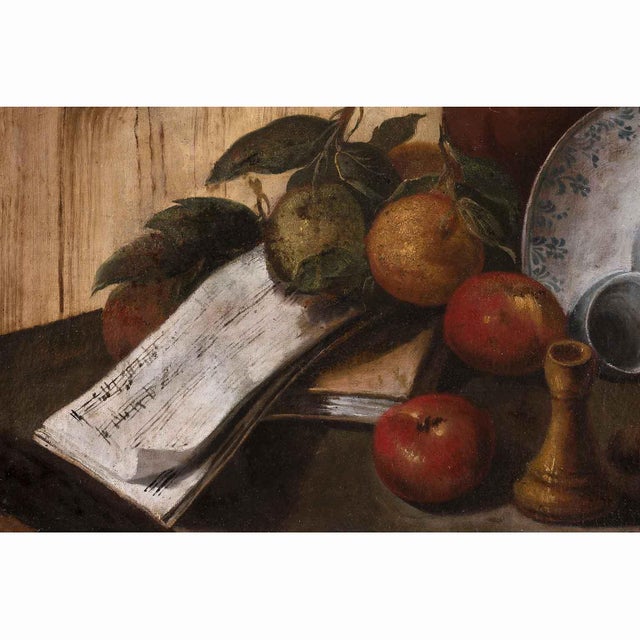
on the square table, we find food and household objects such as biscuits of various shapes, scattered fruit, a bowl, and small oriental porcelain cups arranged in different positions. These are interspersed with objects of luxury, such as the recorder broken into three pieces, the musical score, the vase of cut flowers, and the bucchero vase. On the larch-panelled walls hang papers and an oval frame.
on the hexagonal table, we see a twelve-string mandola, two lemons, one cut in half, plums and cherries, some scattered and some contained in a wicker basket with a handle, three parchment-bound books (one of which is precariously balanced on the edge of the table), a kitchen knife, and a decorated oval basket. On the larch-panelled wall, hanging from nails, we see a bunch of keys, some lunettes, and two sheets of paper, one with a folded corner and a figure drawn in red chalk.
both paintings use a high-angle perspective to better depict the set tables, and both feature the same sharp, diagonal cut of light that helps enhance the depiction of the objects. Regardless of the musical instruments, these are all household objects, creating a synthesis between the kitchen still lifes (tableware and food), the desk/study still lifes (books and notes), and the naturalistic still lifes (vase of flowers).
this fusion also includes elements of deceptive painting (the glasses that invite careful observation, and the keys that mark the boundary between the world of reality and that of illusion).
the pair of paintings under consideration offers a series of interesting reflections on the vast production of still lifes that spread throughout italy between the 17th and 18th centuries. The first question i asked myself while observing them was their classification: are they still lifes or trompe l'oeil?
this hesitation stems from the presence of the wooden wall in the background and the many similarities with the vast production of illusory paintings of the same period by the painters of false boards; francesco raspis, antonio gianlisi, andrea remps, sebastiano lazzari, and many others developed this art of deception starting in the third quarter of the 17th century, following models imported from northern europe.
the wooden boards indicate the everyday nature of the scene; but it is a scene within a scene, an illustration of what is actually present in the environment in which the painting is placed. Even the use of artifices and illusions, such as the corner table, the folds in the corners of the sheets, or the tilted arrangement of objects on the surface, are all devices designed to accentuate the depth of the scene.
the lunettes, keys, and hanging sheets are found in the majority of trompe l'oeil paintings of the period. I find the inscription on the left of the painting, with the mandola 6.s6.90, placed on the background of the panels, highly original. Although devoid of any apparent meaning (perhaps intentionally enigmatic), it appears to have a didactic purpose.
that said, it is my opinion that the artist of the painting intended to modernize his works with the use of the false background panels, but that in reality his primary intent was to pay homage to the painting of cristoforo munari, whose works greatly inspired our painter for the following reasons.
the mexican bucchero depicted has strong similarities with munari's painting exhibited at the galleria nazionale in parma and with others mentioned in francesca baldassarri's text. This clay vessel was used to perfume water and became highly prized at the florentine court and nobility of the late 17th century, both for its exotic provenance and its usefulness. This interest in the allure of perfumes culminated in the late 17th century with the founding of the accademia degli odorati cavalieri.
in the same composition on the square table, we find the white porcelain pieces decorated with cobalt blue plant motifs, a favorite of munari; he almost always arranged them in pairs and in different positions (one upright and the other upside down). This was a device the artist used to give depth to the scene.
another recurring element from his earliest works was the use of the same musical instruments (the recorder and the mandola), which are similarly depicted here.
moreover, in the composition on the square table, we find a score with non-musical writing, exactly as found in munari's paintings, who evidently had no knowledge of music. The iconographic comparison strongly suggests the works of cristoforo munari, which our author reproduced in a more cursive style over a period of approximately thirty years, after the master's death. Read the fact sheet
bibliography:
francesca baldassari, cristoforo munari, milan 1988;
alberto veca, inganno e realtà, bergamo 1980;
various authors, la natura morta in italia, milan 1989.
the paintings were selected from a private collection in milan and were in good condition, with old lining and modern frames. We performed a light cleaning and made minor pictorial retouching where necessary.
See less
- Dimensions
- 44.88ʺW × 1.57ʺD × 36.22ʺH
- Art Subjects
- Still Life
- Country of Origin
- Italy
- Item Type
- Vintage, Antique or Pre-owned
- Condition
- Unknown, Some Imperfections
- Color
- Brown
- Condition Notes
- Reupholstered,Partially Restored Reupholstered,Partially Restored less
Returns & Cancellations
Return Policy - All sales are final 48 hours after delivery, unless otherwise specified in the description of the product.
Related Collections
- Drypoint Paintings
- Steve Kaufman Paintings
- Carrie Bergey Paintings
- Lee Krasner Paintings
- Jacobean Paintings
- Roy Lichtenstein Paintings
- Sol LeWitt Paintings
- Damien Hirst Paintings
- Camille Pissarro Paintings
- Paintings in Panama City, FL
- George Coggeshall Paintings
- Nikolaos Schizas Paintings
- Laminate Paintings
- Limoges, France Paintings
- Rolph Scarlett Paintings
- Richard Anuszkiewicz Paintings
- William IV Paintings
- Donald Judd Paintings
- Lee Reynolds Paintings
- Mid-Century Modern Paintings
- Abstract Paintings
- Landscape Paintings
- Portrait Paintings
- Nautical Paintings
- Velvet Paintings