




Details
Description
Measurements:
teapot: height: 13 cm; width: 25 cm; depth: 16 cm
milk jug: height: 6.5 cm; width: 12 cm; depth: …
Read more
Measurements:
teapot: height: 13 cm; width: 25 cm; depth: 16 cm
milk jug: height: 6.5 cm; width: 12 cm; depth: 8 cm
sugar bowl: height: 8 cm; width: 15 cm depth: 9 cm
description of the item:
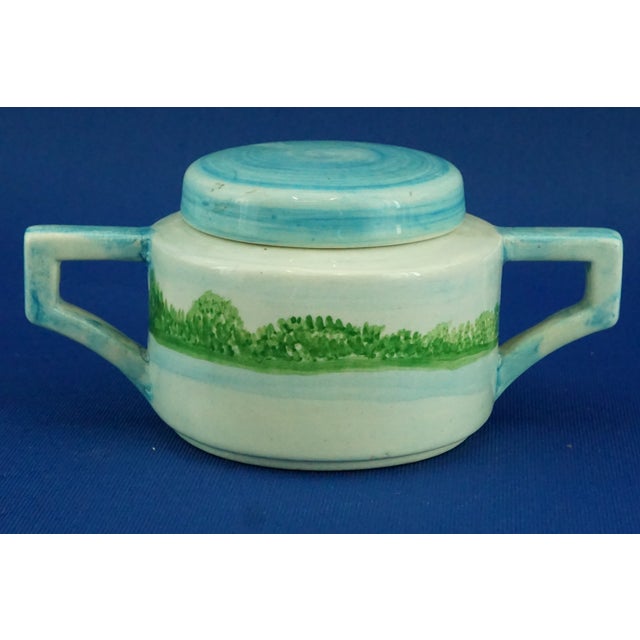
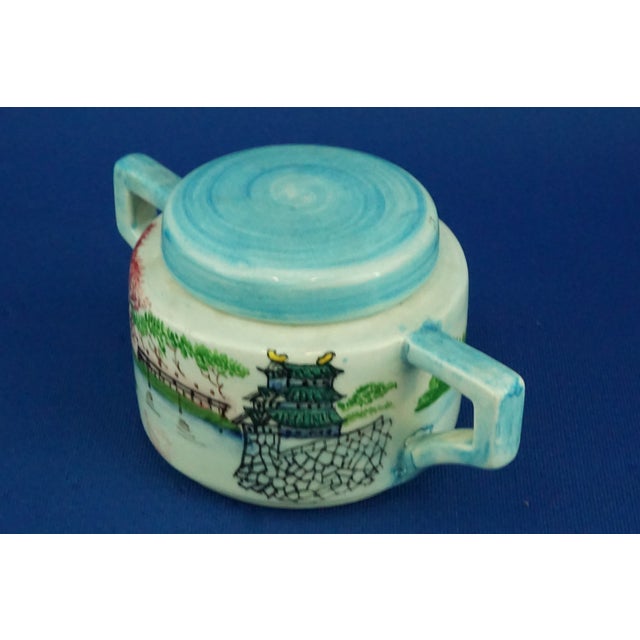
a wonderful tea set consisting of three main pieces, a teapot, a milk jug, and a sugar bowl, made of cast ceramic, entirely hand-decorated with oriental landscapes, and glazed with a third firing, dating back to the first half of the 20th century. Under the base of one of the three pieces is a blue mark attributable to the 'agostinelli e dal pra' factory in bassano.
final considerations on the item:
the decorations on the three objects are beautiful, entirely brush-painted by the artist in bright, vivid colors, with green and magenta predominating on a beautiful blue background. The three circular lids are beautiful, and the shape of the three pieces echoes the style of ancient chinese ceramic services, but with a clear art deco decoration. The sizes are good, especially the teapot, which is really large compared to common table teapots.
information about the artist and/or manufacturer:
the ceramic manufacturer "agostinelli e dal prà" was founded in 1904, on the ashes of the "società ceramica cooperativa" (ceramic cooperative society) active in the area since 1890, by domenico agostinelli from bassano, whose family of potters had been working in bassano since the early 18th century, and giuseppe dal prà, also a descendant of generations of majolica makers, who took over the ancient and historic "tommasi" kiln. The company, under the name "fratelli agostinelli nove," debuted its own production, inspired by the novese tradition, at the 1900 universal exposition in paris. In 1904, under the name "società ceramica cooperativa," it exhibited some of its work in london and in 1908 in copenhagen. Among the ceramists who collaborated with the cooperative, some of whom were probably also members, we remember: giovanni tasca, pietro righetto, and pio coron, who worked there until 1907. In 1914, the company structure changed again, and the factory was registered as "società cooperativa ceramica successori di agostinelli & dal prà." in 1917, the factory acquired the passarin company owned by luigi fabris, also purchasing its molds, which immediately went into production under the new brand name. At the end of world war i, production underwent a profound modernization inspired by art deco and late liberty styles. In 1923, it took part in the first biennial exhibition of decorative arts in monza, winning a silver medal, and participated in numerous editions of the milan triennial. During these years, he collaborated with the modeling company pacifico pianezzola, which created models for the factory until the end of the 1930s. Other collaborators over the years included giuseppe scotton and, starting in the second half of the 1940s, enrico cacciaguerra. In 1933, the company participated again in the biennale of decorative arts. In 1955, the ownership was divided and the companies "agostinelli porcellane d'arte" and "dal prà luigi ceramiche" were formed. The production of this important manufacturer, which in the mid-1950s was based in via roma 24 in nove, in the province of vicenza, focused on reviving the shapes and decorations of ancient local ceramics.
this piece has an attribution mark,
i am sure that it is completely authentic and take full responsibility for any authenticity
issues arising from misattribution
See less
- Dimensions
- 9.84ʺW × 6.3ʺD × 5.12ʺH
- Period
- 1920s
- Country of Origin
- Italy
- Item Type
- Vintage, Antique or Pre-owned
- Materials
- Ceramic
- Condition
- Good Condition, Original Condition Unaltered, Some Imperfections
- Color
- Blue
Returns & Cancellations
Return Policy - All sales are final 48 hours after delivery, unless otherwise specified in the description of the product.
Cancellation Policy - Prior to shipping or local pickup, buyers may cancel an order for up to 48 hours, unless otherwise specified.