
![Ceramic, 1956 Edition : 500 Publisher : Edition Picasso Catalog : [Ramié 368] White terracotta, oxidized kerosene...](https://chairish-prod.freetls.fastly.net/image/product/sized/49e43a38-044f-4808-a6dc-950167e57000/pitcher-with-heads-by-pablo-picasso-1956-6708?aspect=fit&width=640&height=640)



![Ceramic, 1956 Edition : 500 Publisher : Edition Picasso Catalog : [Ramié 368] White terracotta, oxidized kerosene...](https://chairish-prod.freetls.fastly.net/image/product/sized/49e43a38-044f-4808-a6dc-950167e57000/pitcher-with-heads-by-pablo-picasso-1956-6708?aspect=max&width=50&height=50)


Details
Description
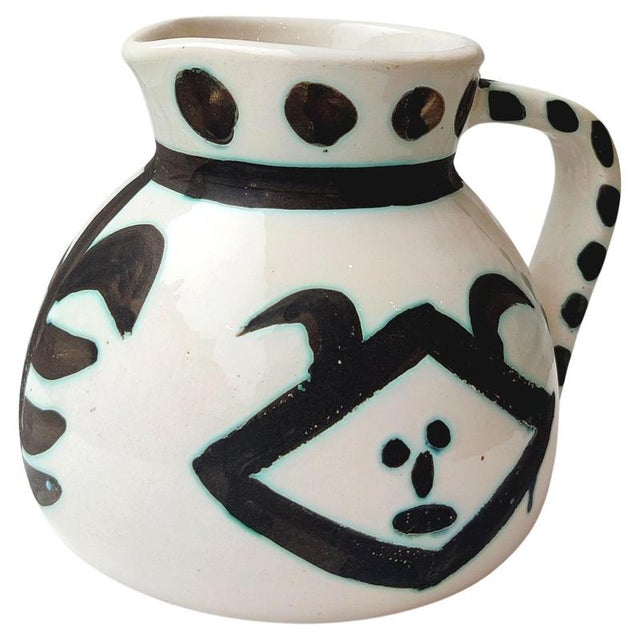
Ceramic, 1956 Edition : 500 Publisher : Edition Picasso Catalog : [Ramié 368] White terracotta, oxidized kerosene decoration, white enamel …
Read more
Ceramic, 1956 Edition : 500 Publisher : Edition Picasso Catalog : [Ramié 368] White terracotta, oxidized kerosene decoration, white enamel Inscriptions and stamps under the base: "Edition Picasso", "Madoura" and "Madoura plein feu". Dimensions: 12.50 x 16.50 cm Our work testifies to Picasso's important ceramic production, alongside painting and graphic arts, which he began when he met ceramists Suzanne and Georges Ramié in 1947. Produced at the Madoura studio in Vallauris, this pitcher features the striking brilliance and minimalist designs of faces and ornaments characteristic of the famous Spanish artist. Certificate of authenticity Excellent condition How is Pablo Picasso? Pablo Ruiz Picasso was born in Málaga on October the 25th, 1881. His father, a teacher at the Academy of Fine Arts in Barcelona, gave him his first artistic education. In 1903, Picasso settled in Paris: he immediately felt the distance that separates him from the "Fauves", then in vogue, from their flat figuration and their bright colors. Like Toulouse-Lautrec, he chose his subjects in the world of theater, circus, the poor people, rendering them with a precise line, and with a unique color: these are the "blue period" and, after 1905, the " pink period ". with Braque, from 1906 to 1910, he sought a new way of dealing with subjects, at first simple such as still lifes. As in a laboratory, the canvas becomes a work surface on which objects are placed and recomposed from multiple angles. Thus is born cubism which is a "creation" of forms, and not only a way of rendering real. from 1918, Picasso returned to a more traditional, more classic style (Flûte de Pan, 1923). Around 1925, Picasso changed course again: the influence of surrealism broke out in the irreverent "Crucifixion" (1930) and in a series of paintings where fantastic metamorphoses unfold ("figures au bord de mer", 1931). Upset by the Spanish war, he painted the tragic "Guernica" (1936). After World WarII, Picasso created the famous Dove for the poster of the peace movement (1949). Picasso then aroused a crowd of imitators, and was known worldwide. This did not prevent him from pursuing an extraordinary and prolific production that André Malraux has defined as "the greatest enterprise of destruction and creation of forms of our time". Considered the greatest genius of modern art, Picasso passed away in Mougins in 1973, over ninety years old. This piece is attributed to the mentioned designer/maker. It has no attribution mark and no
official proof of authenticity,
however it is well documented in design history. I take full responsibility for any authenticity
issues arising from misattribution
See less
- Dimensions
- 6.3ʺW × 4.72ʺD × 5.51ʺH
- Styles
- Modern
- Period
- 1950s
- Country of Origin
- France
- Item Type
- Vintage, Antique or Pre-owned
- Materials
- Enamel
- Condition
- Good Condition, Unknown, Some Imperfections
- Color
- White
- Condition Notes
- Very Good — This vintage item has no defects, but it may show slight traces of use. Very Good — This vintage item has no defects, but it may show slight traces of use. less
Returns & Cancellations
Return Policy - All sales are final 48 hours after delivery, unless otherwise specified in the description of the product.
Cancellation Policy - Prior to shipping or local pickup, buyers may cancel an order for up to 48 hours, unless otherwise specified.
Related Collections
- Emilia Castillo Pitchers
- Dark Gray Pitchers
- Eggshell Pitchers
- Baccarat Pitchers
- Jens Quistgaard Pitchers
- Abalone Pitchers
- Arol Halden Pitchers
- Rosenthal Pitchers
- Greige Pitchers
- Pitchers in Santa Fe
- Ironstone Pitchers
- Glass Pitchers
- Ceramic Pitchers
- Crystal Pitchers
- Green Pitchers
- Brown Pitchers
- Metal Pitchers
- Silver Pitchers
- Blenko Pitchers
- Copper Pitchers
- Italian Pitchers
- Blue Pitchers
- Pink Pitchers
- Japanese Pitchers
- French Pitchers