

Details
Description
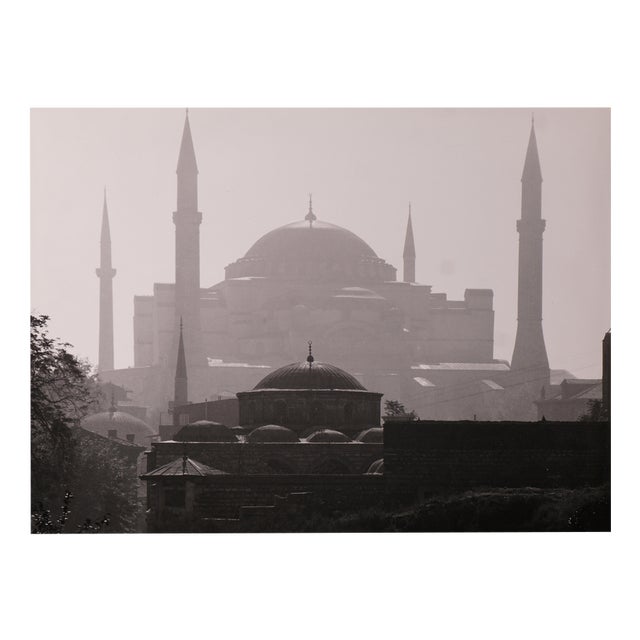
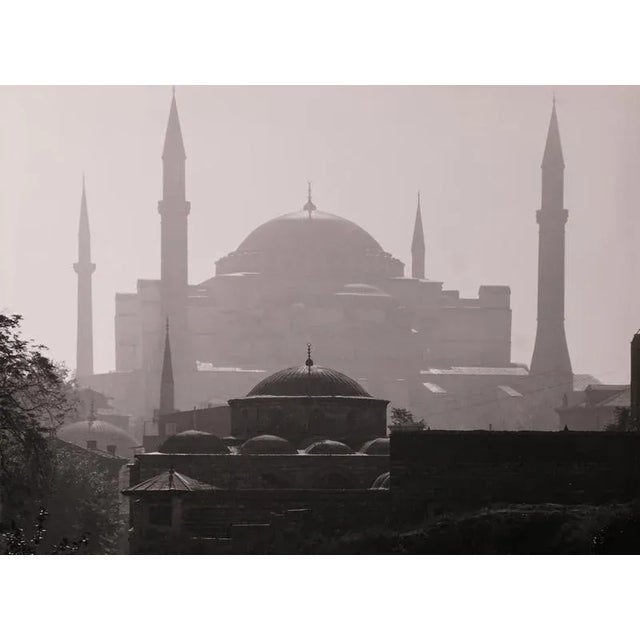
This black-and-white photograph, taken by klaus redenbacher in istanbul in 1960, captures the silhouette of the hagia sophia with its …
Read more
This black-and-white photograph, taken by klaus redenbacher in istanbul in 1960, captures the silhouette of the hagia sophia with its iconic domes and towering minarets against a hazy sky. The foreground consists of traditional ottoman-style architecture, featuring domed rooftops and intricate masonry, which add depth and a sense of timelessness to the composition. The soft, diffused light creates a mystical atmosphere, emphasizing the contrast between the darkened structures and the luminous background. This image exemplifies redenbacher’s ability to blend artistic vision with documentary photography, capturing not only the grandeur of istanbul’s historic skyline but also the essence of a bygone era. About klaus redenbacher "a photographer paints with the camera" (augsburger allgemeine, may 7/8, 1970) or "pioneer and father of the modern color portrait" (who's who in photo, film & tv, circa 1980) are just a few examples of the press acclaim that describe klaus redenbacher’s photographic work and career, which spanned nearly five decades. Born in nuremberg in 1935, he began an apprenticeship as a photo lab technician with portrait photographer ludwig harren in nuremberg from 1952 to 1956, before enrolling at the bavarian state institute of photography in munich. His first professional steps followed as a fashion and advertising photographer for the daco publishing house (günther bläse) and the herrmann bruder advertising agency in stuttgart. In 1960, he passed his master craftsman's examination in photography, with a focus on portrait, fashion, industry, and advertising. He then worked as a freelance photojournalist. A photo report on istanbul was published in madame magazine and awarded first prize by the travel magazine merian (1960/61). As part of the university of the seven seas program, redenbacher served as a ship photographer aboard the intercontinental cruise ship ms seven seas in 1963/1964. He also produced advertising and industrial photography for companies such as bayer ag, electrostar, the waldhof-aschaffenburg paper mills, and kodak. Starting in 1969, redenbacher increasingly devoted himself to color portrait photography. In the same year, he took over the management of the ertl photo studio in augsburg. Two years later, in 1971, he opened his own studio at martin-luther-str. 24 in munich-giesing, which remained a prominent address for portrait photography in munich until 2004. Redenbacher achieved his greatest success in portrait photography, benefiting from his background in fashion and advertising as well as from the fact that german print media began introducing color photography in the second half of the 1950s, while traditional photographic portraiture was still primarily done in black and white. Ultimately, redenbacher saw himself as a portrait photographer with an artistic, painterly ambition, whose work was largely informed by a journalistic approach in color. Over the course of his long career, he portrayed prominent figures such as writer and painter jean cocteau, composer carl orff, zoologist konrad lorenz, nobel prize-winning physicist werner heisenberg, and sculptor helmut lederer. For his achievements in portrait photography, he was awarded the euro medal for art and culture in gold by the baden-baden cultural circle (1980) and the gold medal of the accademia italia delle arti e del lavoro, based in salsomaggiore terme, italy (1982). This piece is attributed to the mentioned designer/maker. It has no attribution mark and no
official proof of authenticity,
however it is well documented in design history. I take full responsibility for any authenticity
issues arising from misattribution
See less
- Dimensions
- 9.45ʺW × 11.42ʺH
- Period
- 1960s
- Item Type
- Vintage, Antique or Pre-owned
- Condition
- Good Condition, Original Condition Unaltered, Some Imperfections
- Color
- Black
Returns & Cancellations
Return Policy - All sales are final 48 hours after delivery, unless otherwise specified in the description of the product.
Cancellation Policy - Prior to shipping or local pickup, buyers may cancel an order for up to 48 hours, unless otherwise specified.