






Details
Description
Italian artist Enrico Baj (1924-2003).
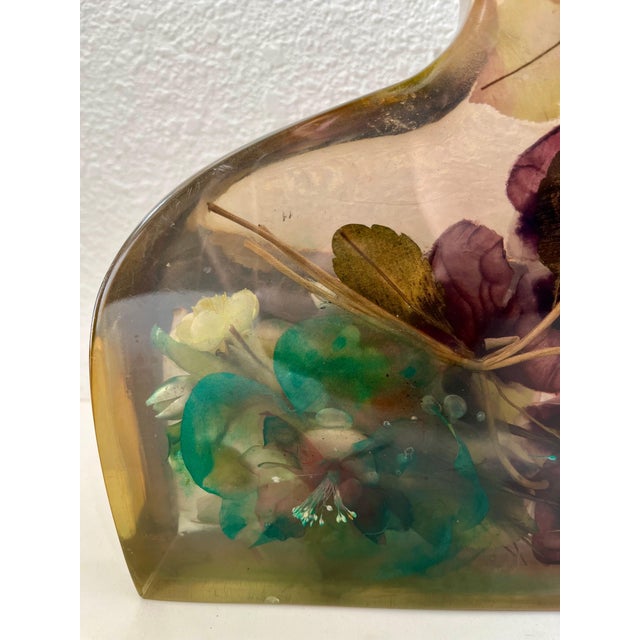
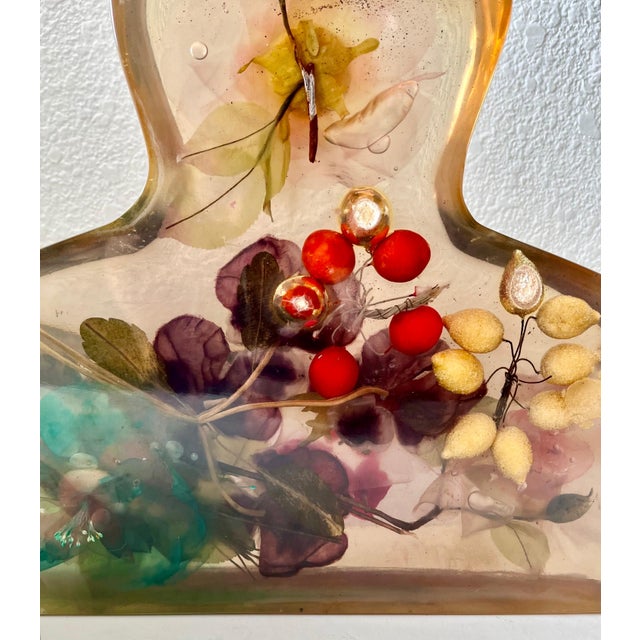
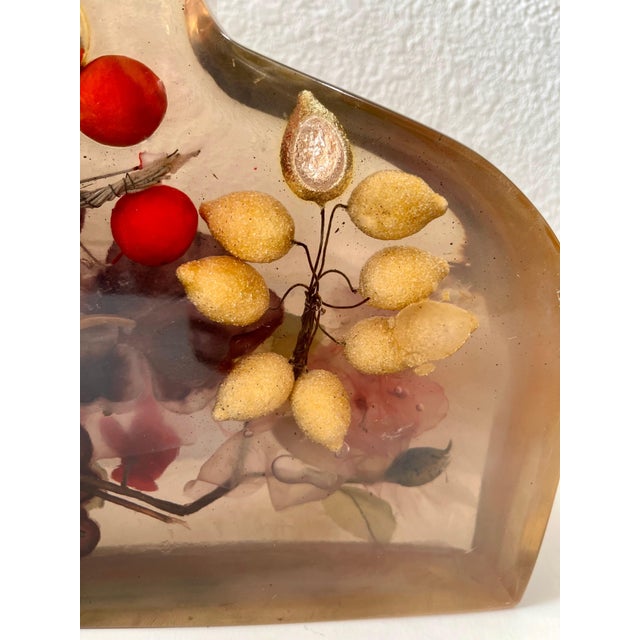
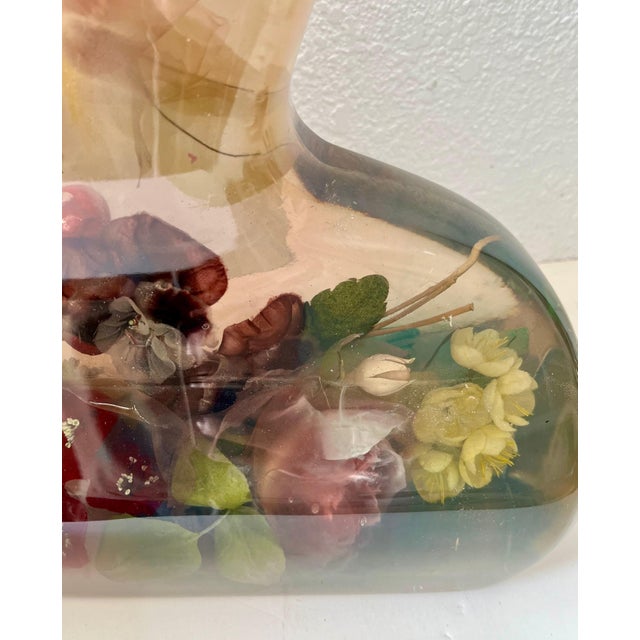
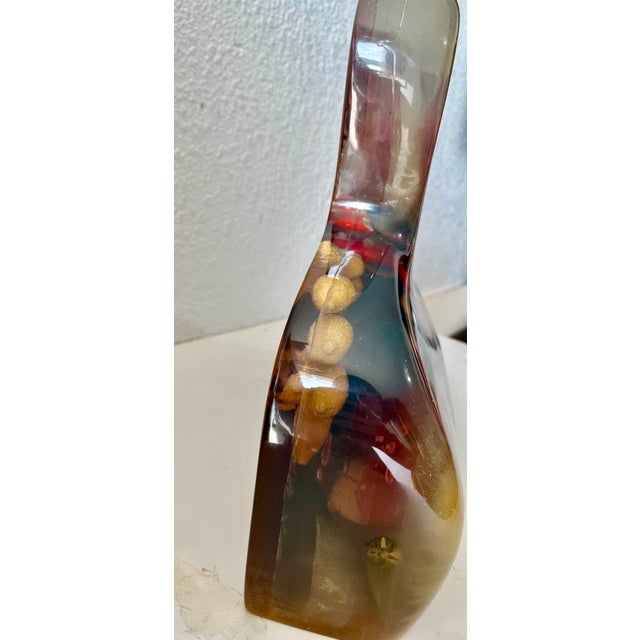
Perspex (acrylic resin) Inclusion Sculpture with flowers and fruit
13.5 X 14 X 4 inches
…
Read more
Italian artist Enrico Baj (1924-2003).
Perspex (acrylic resin) Inclusion Sculpture with flowers and fruit
13.5 X 14 X 4 inches
Hand signed and marked AP
this is not dated.
Baj was born in Milan into a wealthy family, but left Italy in 1944 having upset the authorities and to avoid conscription. He studied at the Milan University law faculty and the Brera Academy of Art.
Artist, attorney, ironist, writer, sharp critic, and political dissenter, Enrico Baj brought an urgent, refreshing and unique voice to the art of his time. In 1951 he founded the Movimento d'Arte Nucleare (the Nuclear Art Movement, or Art for the Nuclear Age) with Sergio Dangelo whose manifesto stated that its members "desire to demolish all the 'isms' of painting that inevitably lapses into academicism, whatever their origins may be." Baj took inspiration from the most radical notion of Surrealism (he joined the COBRA Group with Karel Appel in the late 1940s), adhered to Ubu's sardonic and rocambolesque spirit and André Breton (in Le Surréalisme et la peinture) claimed him for his movement. His work was acclaimed by Gillo Dorfles as kitsch pioneer and embraced by artists like Asger Jorn, Marcel Duchamp and Max Ernst. Baj's work reflected a necessity for continuous re-evaluation and renovation in which the experimental process took precedent over the realized objects.
The exhibition features works from various moments in Baj's output, spanning the late 1950s to 2002, including his Modificazioni paintings (1959-60), a visual farce in which Baj modified kitschy commercial paintings in order to push further still the Dada anti-art idea, and his Idraulica series (2002) consisting of sculptures and assemblages made from hydraulic plumbing fittings.
Also on view Baj's Generali, gorilla-like figures with ferocious expressions, laid down upon a floral fabric background, whose effeminacy clashes with the general's predatory qualities, making them even more absurd and demonstrating both the comedy and the tragedy of the frail human ego as it searches for validation and self-worth. A series of his portraits, assemblages in which Baj address the absurdity of human self-perception and a critic to the provincialism of the Italian bourgeoisie will also be exhibited.
Previous main exhibitions include: The Art of Assemblage, MoMA, New York, 1961; Pittura a Milano dal 1945 al 1964, Milan, 1964; XXII Biennale di Venezia, Venice, 1964; Baj's at Marconi, Studio Marconi, Milan, 1967; Gemeentemuseum, L'Aja, 1967; Palazzo Grassi, Venice, 1971; Museum of Contemporary Art of Chicago, 1971; Enrico Baj. Opere 1951-2001, Palazzo delle Esposizioni, Roma, 2001/2002.
Many of his works show an obsession with nuclear war. He created prints, sculptures with a nod to Arman and Cesar, but especially collage. He was close to the surrealist and dada movements, and was later associated with CoBrA. As an author he has been described as a leading promoter of the avant-garde. He worked with Umberto Eco among other collaborators. He had a long interest in the pseudo-philosophy pataphysics.
In 1951 he founded the arte nucleare movement with Sergio Dangelo, which unlike abstract art was overtly political. Baj himself was aligned with the anarchist movement. His most well-known pieces are probably the series of "Generals": absurd characters made from found objects such as belts or medals.
He made numerous works using motifs from other artists, from Leonardo da Vinci to Pablo Picasso. Sometimes he recreated entire works of other painters.
Baj had his debut in New York in 1960, as part of the exhibition Surrealist Intrusion in the Enchanters’ Domain, organized by Marcel Duchamp and André Breton at D’Arcy Galleries. The following year, his work was included in the influential exhibition Art of Assemblage (1961), organized by William Seitz at the Museum of Modern Art, New York. In 1964 a room devoted to Baj’s work was presented in the 22nd Venice Biennial, and three major retrospectives followed in 1971, held at Palazzo Grassi, Venice; Museum of Contemporary Art, Chicago; and Musée de l’Athénée, Geneva. Recent exhibitions were held in the following venues, among others: the 55th Venice Biennial (2013), Fondazione Arnaldo Pomodoro, Milan (2013), and Palazzo delle Esposizioni, Rome (2001-2002).
See less
- Dimensions
- 14ʺW × 4ʺD × 13.5ʺH
- Styles
- Surrealism
- Art Subjects
- Other
- Period
- 1960s
- Country of Origin
- Italy
- Item Type
- Vintage, Antique or Pre-owned
- Materials
- Mixed-Media
- Resin
- Condition
- Good Condition, Unknown, Some Imperfections
- Color
- Green
- Condition Notes
- Good Minor wear commensurate with age and material. Good Minor wear commensurate with age and material. less
Questions about the item?
Returns & Cancellations
Return Policy - All sales are final 48 hours after delivery, unless otherwise specified in the description of the product.
Cancellation Policy - Prior to shipping or local pickup, buyers may cancel an order for up to 48 hours, unless otherwise specified.
Related Collections
- Mathurin Moreau Sculpture
- Lime Sculpture
- Boris Lovet-Lorski Sculpture
- David Palombo Sculpture
- Chaim Gross Sculpture
- Photorealism Sculpture
- Polycarbonate Sculpture
- Gourd Sculpture
- Hagenauer Werkstätte Sculpture
- Peter Shire Sculpture
- Fernando Botero Sculpture
- Constantin Brancusi Sculpture
- Albert Ernest Carrier-Belleuse Sculpture
- Parchment Sculpture
- Recycled/Repurposed Sculpture
- Straw Sculpture
- Far Pavilions Sculpture
- Oil-Rubbed Bronze Finish Sculpture
- Georgian Sculpture
- Maison Jansen Sculpture
- Austin Productions Sculpture
- Mid-Century Modern Sculpture
- Brutalist Sculpture
- Alabaster Sculpture
- Folk Art Sculpture