




Details
Description
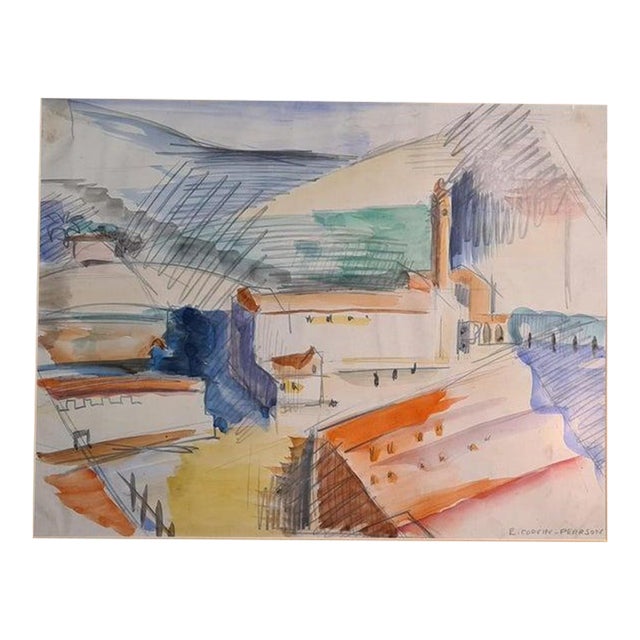
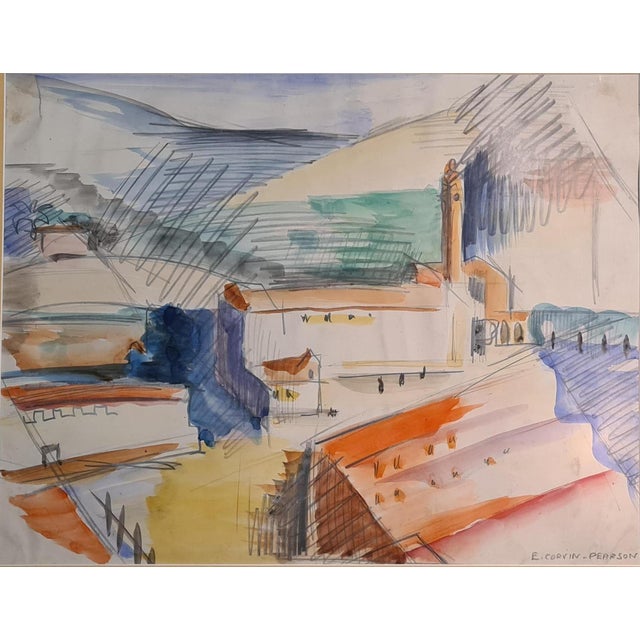
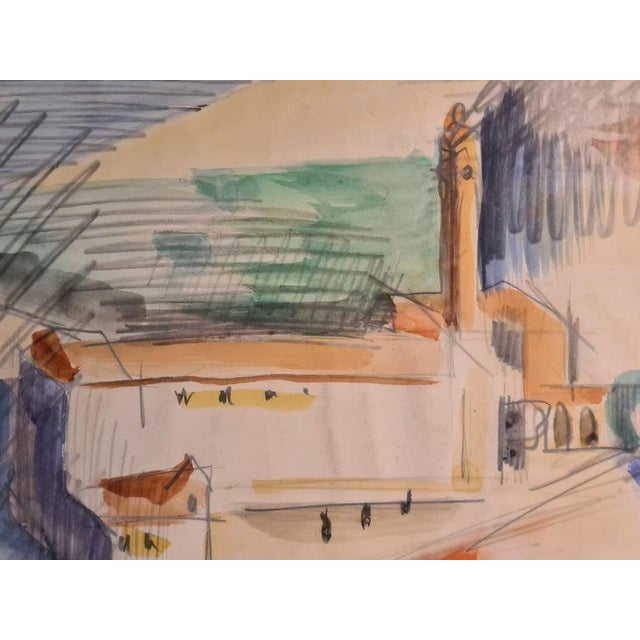
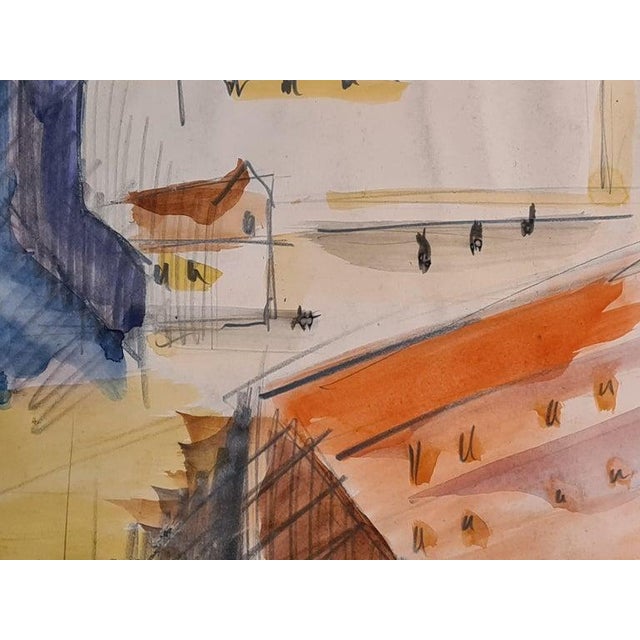
Early 20th century Cubist influenced watercolour on paper of a factory in a landscape by English artist E Corvin-Pearson. The …
Read more
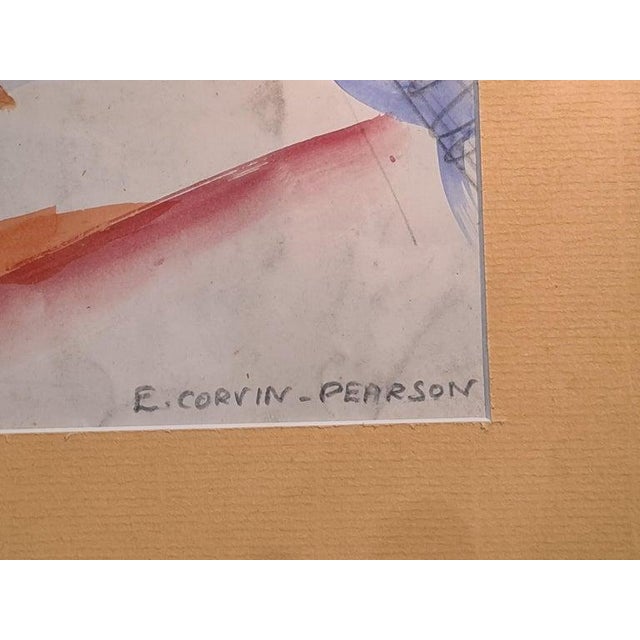
Early 20th century Cubist influenced watercolour on paper of a factory in a landscape by English artist E Corvin-Pearson. The painting is signed bottom right and marked ' 3 Guineas' to the backboard.
The painting was bought with another work, stylistically very similar, which was dated 1928.
Cubism is an early-20th-century avant-garde art movement begun in Paris that revolutionized painting and the visual arts, and influenced artistic innovations in music, ballet, literature, and architecture. Cubist subjects are analyzed, broken up, and reassembled in an abstract form—instead of depicting objects from a single perspective, the artist depicts the subject from multiple perspectives to represent the subject in a greater context. Cubism has been considered the most influential art movement of the 20th century. The term cubism is broadly associated with a variety of artworks produced in Paris (Montmartre and Montparnasse) or near Paris (Puteaux) during the 1910s and throughout the 1920s.
The movement was pioneered in partnership by Pablo Picasso and Georges Braque, and joined by Jean Metzinger, Albert Gleizes, Robert Delaunay, Henri Le Fauconnier, Juan Gris, and Fernand Léger. One primary influence that led to Cubism was the representation of three-dimensional form in the late works of Paul Cézanne. A retrospective of Cézanne's paintings was held at the Salon d'Automne of 1904, current works were displayed at the 1905 and 1906 Salon d'Automne, followed by two commemorative retrospectives after his death in 1907.
In France, offshoots of Cubism developed, including Orphism, abstract art and later Purism. The impact of Cubism was far-reaching and wide-ranging in the arts and in popular culture. Cubism introduced collage as a modern art form. In France and other countries Futurism, Suprematism, Dada, Constructivism, De Stijl and Art Deco developed in response to Cubism. Early Futurist paintings hold in common with Cubism the fusing of the past and the present, the representation of different views of the subject pictured at the same time or successively, also called multiple perspective, simultaneity or multiplicity, while Constructivism was influenced by Picasso's technique of constructing sculpture from separate elements. Other common threads between these disparate movements include the faceting or simplification of geometric forms, and the association of mechanization and modern life.
See less
- Dimensions
- 18.75ʺW × 0.1ʺD × 15.75ʺH
- Styles
- French
- Art Subjects
- Architecture
- Cityscape
- Landscape
- Frame Type
- Unframed
- Period
- Early 20th Century
- Country of Origin
- France
- Item Type
- Vintage, Antique or Pre-owned
- Materials
- Paper
- Watercolor
- Condition
- Good Condition, Original Condition Unaltered, Some Imperfections
- Color
- Burnt Orange
Questions about the item?
Returns & Cancellations
Return Policy - All sales are final 48 hours after delivery, unless otherwise specified in the description of the product.
Related Collections
- Carrie Bergey Paintings
- Steve Kaufman Paintings
- Limoges, France Paintings
- Lee Krasner Paintings
- Paul Jenkins Paintings
- René Magritte Paintings
- Roy Lichtenstein Paintings
- Sol LeWitt Paintings
- Paintings in Panama City, FL
- Rolph Scarlett Paintings
- Richard Anuszkiewicz Paintings
- Laminate Paintings
- Keith Haring Paintings
- Design Paintings
- Gino Hollander Paintings
- George Coggeshall Paintings
- Damien Hirst Paintings
- William IV Paintings
- Donald Judd Paintings
- Camille Pissarro Paintings
- Michelle Arnold Paine Paintings
- Nikolaos Schizas Paintings
- Jacobean Paintings
- Lee Reynolds Paintings
- Mid-Century Modern Paintings